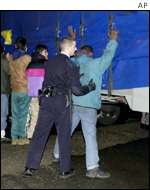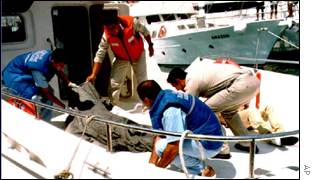
Because of its porous eastern borders, and its geographical position on the edge of the EU, Turkey has become a centre for the smuggling trade. Stand on the Aegean coastline after dark and stare out at the twinkling lights of the Greek islands. They seem almost close enough to touch, and they draw would-be migrants like moths to the flame.
So the smugglers are feeding a growing demand. They have the power and the money to corrupt, and the ruthlessness to abandon anyone whose luck deserts them.
Make no mistake, getting to Europe is a hazardous business and it costs money - thousands of pounds with no guarantee of success.
Some people arrive in Turkey and then get stuck, forced to eke out a life outside the system in grinding poverty. Nashmi Rashidi is living illegally in Turkey with her husband and two young children. They paid several thousand pounds to buy false Iranian passports, and bribe their way across international borders via Iraq and Syria.
Now they live in a rented room with no source of income, and no means of escape. "We can't go back to Iran because my husband could face the death penalty," said Nashmi. "But we haven't got the money to go any further. We can't even buy clothes for the children."
Nashmi regards herself as a political refugee - but it can be a hard point to prove. Others may see her family in a different light - part of the wave of unwanted economic migrants heading remorselessly westward.
Global inequality
In one form or another, the problem is bound to get worse as long as inequality in the global economy is so striking.
And when images of Western affluence are fed by television into huts and shanties across the world, who can blame those who want to take to the road, convinced that on the other side of the divide the streets really are paved with gold.
Europe can try to stem the tide with new regulations and better cross-border co-operation, but it cannot plug every hole. For those on the outside looking in, the temptations are too great. Migrants come in all shapes and sizes, some good, some bad, but all of them united in their search for a better life.
I used to get phone calls from a Ugandan refugee in Istanbul called James, a deserter, he said, from the Ugandan army. Could I get him a passport, he wondered, or have a quiet word with the local United Nations office. They might help him if he knew the BBC.
James used to call once every few weeks until his pay phone cut him off. Speaking perfect English, he never asked for money, only for advice, and for help which I could not provide. A few months ago, the calls stopped as suddenly as they began. Perhaps he made it to Europe - he said he had family in Holland. Or perhaps he became another victim of the smuggling gangs who ply their trade in the currency of human hope.