| ReviewsOnline |
| Car review - Holden VY SS Ute |
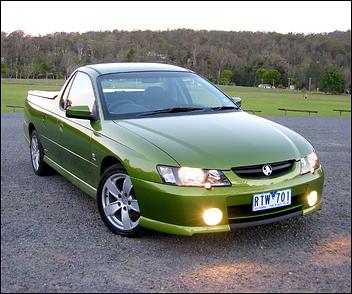
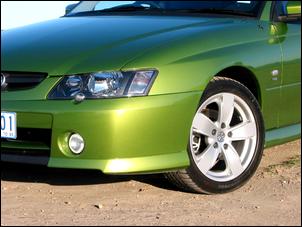
| By Julian Edgar (AutoSpeed Magazine) To suggest that the VY Commodore represents anything other than a sideways move over the previous VX would be to stretch the truth. The mid-model tweaks have been minor, and despite a whole new dash, the end result is no stunning breakthrough. But does the new model actually have to be a complete change to continue to achieve market success? The V8 versions are already damn' good cars - although the awful V6 engine should've been pensioned off years ago. So despite rival manufacturer Ford having recently released a range of cars and engines that (should) up the local ante very considerably, Holden can probably be fairly confident that their styling tickle is sufficient to keep their Gen III models in the hunt. Of course those comments apply to all the new VY models, and even though the Ute gets only half the exterior makeover - the rear styling remains virtually unchanged - there's enough new about the car that most will readily recognise the model upgrade. On test was the SS Ute, costing in base form $39,340. Our optioned car came with a hard tonneau cover and leather seats, but was otherwise Standard - ABS, a body kit (complete with LED brakelight high rear spoiler), leather steering wheel, cruise, air, trip computer and in-dash 6-stacker CD radio. The driveline consists of the 235kW 5.7-litre V8 (up by 10kW courtesy of a new twin stainless steel exhaust), heavy 6-speed manual 'box and 3.46 ratio LSD. Noticeably lacking on the features list is traction control - all other V8 models have it as standard. Suspension is FE2 Sports, and the VY gets revised low-speed front damping. The wheels are also new 17x8 alloys wearing 235/45 Bridgestones - slightly higher in profile than those used on the SS sedan. And what a good car the Ute is! Surprised by that statement? We were very taken aback - compared with the other two-door Holden (the Monaro), this car drives far better. Rather than having the limited suspension travel, slow steering rack and lack of handling cohesion of the beautiful coupe, the VY Ute reminds us of nothing less than the HSV Clubsport. The on-road poise is exceptional, with in most conditions a really great ride (yes, even unladen), and grippy but forgiving handling. And that's despite the rear suspension lacking the extra toe-control links that were introduced on the VX sedans... More than anything else, it's the brilliant combination of damping and spring rates - the Ute is simply exceptional in this regard. The lack of a traction control system is a large problem in wet conditions (and will only get worse as the rear tyres start getting down in tread depth), but the very progressive development of torque from the big engine (the peak of 465Nm is up at 4400 rpm) means that unexpected sideways excursions in dry conditions are a non-event. Turning onto a main highway, for example, you can trounce it in first gear and the back will go nowhere. (However, if you want to have some wheel-spinning fun, simply have three or four thousand rpm on board and then bang out the clutch!) And in real road handling - say a twisty secondary country road - the SS Ute is very, very good. It tracks superbly, even over broken and bumpy bitumen. In fact, if your idea of a SS Holden Ute is a tarted-up truck masquerading as a try-hard sports car, you're a helluva long way from the truth. The steering - revised for this model with different valving and a stiffer torsion bar - is perhaps one of the few weak links in the on-road armoury. It's not the dreadfully slow ratio of the Monaro, but it does appear to have lost some of its alacrity - the "sneeze factor" (how much lock you can apply without the car responding) has got bigger and bigger in locally-built Holdens over the last five years. In fact, it's fast heading in the direction of Magna steering, where you turn-in before actually reaching the corner... However, it's no disaster and is something you get used to. Handling is characterised by turn-in understeer followed by a progressive power oversteer on exit. Perhaps partly because of the long wheelbase (the Ute uses the same platform as the wagon), the change in attitude of the car is always gradual and very well telegraphed. However, with this much performance and handling prowess, the standard brakes can start looking a bit marginal. The HSV performance brakes as an option? Would be getting much too close to the Maloo then... The engine feels far more free-breathing than the last 5.7 Holden we experienced - and in fact, more akin in performance of the original VT model SS Gen III. Over the various model iterations - and in between as well - the engine management programs have varied quite a lot, with hot weather ignition timing retard and over-eager knock sensors being part of the reason that the engines' actual on-road sharpness has undulated so much. This V8 felt f-a-r stronger, and gave 0-100 performances - with a gentle police-friendly launch - of around 6.3 seconds. That's absolutely honking - and quicker than we measured with an HSV 255kW Clubsport driven in the same gentle-launch way. At 1560kg the SS Ute is only 30kg lighter than the SS sedan, so the extra urge doesn't come from a hugely lower mass. On the ChipTorque dyno the engine showed its strength, with a peak power at the wheels of 172kW, and a very 'full' power curve (as in, much more area under the curve than we've seen in some other recent Holden V8s). However, the temp sensitivity of the engine still showed through clearly, with a hot run (the second power line on the graph) showing a major drop. But if there's one major downfall of the engine it's in its fuel consumption. Despite people telling us how - for a big V8 - the fuel economy of the Gen III is good, we just don't see it that way. On test the Ute achieved an average of 18 litres/100 km - which can only be described as dismal. Unlike many high performance cars, where you can get reasonable fuel economy if you give it an occasional squirt and then drive gently the rest of the time, the 5.7-litre requires incredibly gentle and consistent driving all of the time if it is to get acceptable fuel economy. As in, pull out of the petrol station, get on to the highway, select sixth gear, then not move the throttle more than a few millimetres. That way, yes the economy can be around 10 litres/100 km. But in normal performance car driving, it's simply atrocious. But unlike the Monaro we drove - which had a similar thirst - at least the Ute had excellent performance. The new-for-VY dash and controls are a mixed bag - simply, from the exterior paint colour matched instruments (yes, green on this car!) through to the new ventilation controls, it looks more like the stylists wanted something different, rather than something better. Certainly, any typical Japanese car has a dashboard at least as good. However, the new trip computer really is a surprisingly good performer. In the SS incarnation it provides odometer, trip meter, speed warnings, distance to empty, trip distance to go, time to go, average speed, average consumption and stopwatch functions. (Incidentally, the display indicated a range remaining of 50 km, even when the engine was spluttering and coming to a halt, completely dry of petrol!) But the real benefit of the new display is that it allows user-programming of body computer preferences. So it's easy to change all of these little things which drive you mad - whether both doors or just the driver's door open with the first push of the remote button, how long the interior light stays on when the door is shut, whether the horn beeps when arming or disarming the car, and so on. All of these personal preferences can be set just as you want - there are even 'help' menus built into the digital display! Given that in all other cars that we know of this sort of thing requires the use of the dealer tool to re-program the module, Holden should be congratulated on making this accessible to all. It's a relatively small thing in the overall make-up of the car - but one that will result in many more happy consumers. Also new for the VY is a Blaupunkt in-dash 6-disc radio CD. The steering wheel has remote controls for the sound system and data is displayed in the central LCD screen (ie the trip computer/odometer display). Unfortunately we couldn't play any CDs as the unit appeared faulty, while on radio the sound was adequate, being limited by the speaker quality. The system features speed-dependent volume - another user-programmable feature. Of course, a ute is more than just a cabin - there's also that tray out the back, plastic coated and lidded, in this car's case. But as everyone knows, if you want a serious ute for major load carrying, the Falcon's the machine - for this reason it way outsells the Holden (about 1500 v 1000 a month respectively). So the Ute's dimensions (2193mm length and 1477mm width) and payload (655kg including occupants) are much less important that the fact that it's versatile enough to carry a trail bike in the tray - or tow a boat and fit lots of fishing gear out back. No, the killer app for this car is that it looks good (in profile, still amongst the best looking utilitarian cars ever built), goes bloody hard, and has the handling prowess to match. It's one very strong package. Why you would: � Mighty performance � Excellent handling � Comfortable and well-equipped � Practical Why you wouldn't: � High fuel consumption unless car is driven extremely gently � No traction control fitted or available |
 |
|
|
|
|
|
|
|
|
|
|
|
|
|
|
|
| --------------------------------
Fast Facts (info) -------------------------------- Home Holden wallpapers Commodore information Useful car-related info Wheels COTY winners -------------------------------- New Holden car reviews Used Holden car reviews -------------------------------- Forum Guestbook Contact Technical difficulties? -------------------------------- |
| _______________________________________________________________________________________________________________________________________ |
 |
 |