| ReviewsOnline |
| 2004 Aussie Family Car Comparison |
| From Wheels Magazine (Mike McCarthy and Nathan Ponchard)
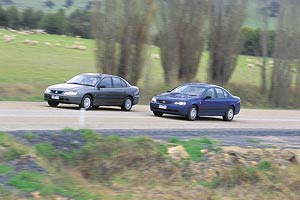
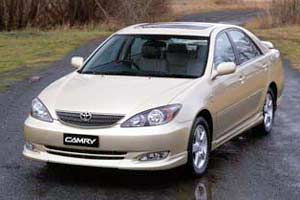
They're big, boofy, built here, and between them account for a quarter of all local new-vehicle sales. But which of these local lads most deserves our patriotic dollar? Setting aside the usual footy-code rivalry, Kiwi sheep jokes, and the desire to wear thongs at black tie events, if you want to raise a chorus of patriotic fervour, you�ll find few better rousers than a bunch of big Aussie sedans. They�re where the entire local industry is at, mate, Japanse descendants included. And it�s has been that way for generations, long before Abigail flashed her rack on Number 96 three decades ago. Last year, these five cars accounted for 25 percent of total domestic vehicle sales, putting to rest the well worn argument that big and boofy is somehow uncool. In terms of size, space, pace, and price, little can rattle the locals. But in this increasingly image-conscious, technology-driven world, does following automotive tradition still make complete sense? And do they offer enough spirit to satisfy the keen driver? The answer lies here, embroiled among the extra-gravy variants of Australia�s meat-and-three-veg types � Ford�s Falcon Futura, Holden�s Commodore Acclaim, Mitsubishi�s Magna LS, and Toyota�s Avalon VXi and Camry Ateva V6. Each sits a rung above the fleet-driven baseline, and each packs enough extra bells to keep both the kids amused and the neighbours at least vaguely interested. The closeness of the base stickers (spanning just $2580) proves just how determined Ford, Holden, Mitsubishi and Toyota are to lure the punter in need of a sprawling sedan. But a level playing field? Not a bleeding chance. Especially when it comes to performance. Despite carrying about 120kg more bulk than the next beefiest model (Commodore), the Falcon has this group�s largest engine capacity (3984cc) and clearly the most power (182kw). Let loose from standing start, the Ford initially toys with the fast-launching Holden before hitting its straps and surging ahead once four grand is showing on its tacho. Taps wide open, the duelling duo are neck and neck up to 60 clicks, but the Commodore�s rush is interrupted by the first upshift and its pace wilts above 100km/h until it almost falls into the clutches of the front-drive trio, thanks to this group�s tallest third gear. Meanwhile, the Falcon has bolted. While it�s eight-tenths of a second quicker than the Holden, the Ford is nearly three seconds clear by 140km/h and keeps widening the gap right to its 210km/h speed-limiter. It�s also the only car here to break into the 15s for the 400m sprint. Boasting the second lustiest power-to-weight quota isn�t enough to lift Magna�s performance into the Commodore�s orbit. In fact, the Mitsubishi has its work cut out just keeping the two Toyotas at bay. Why so, when it has what appears (on paper, anyway) to be a commanding edge in power and torque? Well, not only is Magna�s relatively tall-geared transmission slightly slow to react, but the engine�s delivery is a bit soft until the tacho needle is almost half way to heaven. With the Avalon and Camry climbing all over the Magna from take-off, it�s only beyond 100km/h that it manages to shake off the Toyota pair and start reining in the Holden. Either way, there�s very little between the Commodore, Magna, Avalon and Camry for pure performance numbers. Witness their rolling-response times. Nailed for the burst from 80 to 120km/h, the Commodore, Magna, and Avalon post idenical 5.8-second splits � a mere two-tenths ahead of the Camry, but a whole second adrift of the Falcon. The main differentiator is how these five go about it. Despite very tall gearing, Ford�s twin-cam, 24-valve straight-six combines aggressive performance with elastic tractability, and a real eagerness to brush its 6000rpm rev limiter. Its sole distraction is the too-keen throttle response from idle, necessitating a gentle squeeze of the trigger in slow driving, or a natural reflex to brace against the head-straps. When unhurried, the Ford lopes along the highway with just a purr from the exhaust and no more than a distant rustle from beneath the bonnet. But when you put the boot in, the Futura�s engine breathes deep and speaks its mind, although not quite as stridently as the more outspoken Acclaim, and without the hideous fan noise and high-rpm thrash that blighted Ford�s sixes right up to BA. Ordinarily, the Commodore�s simple, all-iron, pushrod V6 has enough snot to easily lead its multi-cam rivals without sounding strained. Despite its neolithic origins, the 152kw Ecotec V6 performs well above its station, except in terms of ultimate refinement. Stay below 4000rpm � easier than it sounds due to the surplus of bottom end torque � and the Commodore is surprisingly composed, but push to the 6000rpm rev-limiter and the engine betrays its age by turning coarse and thrashy. It�s punchy and always eager, just anything but quiet. Comparatively, the Japanese V6s sustain relatively discreet decorum regardless of how high or hard they�re pressed. Even with Aussie upbringings, they�re as smooth as sake from a crystal shot glass. While you wouldn�t guess from the tightly packed performance figures, Magna�s 155kw single-cam V6 taps just enough aural edge to always seem a shade more spirited than the superbly refined twin-cam V6 Toyotas, even though it�s a bit lacking in low-down urge. The Toyota V6s are very smooth and progressive in their power delivery, but it�s the Mitsubishi V6 that has more personality. Telling demarcations separate the five�s ride and handling arrributes. For starters, there�s no ignoring that fundamental schism between rear-wheel drive (Commodore and Falcon) and front-wheel drive (Camry, Avalon and Magna). Does it matter? That depends on whether you know or care. People for whom a car is no more than transport may never notice, but anyone with a skerrick of driving nous will find the differences obvious, although not necessarily critical. The fact that there are clear dynamic disparities even within each camp is amply demonstrated by Magna, Avalon and Camry. Being front-drivers, all three are inveterate understeerers, but varying degrees or steering and handling response. Wheel them into any forceful change of direction and it�s obvious that the Magna answers the helm more responsively and chases the intended line with more sporting intent. And there�s the advantage of switchable traction control to assist those lacking throttle sensitivity. Revisions to the Boulay-nosed TL have finessed the Magna�s dynamics to the point where it displays very good balance and has a satisfyingly fluid approach to stringing corners together, with even some some mild throttle adjustability here for the taking. In particular, Magna�s newfound meduim-to-firm steering weighting is a vast improvement over its predecessor�s see-sawing lightness, and it gives you a good sense of connection between rubber and road. It could be faster-geared, though, with just over three turns for 11.2m of circle work. In contrast, the Avalon and Camry have noticeably lighter (and near-identical) steering, with larger turning circles. Neither model volunteers any substantial feel to the road, except when their steering (and theirs alone) convulses with sharp and noisy jitters through bumpy corners. Both are a bit slow to turn in, but once the Avalon has settled into its fairly soft and angular attitude, it develops resonable grip and proceeds with a benign sense of balance, if without any real driver involvement. A sporty car Avalon ain�t, but it�s more sure-footed through corners than appearances and its retiree reputation might suggest. Since Avalon has the same wheelbase and tracks as the Camry, its dynamic advantage is purely down to its larger 16-inch alloys with Michelin tyres. Hurried through corners, the Camry�s over-riding sensations are its indifferent steering�s wooden feel, its handling�s lack of poise, and the roadholding�s early surrender to soggy imprecision. Pushed along, the Camry doesn�t hide its petulant disinterest, like a don�t-have-to-if-I-don�t-wanna kid who hardly tolerates exercise and doesn�t do sports. Indeed, in hard cornering or evasive manoeuvres, the high-riding Camry will not only expose a half-metre gap between its rear rubber and arches, but will ultimately fold under an outside rear tyre before switching to sloppy roll-oversteer. Compared to the focused and actually quite pleasant Sportivo variant, the Camry Ateva is a disappointingly recalcitrant drive. Virtually as one, the heavier, rear-wheel-drive Falcon and Commodore immediately score points over the front drivers for quicker steering and tighter turning circles. But, from there, the handling differences between the Ford and Holden are just as pronounced as between the others. The Ford�s steering is light, especially compared to the Holden, which always has a much meatier feel. Initially, the Falcon�s pointy steering can seem like a touch too much of a good thing because its acute sensitivity means it�s easy to steer a bit too far or too fast, resulting in slight raggedness. Body roll amplifies the Falcon�s tendency to nose into corners more keenly than the driver intends, requiring the wheel be unwound a little so that the car can loosen its line. But it can be a very quick point-to-point car once you�re accustomed, with impressive balance and real sophistication in its effortlessness. Pity about the embarrassing tyre squeal from its Goodyear NCT5 rubber. While the Holden isn�t an absolute directional delight, even after 10 metres its nicely progressive steering is easily judged and asks for no furthur learning. Like the Futura, the Acclaim is a mild understeerer, and its chassis balace is more amendable to mid-corner adjustments via wheel and/or throttle than what the front-drivers can manage. But unlike the Falcon, the well-balanced Commodore sits relatively flat and firm � gripping strongly and pointing confidently, with greater fluidity than the Magna and an unexpected level of dynamic enjoyment. For overall ride quality, the Commodore and Magna stand as the pick of this bunch. In both, the body control and suspension travel are sufficiently disciplined that the ride has a slightly firm bias, yet is amply absorbent. Practically all disturbances are taken in stride and dispatched without receipt. Even through deeply rippled corners, the Holden and Mitsubishi refuse to be bullied off line and their well behaved suspensions avoid inflicting much discomfort. The main difference is that, on rough roads, rear-seat passengers hear a stream of suspension noise from the Commodore�s ageing underpinnings, and very little from the Magna. The Avalon and, perhaps unexpectedly, the Falcon are the ride quality softies. Their impressive suppleness is pamperingly comfortable on good roads where small irritations are dismissed with almost patrionising affability, and larger bumps are also blotted with amiable grace. At the same time, very little is heard from the suspension and tyre slap is minimal. This compliance, however, comes at a cost, particularily in the Avalon, because the ride turns woozy over bouncy bits and lolling undulations where the dampers lack sufficient authority to keep things tight and tidy. Moreover, when tipped into corners, the Avalon and Futura kneel submissively, and freely admit to being as soft in roll as they are in ride. Coerced into cornering at high speeds it deems unseemly, the Avalon tsk-tsks a polite, but pointed, reproach by scuffing a mudflap. But in our 110km/h four-up ride test over our usual big-dipper, the Falcon was the only car to bottom-out � heavily scraping its rear cross-member, to the point where we pulled over to check for damage! The Camry�s deportment differs noticeably from the others, and not for the better as a rule. Busy by nature, and seemingly sometimes uncertain about its centre of focus, the Camry�s ride feels shorter, sharper, and generally less fluent than its homelier sibling�s, particularly over niggly and patchy surfaces. Yet, as if a bit stiff in the knees, the Camry matches Magna nor Commodore for pliable suspension discipline and measured roll resistance when hustled through corners, especially over bumps and such. And even if you didn�t know that the Camry Ateva is the lightest car here, you�d soon surmise as much because when wracked by rough stuff, it feels and sounds the least taut of the five in its suspension and body. Each car has more than adequate brakes for brisk driving thanks to well modulated pedal feel and the anti-lock stability of ABS. It�s noticeable, however, that the Commodore has the firmest pedal to begin with, and that it remains so even after several successive hard stops. Worked as hard, the other cars� pedals lose some feel and effectiveness until sufficiently cooled. In the search for an optimal driving position, telescopic wheel adjustment gives Commodore and Falcon advantage over the tilt-only others. While the Falcon and Commodore wheels are generally the most pleasant to use, the Avalon scores over its Camry relative for wrapping its identical steering wheel in leather. And then there�s the Magna. Its forward-angled, plastic horror is about as aesthetically pleasing as fish-heads in brine. In terms of cabin comfort, the Avalon VXi�s good news is that both its front seats have a power-adjustable cushion and backrest, with manual lumbar adjustment. Less welcome is the fact that the seats themselves are almost as firm, flat and lacking in lateral security as the Camry�s numbing all-manual examples. In fact, the Camry�s front seats are so flat, the cushion feels like it�s tilted towards the floor � invoking a pro-submarining effect, instead of under-thigh support. For greater comfort and security, it�s an open choice between the others. The Ford, Holden and Mitsubishi buckets all boasts a fuller shape, deeper sides and more welcoming upholstery. Although Magna�s power cushion includes fore-aft travel in addition to the height/tilt variability also found in Commodore and Falcon, its incredibly cheap looking seat fabric and half-hearted stitching do it no favours. Our test car was barely 5000km old, and yet the cloth of the outer edges of both front seats were already balling and baggy. In terms of dash and cabin design, each is vastly different. For glossy, gaudy woodgrain highlights, check Avalon and Camry. For a more contemporary �metallic� look, the brushed finishes in Commodore, Falcon and Magna have far more appeal. Each set of instruments is adequately legible, but to most eyes it�s a win to the Falcon for appearance, followed by Avalon and Camry. The other two have unembellished flat panels that are somewhat stylistically challenged, particularly the Magna�s poorly lit gauges. The various air/climate, audio and other controls that these cars feature hold no secrets or tricks, although the Camry�s dodgy rotary dials could well be inferior to those in a 1988 Hilux. It�s the Falcon�s wands, buttons and knobs that stand out for consistency of feel and tactile effect. Among the standard cruise-control systems, the steering-wheel-mounted levers in Magna and the Toyota pair are easy to access and use, if completely mis-matched to the rest of the switchgear. But the Falcon�s spoke-buttoned cruise arrangement is a shining light for simplicity. While Commodore�s rotary stalk feels nicely tactile (and light years ahead of the clumsy plastic brick fitted to pre-VY Commodores, and European-sourced Holdens), it requires your hand to leave the steering wheel, and isn�t as ergonomic. With the driver�s seat in the Magna crancked up to bar-stool level (which seriously compromises head room beneath the optional sunroof), even moderately tall occupants are aware thaat the windscreen cowl and window sills are higher than the others. The pit-like effect is, if anything, even more marked for Magna�s rear occupants who, despite the long one-piece side windows, feel rather cloistered, and jipped out of decent forward vision. On closer inspection, that impression is largely illusory. Magna has a tad less knee room that in the others, but (on the makers� same-standard figures) its 1450mm shoulder span is a whisker wider than the Camry (which is perceived to be much roomier thanks to exceptional rear leg room � beating even Avalon, Commodore and Falcon). Avalon offers slightly more shoulder width than the Magna, but the Falcon is almost 40mm broader again, and the Commodore some 30mm wider still. There�s more to seating quality, however, than simply feeling the width. Like every Commodore since the 1988 VN, the VYII�s rear accomodation suffers because the seat � while well shaped and relatively comfortable � is comparatively close to the floor and prompts a knees-up attitude that robs under-thigh support. The other rear benches are better in that regard, but not without their own quibbles. For example, the Camry�s steep backrest angle, unsupported centre armrest, and hard door armrests aren�t wonderful, but at least it�s roomy. Avalon�s bench rates better than its sibling�s, and its rear-seat ride quality is the most comforting here for cruising. But it, too, suffers from a floppy centre armrest and, inexplicably, no rear vent outlets. Aside from a comfortable rear seat, preferably for two, the Magna LS offers particularly good ride quality in all conditions, but suffers from shoulder-shoving lumps instead of proper headrests, and very poor outboard armrests. Falcon�s bench rates the highest for seat comfort and support, and for good armrests. It appeal, however, is qualified by the soft-yet-busy ride quality, and often intrusively loud exhaust and rear-seat road noise. So, what does all that mean for the traditional Aussie sedan? Should company-car folk and patriotic punters be insulted by their available choice, or should we be thankful for the wealth of automotive talent this country has to offer? If you�re after simple A-to-B transport, with assured reliability and resale, a silky drivetrain and a large cabin, the Camry Ateva should match your aspirations. But it certainly won�t if you have a passion for cars, or have in fact tried any of the mid-size Japanese competition. In previous comparisons, we found the Camry Sportivo to be reasonably competitive, and a sound, relaxing drive. But the Camry Ateva is a real disappointment. It doesn�t feel like a $36K car, doesn�t ride, steer, or handle as well as a Sportivo, and is noticeably inferior to its Avalon relative � despite the fact the Avalon is basically a 1995 US/Aussie hybrid, while much of the Camry was all-new in 2002. Obviously it would make a brilliant rent-a-car. We were as surprised as any to discover Toyota�s mildly updated Avalon not only plays the big-car role better than its shorter, lighter sibling, but, in its own soft-centred way, is far more enjoyable to drive. It�s more comfortable, and better equipped for the money (you can�t discount the benefits of its leather steering wheel and electric seats), if equally as challenging to look at. If you can accept its plain-as-rice-cracker styling, the endearing Avalon is worth every extra cent. All the facelifts in the world can�t change the fact that the Magna is now eight years old. That it keeps on keeping on so successfully is due to continuing detail development and refinement of what is essentially a good thing (it won COTY in 1996, remember). Though its dated cabin isn�t the largest or airiest, it�s comfortable, user-friendly and puts you in charge of a real sweetie of an engine. And one of the best-driving big front-drive chassis in the business. The Magna�s driver involvement, alone, helps it trump the Toyotas. If the bronze and also-ran placings were fairly predictable, the same cannot be said for the top two spots. Because we�d place Falcon Futura first by a very slim margin. It obviously scores big-time for performance and comfort, while also kicking goals for fit, finish, interior presentation, accomodation, styling, you name it. But on third-rate roads, the Futura�s supple suspension doesn�t necessarily translate well with a big load, and its overly responsive steering feels at odds with this relative softness. With only the driver, the Futura�s fine, but we�d definitely tick the $330 sports suspension box. Despite this, the Falcon remains the polished, great-value sedan that won us over at 2002�s COTY. Surprisingly for some (us included), the VY Series II Commodore Acclaim stands out as a very accomplished car. It mightn�t be the quite the best thing in all respects, but sits demonstrably ahead of the game in the way it steers, stops, rides and handles. It isn�t quite the Ford�s equal in terms of rear-seat comfort, suspension sophistication or drivetrain refinement, but it absolutely makes the most of what it has and manages to disguise its 1997 origins quite sucessfully (it won COTY in 1997). Yes, it's a little rough around the edges, but what true-blue Aussie isn't? For once, 'export quality' doesn't mean sending everyone else the crap we don't want. |
 |
|
|
|
|
|
| -------------------------------- Home Holden wallpapers Commodore information Useful car-related info Wheels COTY winners -------------------------------- New Holden car reviews Used Holden car reviews -------------------------------- Forum Guestbook Contact Technical difficulties? -------------------------------- |
| _______________________________________________________________________________________________________________________________________ |
 |
 |
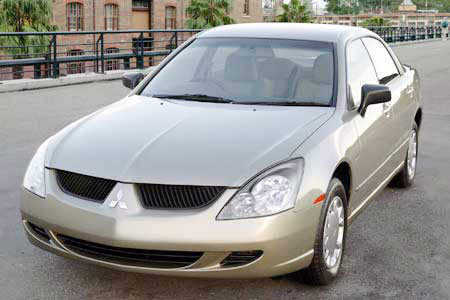 |
| Fast Facts Ford BA Falcon Futura Pricing: $38,015 Drivetrain: front engine (north-south), rear-wheel drive Weight: 1694kg Engine: in-line 6, dohc, 24v Capacity: 3.984 litres Power: 182kw/5000rpm Torque: 380nm/3250rpm Acceleration 0-100km/h: 8.0 seconds Holden VY Commodore Acclaim Series 2 Pricing: $38,570 Drivetrain: front engine (north-south), rear-wheel drive Weight: 1573kg Engine: V6 (90 degrees), ohv, 12v Capacity: 3.791 litres Power: 152kw/5200rpm Torque: 305nm/3600rpm Acceleration 0-100km/h: 8.8 seconds Mitsubishi TL Magna LS Pricing: $37,990 Drivetrain: front engine (east-west), front-wheel drive Weight: 1535kg Engine: V6 (60 degrees), sohc, 24v Capacity: 3.497 litres Power: 155kw/5250rpm Torque: 316nm/4000rpm Acceleration 0-100km/h: 9.2 seconds Toyota Avalon VXi MkIII Pricing: $37,990 Drivetrain: front engine (east-west), front-wheel drive Weight: 1535kg Engine: V6 (60 degrees), dohc, 24v Capacity: 2.995 litres Power: 145kw/5200rpm Torque: 284nm/4400rpm Acceleration 0-100km/h: 9.2 seconds Toyota Camry Ateva V6 Pricing: $35,990 Drivetrain: front engine (east-west), front-wheel drive Weight: 1505kg Engine: V6 (60 degrees), dohc, 24v Capacity: 2.995 litres Power: 141kw/5200rpm Torque: 279nm/4400rpm Acceleration 0-100km/h: 9.3 seconds Good and bad points Ford BA Falcon Futura Good points: Muscular engine, plenty of car for the price, seat comfort, good chassis balance Bad points: Could use a five-speed auto, sharp steering a bit light, suspension a bit too soft Rating: 4/5 "The Futura can be a quick point-to-point car" Holden VY Commodore Acclaim Series 2 Good points: Off-the-line grunt, sharp dynamics, Acclaim's a bloody good family car Bad points: Ancient engine and similarly fossilised auto lets the car down in terms of refinement, but both will be replaced this year with high-tech ones Rating: 3.5/5 "The Acclaim points confidently, with unexpected dynamic enjoyment" Mitsubishi TL Magna LS Good points: Surprisingly fluid dynamics, much-improved steering, likeable V6, frameless windows Bad points: Not what you'd call pretty, claustrophobic and dated cabin, image Rating: 3/5 "The Magna has one of the best big front-drive chassis around" Toyota Avalon VXi MkIII Good points: Big, refined and surprisingly able. Well equipped and great value, too Bad points: Facelift only partially successful, steering somewhat vague, so-so dynamics, image Rating: 3/5 "Avalon has a benign sense of balance, but no real driver involvement" Toyota Camry Ateva V6 Good points: Sweet engine, huge cabin Bad points: Dynamics way off the pace, image Rating: 2/5 "Pushed along, the Camry doesn't hide its disinterest" |