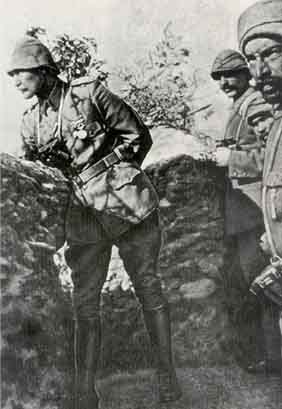
These pages were prepared in rememberance of many unknown heroes
who lost their lives for this land. Our duty is to carryforth this story of
honor to future generations. We, our people, and all the world will never forgot
their epics. Galliboli, with its air, forests, and soil, is a living monument.
Here are some words illustrate the magnificence of the Gallipoli Wars.
"It is impossible for me without mentioning the fights on the Bomb Hill. Distance between trenches is about eight metres, That's to say, death is certain... The soldiers in the first trench are completely dying and the second group replaces them immediately with such great resignation and coldness that noone can imagine. A Soldier sees those dying soldiers and knows that he will die in a few minutes but doesn't show any hesitation and fear at all. By reading Kuran, some are ready to go Heaven and others are fighting and praying to God. This is one of the instances that shows the astonishing high spirit of Turkish soldiers. This is the high spirit that won Canakkale Wars."
( From the diaries of Ataturk - group commander of Anafartalar)
And,
most important are the words for all soldiers who gave their lives for this
land. These words were spoken to our enemies by Ataturk, group commander of
Anafartalar and the founder of Modern Turkey.
" Those heroes that shed their blood and
lost their lives...! You are now lying in
the soul of a friendly country, therefore
rest in peace. There is no differences between
the Johnnies and the Mehmets to us where they
lie side by side here in this country of ours...
You, the mothers who sent their sons from far away
countries wipe away your tears. Your sons are now
lying in our bosom and are in peace. After having
lost their lives on this land they have become
our sons as well."
ATATURK, (1934).
Take
a look at ATATÜRK's page...
The
story started with two huge German warships, Goben and Breslaw. At the time the
winds of World War I were blowing and the Ottoman Empire was not involved yet
until these two ships, Globen and Breslaw, escaped from the British Navy and
stopped in front of Dardenels. The names of these two ships were replaced with
Turkish names, Midilli and Yavuz. A few days later, these ships sailed from
Istanbul and bombed Russian Harbours on the Black Sea shores. As a result, the
Ottaman Empire entered into World War I. Five days later, a huge navy consisting
of England, France, and their allies, attacked the straits. This was the
beginning of their end but who could know the reality.
Let's go back to the story again. The joining of the Ottoman Empire into World War I wasn't a coincidence. This was a part of a well planned game by both sides of World War I. At the time, Russia wasn't in good condition and the Ottoman Empire had Dardanelles and Bosphoroas. These straits between the Black Sea and the Mediterian Sea were one of the obstacles in reaching Russia for its allies, England and France. On the other hand, Germany needed greatly to change the direction of the war. If the Ottoman Empire entered the war, their load would be decreased. Allies didn't pass from the straits by beating the Ottaman Army , but at the end of the war, the Ottoman Empire was on the losing side. Allies passed from the straits without fighting and occupied Istanbul, and then they started to share the land of the Ottoman Empire under the preplanned treaty.
On
August 10, 1914, Goben and Breslaw anchored at the entrance of Canakkale
Straits. After long conversation, the Ottoman Empire accepted these two ships
and announced that they were bought from Germany and included in the Ottoman
Navy. At that time, British and French ships came in front of the strait and
waited for the return of the German ships. After the announcement, there was
nothing to do for them. The names of German ships and the uniforms of soldiers
were changed. These war ships came to Istanbul by carrying the flag of the
Ottoman Empire.
On
October 27, 1914, somehow these two ships sailed to the Black Sea and on October
29, attacked the Russian Harbours of Odesa, Navroski, and Sivastopal for two
days. Russia declared a war without waiting for an explanation from the Ottoman
Empire. This attack was planned by General Enver who was under the of German
pressure. He was the leader of the political party of "Ittihat
veTerakki" , the millitary affairs of the Ottoman Empire, and was the
person that initiated the end of the Ottoman Empire. Essentially Britain,
France, and their allies had blocked the Canakkale strait after the entrance of
German ships into the strait. Four days later, Britain and France declared war
and a few days later (November 3) they bombed the guns at the entrance of the
strait (Sebdulbahir) and caused more damage. The Ottoman Empire replied with
their declaration of war.
Gallipoli
wars can be examined in two phases; sea wars and land wars. We will begin with
sea wars. After the first bombardment, until March 18, 1915, the strait forts
were bombed many times. According to sources, 11 attacks were made and each of
them continued for days. The entrance forts were closed after the first three
attacks. Then they bombed the other forts inside of the straits. The Ottoman
forces had almost 100-150 guns at 40 bases for 247 cannons of the ally ships. In
addition to ground bases, the straits had been mined. Until the end of the war,
approximately 610 mines were set into the deep water of the strait. And two
underwater nets againts the submarines had been set, one of them was between
Karanfil point and Akyarlar, the other one was infront of Nara Point. On March
18, 1915, the enemies attempted a final attack. They would pass from Canakkale
Strait and occupy Istanbul. The Turkish side was expecting a such an attempt.
Outside forts were already stopped on August 25 attack. English admiral belived
that inside forts were destroyed under the heavy bombing of the navy but they
were wrong.
Admiral
Robeck divided his navy into three parts. first group consisted of Queen
Elizabeth, Agamemnon, Lord Nelson, Inflexible, Triumphe (English battleships).
The second group of Albion, Irresistable, Wangeance, Switsure, Majestic, Prince
George, Ocean, Corn Wallis (English battleships). At the third group consists of
Bouvet, Gaulois, Souffren, Charmagne, Canopous (French battleships). The attacks
were planned in four phases. The first and second groups would enter the strait
and destroy the inside forts and clear the mines in the entrance of the strait.
The second phase French battleships would join the first and second groups. In
the third phase, French battleships would pass the English battleships, move
forward and pass the strait. Fortunately during the last phase, Istanbul would
be occupied.
Canakkale
strait had a different feature. At the entrance of the strait, there were four
main forts; Sebdulbahir fort on the Europe side and Kumkale, Orhaniye and
Ertugrul forts on the Asia side. After this the strait widened and in the middle
of the straits it norrowed. Here Kilitbahir fort was on the Europe side and
Hamidiye on the Asia side. These two step defense lines protect the strait.
These forts had many guns along the shore, and between these there were several
small forts.
On March 18, 1915 at 11:10 am, the attack started. The first and second English battleships entered the strait and started to bomb the forts inside of the strait. Before this, mine-search ships had entered the strait but three of them were destroyed by the shore guns, others escaped. It was risky for the battleships to continue the fight. The Ottaman's fort guns returned their fires. This attack wasn't effective. Allies were confused because of the fires from the forts that were thought completely destroyed. Powerful English and French battleships decided to go forward without searching for mines. Then French battleships entered the strait and stopped five mile away from the English battleships. Mesudiye, Dardanos, and Kepez forts were at the range of their guns. The day was hell. Many guns were firing at each other.The surface of the strait was covered with water fountains. Many places on land and over the battleships were on fire.
Then
French battleships began moving to take place infront of the navy. Everything
happened at that moment; Bouvet hit one of the mines, and it sunk immediately.
The shock spread over allies, because all mines had been cleaned before at this
area. But who would know that Nusret, the Turkish mine ship, had mined the same
area after their cleaning operation. Irresistible and Ocean wanted to help
Bouvet but because of the mines and heavy fire from the shore, they were
wounded. After a few minutes these two enormous battleships were lost in the
cold water of the strait. On the other hand, Gaulois, Souffren, Agamemnon,
Albion, Inflexible, and Charlmange were in a very bad situation and getting
worse. At the receding maneuver, Gaulois and Souffren hit the mines. Enemies
lost half of their navy. Turkish forces lost 3 guns, 44 martyrs, and had 70
wounded soldiers. Passing from the strait with battleships was impossible for
the allies. They finally realized the fact that Canakkale strait can not be
crossed through. After that the land fights would begin.
From
March 18 to April 25, the allies prepared to land at Gallipolli pennisula. Three
landings were done at Kumkale, Saros Gulf, and Besige Harbour. These were made
to mislead Turkish forces and to hide the main target. Liman Von Sanders,
genaral of the strait forces, had a different plan. he thought the target was
Bolayir -the most narrow neck of the pennisula respectively, and he believed
that Turkish forces couldn't stop the enemy at the shore. They could be stopped
at the upper side of the shores. This thought was completely wrong. Therefore,
the battle was too bloody and long.
The
allies had three targets: Seddulbahir, the first point of the pennisula,
Ariburnu and Kabatepe ( known today as Anzak Cove ), and Sugla ( Suvla ) Bay.
The first two landings were done on April 25, 1915. The last one was on August
8, 1915.
At
midnight, clock was showing 2 am. A few battle ships were infront of "Kaba
tepe" and "Ari Burnu" shores. Almost 1500 armed Australian sailed
from the battleship to the shores. None of them knew what could happened. They
came from far from these land for their colonists. The travel to the unknown
shores was quite.
When
they were close to the shores 3 hundred yards, there was still no sound. Then
suddenly, a fire was increased from the cliffs to the sky. Everbody knew what
this means. The men jumped from the boats and began to reach to the shores.
Under heavy fire, some were shot, some drowned because of their heavy packs, and
a few of them could reach the shores. The Anzac legend had began. Unexpecttedly
this wasn't a beach, cliffs were standing infront of them as an obstacle. The
fire came from the hills to down yard like a rain. Their situation were
hopeless. Shots and cries had filled the air.
When
the sun raised, they understood where they were. The sunrise showed that they
were not on the Kabatepe beach. The current last night had swept them a mile
north of the main target. Now they stuck in a norrow beach between the sea and
the sharp cliffs. The trops had spread over the beach. Some groups of Australian
had panetrated in land for a mile or more, but most of them were still on the
beach among the rocks and the scrub of the ravines. The situation of the Turkish
trops on the hills were the same as much as the Dominions.
By
7 am. one officer with his two scouts had succeeded to reach first three ridges
on the coast. They could see the calm water of straits. The other group was very
close to peak of Chunuk Bair as much as a half mile and there was no defense
seen on the hills. The fair and hopelessness were gone and instead a string
belief took place on Anzac trops. In a few minutes, officer gathered their trops
and began to march through the hills.
They
would be succesfull, they could be. One of the Turkish commander just received
the information that the Anzac trops had landed on Ariburnu beach. He was
standing with his division at the behind of defence line as a reserve unit. At
6.30 he received an order to stop the Anzack attack. Immediately he moved to
stop this attack. The march was slow and the time was flowing. The area was also
unknown for Turkish. The two quides were lost, Turkish officer found his way
with his own ability. Because of long walk, he left his division for rest. When
he reached the hills, he saw the battle ships and the transports in the sea. The
worse thing was there was no defense infront of the Anzak trops. When he reached
the slope of Chunuk Bair, he met a party of Turkish soldiers. They were running
back and the enemy was close to the hills. He sent his officers to bring his
division to the battle field. He stoped the Turkish soldiers and asked them why
they were running. The answer was quite simple: "Sir the enemy"
pointing down the hill. He ordered them to fight but they protested because they
had no ammunition.
This
was the most critical situation of the Galipoli war. He ordered again and forced
them to fix their bayonets and lie down in a line. When the enemy saw their
defence motion, they also stoped. In his report, the moment that they gained and
changed the destiny of the war. He knew that his division and the other support
groups could not stop more than 6 thousand soldiers. With his division and other
units he started the fire. He immediately realized the situation of the war and
arranged his units against this. He also ordered other officer to attend the war
to stop the Anzak trops. His words are well know in our history because these
words are missunderstood:" I don't order you to attack, I order you to die.
In the time which passes until we die other trops and commanders can take our
place." This young commander was the founder of modern Turkiye (Turkey) and
his name is Mustafa Kemal. This was the epic of 57th Turkish Regiment. There was
nobody left from this unit after the fight.They all died for Turkish land.
At
the same time there was another fight on Seddulbahir beach and they were not
lucky as much as Anzak trops. This was the second story of the landing. Battles
at Cape Helles: Under General Hamilton, 5 separete landing were done to toe of
penisula. This place was proper for landing and a perfect target for the naval
guns. The right of the 300 yard wide cove, there were a ruined fortress and a
village. Both two were a natural shelter for landers. This area had been
searched many times.
At
early morning, the village and the landing areas were bombed by the tramendeus
naval warships. There was no reply from the shore. At night, River Clyde - a
midsize soldier ship with twenty small boats had began to travel through the
shore. The current of strait was giving more trouble to these foreigner.
According to plan of General Hamilton, River Clyde would be landed to the shore
and the soldiers would go shore. When the River Clyde grounded the shore, the
first boat was a few yards far from the shore. There was unnatural silent around
the shore. Suddenly a fire burst from the shore. It was unexpected for Allies.
After many times bombardment, deah or demorilezed Turks came back their trenches
and firing as a rain to Allies. This was the beach the Marines had walked safety
two months before.
The
men were strugling in the boats. Some of them had jumped into the water and
reached the shelter of a little bank on the beach. They weren't moving under the
storm of bullets. Men were tired immediately died. A sailor had landed his boad
to the shore, realized that the passengers all were death in his boat. Everybody
had the same situation. The others died in the boats shoulder to shoulder.
Almost all died from the boats, only the men in the River Clyde were secure.
Many times the soldiers had tried to get out from the bridges both side of the
ship to land on the beach, but each attempt was more blody than the previous
one. Their situation were hopeless. Air commander Samson were flying over
Seddulbahir at that moment. He saw that the sea was absulately red with blood
intead of blue. This was horrible sight to see for everybody.
General
Hunter - Weston knew nothing about what was happening on the beach at cruiser
Euryalus all this time. He sent the main body of the trops in the great
misunderstanding. This was the massacre for them. At the other landing places,
four landing had been going forward. they got much better success. Under the
heavy fighting near the Tekke Point, about 1 mile far from the Cape Helles,
considerable numbers of soldiers were on two landing place at "Eski
Hisarlik"and "Tekke Point". What could be thought about the men
on the western side of penisula for fifth landing place. This landing had been
prepared for a trap. However nobody had reliazed that there were 2000 men there
even Turks. They had their morning breakfast and tea without any defence. They
knew nothing about what was going on at the Cape Helles beaches. The commander
of this trop had no order to go forward. This pleasure time continued until they
were relized. If they have moved forward, they would have changed the destiny of
the war by encircling the equal Turks with themselves in numbers. If they did,
they might have turned a masacre into a brilliant victory.
After
the first landing on April 28, 1915 Org. Hamiltan ordered to attack to Kirte
Hill (Alcitepe) at Capa Helles (Sebdulbahir). English trops under the navy guns
attacked the right side of penisula but they were stoped and pushed back. Then
Turkish attackes started on May 1, and continue until May 2, to push the enemy
to the sea. In spite of heavy lost, Turks didn't move them. The power of navy
guns was the reason for this failure. Having reinforcement from Egypt, Hamiltan
ordered another attack towards the Turks on May 6 and continued two days until
May 8. English and France trops strengthed by Indian trops and 2 ANZAC trops
were taken back from Ariburnu landing, tried to break Turkish defense infront of
the penisula. They didn't succeed very much but they were able to occupy a piece
of land at Krithia (Kerevizdere).Both sides lost many lives during these
attacks.
Dreaming of a great victory, High ranked Turkish officer, Enver Pasha, ordered an attack on ANZACs. Turkish opposite attack started on May 19 and failed. Unnumbered attacks were stoped each time. Under the heavy enemy fire, Turkish soldiers were dying before reaching enemy treches or a few who were able to reach the trenches, were loosing their lives after the hand to hand fight. Then ANZACs realized that Turks were brave fighters which were completly different than what was told to them. First time an armitice were accepted and both sides Turks and ANZAKs met each other. It was a beginning of close releation with respect. It was significant that ANZACs refused to use gas masks later, believing that Turks were fair soldiers. Yes they were ..
During
June, Hamilton ordered three attacks to Turkish line at Capa Helles
(Sebdulbahir) (infront of the penisula) on June 4, 21, and 28. Both sides lost
many lives but got nothing. This was the end of Hamilton's dreams at Sebdulbahir
landing. These failures caused consideration of third landing at Sulva bay.
Hamilton
realized that as far as Turks control the hill, they would not be succesful. The
plan was attacking and occupying the two strategical hills : "Kirich
tepe" (Kirectepe) and "Tekke Tepe"(Teke Tepe) and joining to
ANZAK trops and reaching to Chunuk Bair (Conbayir) then take" Kocacimen
Tepe" at Anzak Cove (Ariburnu) after following landings at Sulva Bay. The
landing started on August 5. At the beginning, they got successfull and occupied
Kirectepe in spite of strong defense of Turks. But they weren't quick enough to
change the destiny of the war at that moment, but they were still superior. Some
of the trops reached the Chunk Bair and they were so close to occupy Chunk Bair.
Additional Turkish trops were immediatly sent to the Sulva front and Chunk Bair
but there were disorders among trops. This reinforcement stoped the enemy
advance in Chunk Bair, but situation was very critical. This was the moment to
take responsibility for Mustafa Kemal (the heart of Turkish defense). When L.V.
Senders asked for his oppinion ; He relied "A unified command" and
added "The only solution is to give all the trops under my command".
"Won't that be too many" asked Liman. His answer was quick and finally
"It will be too few".Limon Van Sander assigned Mustafa Kemal as a
group commander of Anafartalar.
there was no time to wait for reinforcement. it was crucial to stop the enemy advance (move forward). On August 10, there was an hour to sunset, Turkish trops already took place to attack. Mustafa Kemal was infront of their trops, time was critical. If enemy naval bombartments start, the attack can turn to mascare for Turks. With his order, Turkish attack was started in the quiteness of the dark. After a second, there was shouting at the emeny trenches nothing else more. First trences were already occupied and the attack was continued down from hills driving the enemy back (known as First Anafarta Victory). "Kirectepe" was taken back after several counter attacks. With the sunset naval bombartment has started but it was imposible to determine exact targets, because all trops were already mixed and fighting then bombardment was stopped. The last Alied attempts were broken at Second Anafarta fights on 16-21 August 1915 and ended with "Kayacik Agili" fight on August 27, 1915. Now there was no way for Hamilton to reach Istanbul. It was the end for allied forces and Istanbul became a dream.
The
trops were evacuated from Sulva and Ariburnu (Anzak Cove) fronts on December
19-20, 1915. They left "Sebdul Bayir" fronts without any lost on
September 9,1915. It seemed like it was their succsess ,but infact it was wrong
decision which was made by Turks not to fight back during their evacuation.Our
next generation will always remember those unknown heros with their incredible
epics.
Back
Dardanelles
Turkish view Anzac
view Turkish Legends
Anzac
Poems Portraits
Forward