
|
HOME INDEX |
Greece is seismically active, and a series of quakes may have helped to spell the doom of Minoan civilization. All of the palace sites, which were unfortified, have repeatedly burned down. The palaces were not fortified either. Earthquakes can cause fires to start from cooking fire, oil lamps (may have used beeswax lamps though, not olive oil as suspected earlier), etc., although the Minoan usually rebuilt. Finally, some series of events overtook the Minoans, and they never did fully rebuild from that calamity. Go to the ruins of Akrotiri on Thera. The Minoans left no written histories, although they had two types of writing known as Linear A, and a Linear B. Clay accounting tablets have survived (baked accidently in the fires that periodically destroyed palaces), and tell of their economic wealth. Linear B has been deciphered, but Linear A has not. While the writing looks like scratches on clay, hand writing styles can be discerned from studying enough tablets to say that it was either the same person at one or more sites writing or that students from a certain school learned to write with a particular hand. If it is the same writer, then it poses interesting questions about travelling scribes or accountants moving from one palace to another. Crete appears to have been first inhabited during the Neolithic period (new stone age), from the 6th millennium BC. The earliest people may have come from Asia Minor and they were early agriculturalists with domesticated animals. These people had good craft making skills and made burnished pottery that was often decorated with incised geometric motifs. Metal working was unknown and tools and weapons were made of stone, including obsidian from the Cycladic Island of Milos . Simple figurines have been found that suggest they worshipped a female fertility goddess. The Bronze Age arrives in Crete via new immigrants, and they use bronze for creating jewellry, tools, and weapons. The use of bronze rapidly spreads on the island and the new mix of peoples becomes the Minoans. Not much is known about the Pre-Palace settlements, but there were strongly built houses of stone and brick A few settlements are at Vassiliki and Myrtos. These Pre-Palace period people left many tombs behind that have provides many artifacts from the period. There was a variety of tombs, including large vaulted tombs on the plain of the Messara, cist tombs cut into the rock at Mochlos, chamber tombs at Agia Photia, Sitia, and grave compounds at Archanes, Malia, Palaikastro and Zakros. The arts and crafts continued to develop and the pottery styles include the famous Vassiliki wares. The Vassiliki style pots have striking mottled decoration, produced by the firing, and sophisticated shapes, like the "teapot" and the tall, beaked pitchers. The first polychrome pottery makes its appearance towards the end of the period. Jewellry making, particularly gold smithing is outstanding, and early examples of seals tones made of ivory and steatite appear. The Mother Goddess is still being worshipped. Sir Arthur Evans who excavated the palace at Knossos named them the "Minoans" after Minos, the legendary king of Crete. Very little was known about Minoan Crete prior to the late 19th century AD, and a great deal of the work was done by Sir Arthur Evans. The Minoan civilization lasted about 1200 years from 2200 BC to about 1000 BC (with the last two hundred years or so in a period of great decline). They reached the height of their prosperity around the 18th - 16th centuries during the Second Palace Period. The palace at Knossos appears to have been the center of Minoan government. The memory of the Minoans survives only vaguely in Greek myth. Ancient authors speak mainly of Minos, the king who had his capital at Knossos. Minos was a wise lawgiver, a fair judge, and a great dominator of the sea. Homer calls him "..companion of mighty Zeus." Thucydides mentions he was the first man to hold sway over the Aegean with his fleet, and Plato mentions that Attica peninsula (Athens, etc.) paid a heavy tribute to Minos. The legend of Theseus and the Minotaur, Daedalus, etc., are all concerning Minos, a son of Zeus. Th Minoan domination of the sea was due to their fortune in having the island home of Crete, which was the crossroads that linked the continents of Africa, Asia, and Europe. Trade in goods and ideas allowed for the growth and development of their advanced civilization. Their arts and crafts were without comparison against many of their contemporaries and had unique charms and variety.
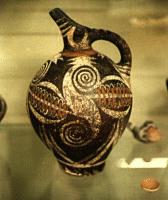
First Palace period 2200 - 1700 BC The skimpy remains of these palaces are typically discovered beneath the later palaces as the Minoans rebuilt upon the same sites. All the features of Minoan architecture are already present. The buildings are arranged around a central court and have fine facades of closely fitted stone blocks with monumental entrances. Inside, they are multi-storied and have workshops, storage magazines and sacred rooms. The finest example was uncovered in the west palace section at Phaestos. The palaces workshops are also producing fine wares already. The gorgeous Kamaresware pottery dates to this period and the style is named after the cave of Kamares where it was first discovered. Kamaresware is exquisitely made pottery with polychrome motifs of rosettes, spirals and hatching vibrantly painted on a shiny black background, and was produced in a variety of vase shapes (see picture at left). The workshops also produced fine vases and vessels of stone and faience; seal stones of precious or semi-precious stones, with hieroglyphics and dynamic natural scenes; elegant weapons and tools; vessels of bronze or silver; jewellery of marvellous technique ("the Bee Pendant" from Malia); and charming miniature sculpture. The Minoan religion is centered around the Mother Goddess, and the use of sacred symbols such as the sacred horns and the double axe becomes prevalent. Hieroglyphic script, which quickly developed into a linear A, was used in the palace archives. The first palace centers and the settlements of Crete were reduced to ruins possibly by earthquakes .
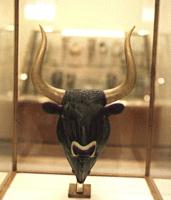
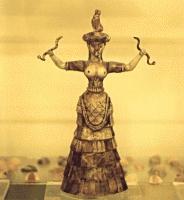
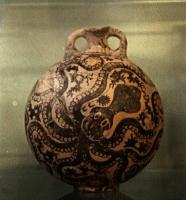
Second Palace period 1700 - 1500 BC The marine style of pottery developed with flowing elements including stylized octopuses and seaweed. The floral style also developed inventive plants and open flowers. Frescos depicted landscapes with animals along with scenes from religious and social life. Bull jumping and other festivities were shown on the frescos. Faience work, decorative plaques, figurines such as the snake goddesses, royal gaming boards, detailed gold and silver jewellery and vessels were produced in the workshops of the day. Some very fine bronze work was achieved during this period. The main deity is still the Mother Goddess, who is portrayed in different forms such as the "goddess with the snakes." The Bull was also worshipped as a powerful symbol of fertility beside her. Deities were worshipped in sanctuaries of the palaces, various dwellings, the peak sanctuaries, and in sacred caves. Many of the features of Minoan religion passed into the cycle of the Greek mystery religions. Most of the tombs were cut into the soft rock and had a square burial chamber and a sloping dromos. Some were still vaulted tombs with a circular or rectangular chamber. The still undeciphered Linear A is now in use. There are about 200 surviving texts on clay tablets apparently deal with accounting and inventory information. The tablets come from the archives of palaces such as Knossos or villas and were preserved by firing in the fires that destroyed the palaces. The Phaestos Disk, with its unique hieroglyphic text, belongs to the first phase of the second palace period. All of the centers of the second palace period were destroyed around 1450. The terrible volcanic eruption of Santorini had large impacts on Crete depending on how the ash fell, but did not have enough effects to destroy the palaces or the Minoan way of life. The eruption of Santorini may have destroyed some coastal towns and shipping, and would have depressed the economies of the eastern Mediterranean though. Terrible palace destructions did happen though (probably through earthquake again). Life resumed only at the palace at Knossos, which was reconstructed and served as the residence of a new Mycanaean (Achaean) rulers from the mainland. Their presence is inferred by the appearance of the very archaic written Greek language of Linear B and by the appearance of Palace Style pottery. Changes were made in the arrangement of the palaces, and the Knossos Throne Room and many surviving frescoes (such as the Corridor of the Procession also at Knossos) date from this period.
Third Palace period 1500 - 1200 BC
Post-palace period 1200 - 1050
Sub-Minoan Period 1100-1000 BC
Are The Minoan Palaces Really Palaces? Study of the archaeological remains of the palaces revealed they served as religious and economic centers. Religion is evident as large amounts of cult equipment and areas are found in the palaces. In addition, frescoes with religious representations abound in the palace of Knossos (few frescos have survived in the other palaces). The economic aspect comes from the large storage magazines found at the palaces so they were obvious centers for regulating the flow of goods and storing them. However, there is a connection between religion and economy too, as the magazines and workshops are close to the palace shrines. The large concentrations of magazines in the west wings of all the palaces, which was also the major cult area of the palaces, also supports this idea. The connection between religion and economy suggests the system was theocratic where the economy and government was controlled by the priesthood. Such systems were well known in Egypt with the Pharoahs as god-kings, and Mesopotamia with its temple states. There may have been king, or a priest-king or priestess-queen, or a board of priests running Minoan society. A king may have ruled in the palace with his administration carried out by a priesthood. A king may also have shared power with a priesthood too, but all these governing relationships are just suggestions. The palaces may have been palaces for royalty and a temple, but we only know for sure that there are luxurious quarters, large halls, workshops, storage areas, and religious shrines in these structures. Mesopotamian Temples and Minoan Palace Comparison The land of Sumer of the third millenium BC was divided into city states. Each city had the temple of the deity to whom the city belonged at its center. The temple was primarily the dwelling of the god, but also a ceremonial center, a treasury, a town hall, a store house and a commercial center. In addition it housed the priesthood and the temple workers. Both Minoan palaces and Mesopotamian temples had: A general resemblance between the Mesopotamian temple and the Minoan Palace in layout and design. A substantial section was occupied by the workshops and magazines. In the Sumerian economy,controlled by the priesthood to a large extent, the temple acted as a redistribution center. It amassed wealth from the land it possesed and from tribute. This wealth was then redistributed to the population as wages for their services. Rations of flour, beer and even clothing were given as wages, as we can tell from the written records of the temples. Regarding the rituals and ceremonies that took place in the precinict of the temple, sacrifices and cult meals were among the most frequent ones. Banquet areas and cult eating areas (possibly bench sanctuaries in Minoan Palaces exist in both types of buildings for ceremonial communal meals.
Kings emerged in 3rd millenium Sumeria because of the increasing military threat that these people faced from the invading tribes of the desert and the mountains, so kingship with the Minoans is not out of the question either.
Minoan Sources Blue Guide to Crete by Pat Cameron. Best general overall source to archeological sites and info. The original source. Arthur Evan's massive 3 volume dig report on Knossos, which laid a great deal of groundwork. It is detailed but made prior to the field developing real excavation reports, and there have been new interpretations since on some of the material. Researchers really digging here usually end up having to look at the original field notes in pen and pencil. Art and religion in Thera : reconstructing a Bronze Age society / Nanno Marinatos, Athens : D. & I. Mathioulakis, 1984. Excavations at Thera / Marinatos, Spyridon Nikolaou, 1901-, Athens : s.n., 1968-. Thera and the Aegean world III : proceedings of the third international congress, Santorini, Greece, 3-9 September 1989 / editors: D.A. Hardy, with C.G. Doumas, J.A. Sakellarakis, P.M. Warren London : Thera Foundation, 1990. Massive 3 volume set. Knossos A Labyrinth of History. The British School at Athens, 1994. A New Guide to the Palace of Knossos by Leonard R. Palmer. Minoan and Mycenaean Art by Reynold Higgins. Minoan Civilization by Stylianos Alexiou. Minoans: Life in Bronze Age Crete by Rodney Castleden. Has annoying habit of calling all the periods New Temple. Seems technically correct overall, even if you don't agree with his theories. Guide of Cretan Antiquities by Costis Davaras.
Sources on Minoan Religion M. P. Nilsson's The Minoan-Mycenaean Religion and its Survival in Greek Religion (1927,1950). Axel W. Persson's The Religion of Greece in Prehistoric Times (1942). B. Rutkowski's Cult Places in the Aegean (1971, 1986). G. Gesell's Town, Palace, and House Cult in Minoan Crete (1985). Articles by K. Branigan and P. Warren discussing new material, Warren's most recent piece is a summary of current trends for, ""Minoan Religion as Ritual Action" (1988). C. Renfrews shrine of Phylakopi on the island of Melos in the Aegean K. Kilian, have introduced new methodological approaches to the study of prehistoric religions. Minoan and Mycenaean religions are coherent autonomous and distinct systems, not primitive versions of later Greek religions.
|
| Source www.dragonridge.com |
 The Minoan civilization, based on the island of Crete, achieved political and economic dominance of the Eastern Mediterranean at their height of power. They were a sophisticated culture that was generally peaceful and enjoyed the profits of a healthy trade economy. Trading ties existed to Egypt and the Minor Asia coast, as indicated in the writings on Egyptian temples and by artifacts found. They have also been linked to the Atlantis legend described by Plato. After the Minoan civilization collapsed, the Mycaneans from the mainland filled the power vacuum.
 Power began to be centered around kings. The first large palace centers came into being. Excavation has revealed four large palaces at Knossos, Phaestos, Malia, and Zakros so far.
 Minoan Civilization reached its zenith in the Second Palace Period. Magnificent new palaces were built upon the ruins of the old ones. The cities around them expanded. Many lords in rural villas controlled areas in the same way as the feudal lords of the Middle Ages. Their ships carried both the products of Minoan and other societies throughout the Aegean and Eastern Mediterranean to trade. The new palaces were multi-storeyed and complex. They had great courtyards with grand porticoes, broad staircases, processional paths and monumental entrances. Many rooms could be opened for air circulation and sunlight to enter via pier and door partitions making the rooms quite bright and pleasant in the summer. Benches and thrones were found in royal rooms. There were many interior light wells to allow light in through all levels of the palace via the roof. Bathrooms and water supply and drainage systems allowed for a easier style of life. Sections of the palaces were royal quarters, sacred areas (pillar crypts, tripartite shrines), audience and banquet halls. Large areas of these palaces were set aside as storage areas (magazines), and workshops also existed within the palaces. Wonderful fresco painting decorating the walls with fresh, lively scenes in an array of colors. Gypsum was a common building material used for wall siding and floors.
 Crete entered upon the purely Greek period of its history with the arrival of massive waves of Dorians at about 1100 BC. The Protogeometric period that followed (1100-900 BC) unfolded alongside the Sub-Minoan, as the earlier Minoan cultural traditions continued on especially in the mountain areas of central and eastern Crete. Many mountain top settlements existed due to their defensive locations. The use of iron, and cremation of the dead became general.