HOME
INDEX
|
The name Atlandis means the land of Atlas, a mythical Greek titan who was holding the sky on his shoulders. He was also the ruler of the Atlandic Ocean the Atlandean mountain range in Morrocco. |

Visit an external site that claims to have found an ancient medallion proving the existance of Atlantis.
Plato spoke of bulls hunted with ropes within a temple in Atlantis. Archaeological evidence has shown the Minoans built bull rings, hunting the animals with nooses, (the only example of this kind of "bullfight" in world history) and practiced "bull jumping"
(taurokathapsia) either a sport or religious ritual. These practices gave rise to the legend (?) of the Minotaur, half man, half bull, secured within the labyrinth. With the founding of Greek collonies in Spain the custom was introduced there and evolved into the modern bullfighting. |
|
Atlantis
The lost paradise
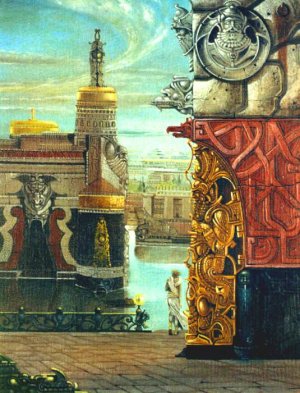 In the depth of the oceans lie the secrets of once fertile countries such as Atlantis, and maybe the ocean will release them one day. As victims of great floods, seaquakes or storm tides, those countries today are symbols of a golden age, as they represent romantic, idyll and the lost paradise.
The first description of the legendary Atlantis is found in the text Timaios, written by the greek philosopher Plato (approx. 427 - 347 b.c.). In his narration Plato describes this Atlantis as a group of separate islands, which were united in a huge kingdom with a highly developed culture. Its society was structured into priests, hunters, soldiers, tradesmen and herdsmen, who lived in fortified cities and castles.
They built docks with shipyards and had a big fleet and an organized army with chariots and metal weapons at their disposal. Atlantis is said to have governed the whole Mediterranean Region, and it was blessed with an ideal political constitution.
But when the population became increasingly decadent, agressive and imperialistic, the gods sent a storm tide, which devoured the whole land. Atlantis sunk leaving no trace.
As a source for this text about Atlantis, Plato refers to his ancestor Solon (640 - 559 b.c.), who is supposed to have heard this story during his journey through Egypt, from the priests of the city Saïs, which was at that time the egyptian capital.
According to Solon, Atlantis existed 8.000 years before his time and was situated "beyond the Columns of Herakles". In reality, Egyptian legend placed Atlantis west of Egypt, not necessarily west of the Mediterranean. In describing Atlantis as an island (or continent) in the Atlantic Ocean, we suspect Plato was merely wrong in his interpretation of the Egyptian legend he was retelling.
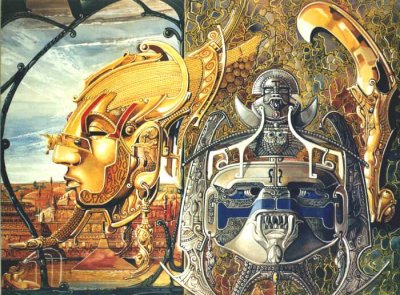 Not only because of these two confusing statements, a lot has been speculated about Atlantis. It was assumed everywhere, and places like the Caucasus, the Netherlands, the Bahamas, the Arctic, the Mongolia, the Crimea as well as Carthage, Malta, Iran, Australia, Spitzbergen, Ceylon, Brasilia, Prussia, North- and South America, Marocco, Nigeria, Heligoland, Portugal, Spain, Greenland and the Azores show in their wide range, that the myth Atlantis could be integrated into the structures of each of the religious traditions without any problems.
Yet Plato preserved enough detail about the land of Atlantis that its identification now seems very likely, and rather less mysterious than many new-age advocates would like. It is likely that Atlantis was the land of the Minoan culture, namely ancient Crete and Thera. If this hypothesis is correct, Plato never realized that the land of Atlantis was already familiar to him. The two most prominent theories about the location of Atlandis though place it in the Atlandic Ocean or the Agean Sea where the Greek island of Thera (or Santorini) is located today.
So could Santorini have been Atlantis?
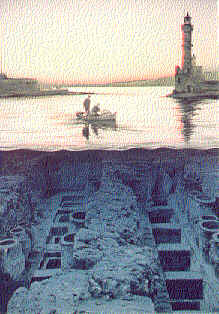 A new, scientifically sound basis is brought into the discussion about Atlantis by the geoarchaeologist Dr. Eberhard Zangger. In his book "Atlantis - A legend is deciphered" he puts forward the bold thesis, that the story about Atlantis is nothing more than the egyptian retelling of a worldwide known historical phenomenon of nature, such as an enormous volcanic eruption (Santorini) or immense floods - a story which has been seriously distorted throughout the centuries of handing down.
According to Zangger, it is absurd to estimate a civilization with such a high standard of living at approx. 10.000 b.c., whereas it would fit much better into the late Bronze Age (1.400 - 1.150 b.c.).
A possible explanation for the difference between the archaeological dates and the year told in the legend could be, that at the time of Solon it was common to measure the year after the cycles of the moon. If therefore we have to assume 8.000 years of these past 10.000 years as lunar years, which must be divided through 12, 37 (number of moons per year) for conversion, then the real time of Atlantis would lie around 1.207 b.c., provided that Solon's journey through Egypt actually took place in the year 560 b.c. Also the biblical age of Adam (930 years), Seth (912 years), Methusalem (969 years) and Noah (950 years) become explainable, if we measure their lives in lunar years. Converted to our modern calender they would at least have turned 75 - 78 years old.
 In regard to the geography, Eberhard Zangger offers another correction of the Atlantis mystery: If one compares the land- / sea-distribution in Egypt and in the Aegean Sea, it becomes obvious why the Egyptians used at that time the expression "from the islands". While today the word "island" has a clear meaning, this was not the case at the late Bronze Age. For the Egyptians more or less all strangers came from the islands. As there had been practically no islands in Egypt, the ancient Egyptian language did not have any special character for it. The hieroglyphic used for "island" was also meaning "sandy beach" or "coast" and was generally used for "foreign countries" or "regions on the other side of the Nile".
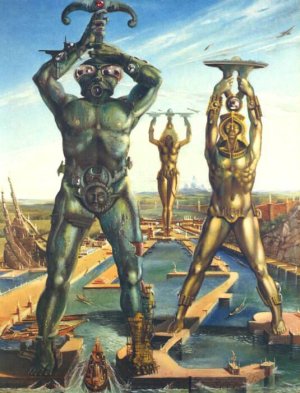 Finally there are two narrow waterways in the Mediterranean Sea, both leading into other oceans: The Straits of Gibraltar (into the Atlantic Ocean) and the Dardanelles / Bosporus (into the Black Ocean). According to the roman grammarian Servius (approx. 400 a.d.), both of them had been called "Columns of Herakles": Columnas Herculis legimus et in Ponto et in Hispania." (through the Columns of Herakles we go within the Black Sea as well as in Spain). But only one of them was - at the late Bronze Age - lying within the range of the archaic ships: the one into the Black Sea.
In the written tradition the "Columns of Herakles" marked the edge of the known world. In the late Bronze Age the greek world was ending at the Bosporus, whereas in Solon's time it already reached Gibraltar (in the south of France the greek colony Massilia, today Marseille, had been established just a few years before Solon's journey to Egypt, so that for the first time the Straits of Gibraltar were reachable for greek ships).
Due to the geographically expanded region of the ancient Greeks, obviously also the mythologial area called "Columns of Herakles" was transferred to the new borders of the known world.
Evidence
There are some fairly convincing arguments of those who believe it was Santorini:
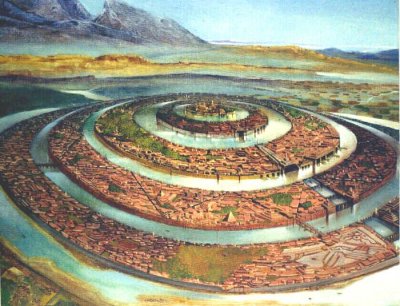 1. Plato tells about a circular island with concentric structures, which would fit quite well with the newest reconstruction of the ring-shaped pre-Minoan island with a central shield; furthermore Heiken and McCoy (1990) indicated that the famous picture in the West House from the Akrotiri excavations that shows an inhabited and flowering island landscape and the departing Therean fleet, most likely represents a relatively naturalistic portrait of Thera and actually displays some such concentric water-land ring structures. Plato speaks of the stone quarried from under Atlantis; "one kind of stone was white, another black, and a third red". The first sight of Thera that modern day tourists see is the sheer cliffs remaining when the rest of the island dropped into the sea, and these cliffs are a breathtaking mix of white, black and red stone. A unique sight in the Aegean world. Archaeologists have found an extensive and sophisticated system of sewers, drainage, drinking and bath water pipes in Crete and Thera. Private homes had flush toilets and bathtubs. It appears Minoans heated their houses and had hot and cold running water from hydrothermal vents. Plato describes the "bringing up (of) two springs of water from beneath the earth... fountains, one of cold and another of hot water...there were the king's baths and also the baths of private persons. Some may argue the fact of Plato saying that this civilization was destroyed "9000" years ago, and the actual date from Plato's time being closer to "900" years ago. The reason is this:
The symbols for "900" and "9000" were simply written incorrectly after being copied time and time again.
1. Plato tells about a circular island with concentric structures, which would fit quite well with the newest reconstruction of the ring-shaped pre-Minoan island with a central shield; furthermore Heiken and McCoy (1990) indicated that the famous picture in the West House from the Akrotiri excavations that shows an inhabited and flowering island landscape and the departing Therean fleet, most likely represents a relatively naturalistic portrait of Thera and actually displays some such concentric water-land ring structures. Plato speaks of the stone quarried from under Atlantis; "one kind of stone was white, another black, and a third red". The first sight of Thera that modern day tourists see is the sheer cliffs remaining when the rest of the island dropped into the sea, and these cliffs are a breathtaking mix of white, black and red stone. A unique sight in the Aegean world. Archaeologists have found an extensive and sophisticated system of sewers, drainage, drinking and bath water pipes in Crete and Thera. Private homes had flush toilets and bathtubs. It appears Minoans heated their houses and had hot and cold running water from hydrothermal vents. Plato describes the "bringing up (of) two springs of water from beneath the earth... fountains, one of cold and another of hot water...there were the king's baths and also the baths of private persons. Some may argue the fact of Plato saying that this civilization was destroyed "9000" years ago, and the actual date from Plato's time being closer to "900" years ago. The reason is this:
The symbols for "900" and "9000" were simply written incorrectly after being copied time and time again.
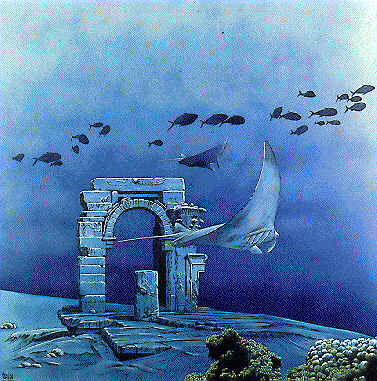 2. Plato writes that Atlantis was situated in the Atlantic Ocean, beyond the "Pillars of Hercules", the Streets of Gibraltar and was bigger than Libya and Asia together. Concerning its position outside of the Mediterranean region, it is likely that Solon or Plato either were misinterpreting their old sources or that Plato put it willingly far beyond the Greek-influenced world.
- The first possibility could be explaineed by the fact that the original text was much older and the Pillars of Hercules had not necessarily always beenassociated with the Street of Gibraltar; it could very well have meant a place within the Aegean Sea. The association of pillars could even be an allusion to the giant eruption cloud from the Minoan eruption that undoubtedly was visible in the whole Eastern Mediterranean and virtually reached the sky. Then, the connection to the mythical titan Atlas who held the sky upon the shoulders would be obvious.
- Putting Atlantis and its civilisation ffar away from the ancient world would suit Plato's intention of providing a antitheses to the Greek society and its values that he defends. This is clearly Plato's major purpose in his account. - As to Plato's words, "bigger than Libya and Asia together", there could be an easy explanation if Plato changed the very similar Greek words for "bigger than" ("meson") and "between" ("mezon"). If this the case, Atlantis could be identical with Santorin (Luce, 1969). Besides, it is geologically not plausible that a large continent could disappear in a dramatic event there is nowhere on earth such evidence.
 3. Galanopoulos and Bacon (1969) argue that the date for the destruction of Atlantis Plato gives as 9000 years before his time should be read as 900 years and was due to an erroneous translation by Solon from the old Egyptian number system. Plato lived ca. 300 BC and Solon's journey to Egypt had taken place about 300 years earlier. Adding the figures, the Atlantis event should have taken place around 1500 BC, in perfect agreement to the recent datings.
4. The exiting archaeological findings on Thera (near Akrotiri) clearly demonstrate that before the Minoan eruption there was a developed, rich, and probably oligarchic marine community whose flourishing economy was provided by intensive trade, shipping, and probably vine, too, - like at present (Doumas, 1983). We do not know what happened to these people and so far no human body has been found killed by the eruption. It seems that they had been warned in time to evacuate the island. After all there are evidence of various restorations after a previous smaller eruption around 3.500 years ago.
An event of that size must have had enormous impressions on the people living at that time. It is difficult to imagine that the eruption, which was much bigger than the 79 AD Vesuvius eruption, was completely forgotten in history. No unambiguous sources seem to refer directly to the event, but several ancient myths and hints could allude to it, the most evident one being the Atlantis legend.
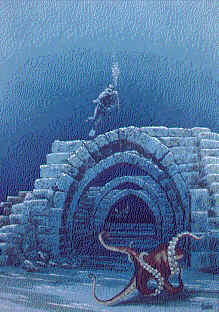 5. Probably there were no close eyewitnesses of the eruption that could survive and give a direct report. What the ancient people experienced, must have been terrifying. If one compares the Minoan with the much smaller 79AD Vesuvius and the 1883 Krakatau eruptions one gets an idea of the circumstances of the eruption. Geologically, not all volcanoes are the same. Some drip lava slowly for centuries, others explode cataclysmically. From tectonic location, composition, and physical structure one can identify similarities between volcanoes. The volcano at Santorini was geologically similar to the 19th century Pacific volcano Krakotoa, and quite different from (for example) the volcanoes on Hawaii. Krakotoa exploded violently in 1883, spreading unparalleled tidal waves (tsunamis) throughout the southwest pacific, and filling the atmosphere with ash that spread through the entire world.
Santorini was about 4 times larger than Krakotoa, and probably at least twice as violent. A research by the American Smithsonian Institute showed that the winds carried the volcanic ash from Thera to the northern part of the Egyptian Kingdom. There are evidence of that in numerous egyptian papyrus and in Bible. The fury of Santorini's final explosion is inferred from geologic core samples, from comparison to the detailed observations made on Krakotoa in 1883, and from the simultaneous obliteration of almost all Minoan settlements. The geologic record time the final explosion of Santorini with remarkable accuracy.
5. Probably there were no close eyewitnesses of the eruption that could survive and give a direct report. What the ancient people experienced, must have been terrifying. If one compares the Minoan with the much smaller 79AD Vesuvius and the 1883 Krakatau eruptions one gets an idea of the circumstances of the eruption. Geologically, not all volcanoes are the same. Some drip lava slowly for centuries, others explode cataclysmically. From tectonic location, composition, and physical structure one can identify similarities between volcanoes. The volcano at Santorini was geologically similar to the 19th century Pacific volcano Krakotoa, and quite different from (for example) the volcanoes on Hawaii. Krakotoa exploded violently in 1883, spreading unparalleled tidal waves (tsunamis) throughout the southwest pacific, and filling the atmosphere with ash that spread through the entire world.
Santorini was about 4 times larger than Krakotoa, and probably at least twice as violent. A research by the American Smithsonian Institute showed that the winds carried the volcanic ash from Thera to the northern part of the Egyptian Kingdom. There are evidence of that in numerous egyptian papyrus and in Bible. The fury of Santorini's final explosion is inferred from geologic core samples, from comparison to the detailed observations made on Krakotoa in 1883, and from the simultaneous obliteration of almost all Minoan settlements. The geologic record time the final explosion of Santorini with remarkable accuracy.
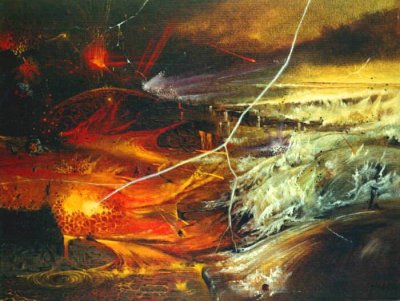 In summer, circa 1470 BC, Santorini exploded. Volcanic ash filled the sky, blotted out the sun, and triggered hail and lightning. A heavy layer of volcanic ash rained down over the Aegean, covering islands and crops. Earthquakes shook the land, and stone structures fell from the motion. When the enormous magma chamber at Santorini finally collapsed to form the existing caldera, enormous tsunamis (tidal waves) spread outward in all directions. The coastal villages of Crete were flooded and destroyed. The only major Minoan structure surviving the waves and earthquakes was the palace at Knossos, far enough inland to escape the tidal waves. But in the days that followed, volcanic ash covered some settlements, and defoliated the island.
The 30-40 km high eruption cloud was seen from hundreds of km and the thundering noise from the explosions must have been heard very far. Ash and pumice fell throughout the Eastern Mediterranean lasted for several days or weeks. The sky could have been completely dark close to Thera for hours or days and it is probable that a series of tsunamis were generated like in the Krakatau case that could have devastated the coasts of Crete and other surrounding islands.
It was the same period when the Israelians made their "exodus" through the Red Sea (or as it is more probable the Bitter Sea in Northeast Egypt). According to the Bible the waters retreated allowing the Israelians to cross the Sea without even wetting their feet. A little bit later the waters returned drowning their persuers. This could be an indication of a nearby volcanic eruption: the waters retreat for a few hours and then they return crashing violently the shores.
In the same time in famine from the ash, with the bulk of their civilization washed away, the remaining Minoans were overrun by Mycaeneans from Greece, and Knossos finally fell.
In summer, circa 1470 BC, Santorini exploded. Volcanic ash filled the sky, blotted out the sun, and triggered hail and lightning. A heavy layer of volcanic ash rained down over the Aegean, covering islands and crops. Earthquakes shook the land, and stone structures fell from the motion. When the enormous magma chamber at Santorini finally collapsed to form the existing caldera, enormous tsunamis (tidal waves) spread outward in all directions. The coastal villages of Crete were flooded and destroyed. The only major Minoan structure surviving the waves and earthquakes was the palace at Knossos, far enough inland to escape the tidal waves. But in the days that followed, volcanic ash covered some settlements, and defoliated the island.
The 30-40 km high eruption cloud was seen from hundreds of km and the thundering noise from the explosions must have been heard very far. Ash and pumice fell throughout the Eastern Mediterranean lasted for several days or weeks. The sky could have been completely dark close to Thera for hours or days and it is probable that a series of tsunamis were generated like in the Krakatau case that could have devastated the coasts of Crete and other surrounding islands.
It was the same period when the Israelians made their "exodus" through the Red Sea (or as it is more probable the Bitter Sea in Northeast Egypt). According to the Bible the waters retreated allowing the Israelians to cross the Sea without even wetting their feet. A little bit later the waters returned drowning their persuers. This could be an indication of a nearby volcanic eruption: the waters retreat for a few hours and then they return crashing violently the shores.
In the same time in famine from the ash, with the bulk of their civilization washed away, the remaining Minoans were overrun by Mycaeneans from Greece, and Knossos finally fell.
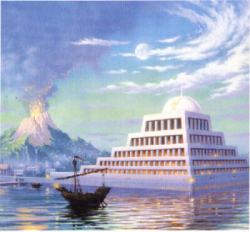 It is a matter of speculation how long it took until the first curious visitors arrived again by ship and visited Thera. Considering the possible destructive effects of the eruption on the coastal areas and that the sea due to rafting pumice probably was innavigatable for months (as was the case for the much smaller historic 726AD eruption of Palea Kameni) some time (years, decades ?) could have passed before a human being first saw the changed island. Was among these people somebody who knew the island before the eruption? Would he or she have recognised it?
The mentioned mud that remained at the site of Atlantis, according to Plato, could simply be the enormous masses of pumice from the eruption. Thera itself would have presented to these people a picture of complete destruction and profound change and there would have been visible no trace at all of what existed before, everything being covered with white and unstable masses of ash subject to frequent landslides and other forms of erosion.
It is a matter of speculation how long it took until the first curious visitors arrived again by ship and visited Thera. Considering the possible destructive effects of the eruption on the coastal areas and that the sea due to rafting pumice probably was innavigatable for months (as was the case for the much smaller historic 726AD eruption of Palea Kameni) some time (years, decades ?) could have passed before a human being first saw the changed island. Was among these people somebody who knew the island before the eruption? Would he or she have recognised it?
The mentioned mud that remained at the site of Atlantis, according to Plato, could simply be the enormous masses of pumice from the eruption. Thera itself would have presented to these people a picture of complete destruction and profound change and there would have been visible no trace at all of what existed before, everything being covered with white and unstable masses of ash subject to frequent landslides and other forms of erosion.
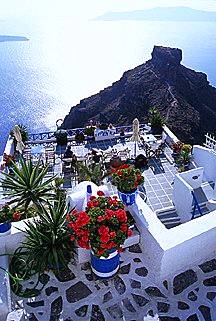 The modern island of Santorini is now the rim of the the volcano — the caldera is covered by the Aegean sea. Mounds of pumice and volcanic ash mark its center, where the volcano remains. New inhabitants of Santorini mine the volcanic ash to make cement — and still find ancient ruins under the stone. The ash is now the soil, olive and fruit trees cover the landscape, and former Atlantis (Crete, Santorini, and perhaps other Aegean islands) is mostly buried. New inhabitants have rebuilt Crete, but the mute ruins of ancient Atlantis can still be seen.
6. Furthermore, the shape of the island was largely changed. Some steep slopes had been smoothed and new coastal plains created by the ash flows, the isolated rock of Monolithos, previously a small island, had been integrated. Most striking of all, parts of the former ring-shaped island had subsided and disappeared during caldera collapse. Probably it was not a very pleasant and inviting sight. That explains that no traces of resettlement occur on the island for many hundreds years after the eruption.
Probably the first people who repopulated the island centuries later were the Phoenicians. A new part of history began then; antique legends refer to Thera, then also called 'Callisti' (gr. = the most beautiful one) as a present by the God Triton to the the Argonauts, as for example reported by Pindar (4th Pyth. Ode, Verse 10).
7.Plato talks about the existance of elephants in Atlantis. The University of Athens, which has no relation with any research as far as concearns Atlantis, has a large collection of bones from small elephants which were resently descovered on the island of Tilos in the Aegen Sea. What is interesting is that these elephants seem to inhabit all the Aegean islands until around 1.500 BC when they dissapear mysteriously. The scintefically proven date of their destinction agrees with the date of the destruction of Santorini.
One of the frescoes in Santorini shows a war fleet sailing among two cities. The one is Egypt with tropical plantation and lions hunding antilopes. The other is Thera with an image of an active volcano next to it. People in Thera seem to celebrate something. A little further the explanation of the celebration seem to appear: a battle between the Minoans and the Egyptians. The ships return to their homeland, Thera, after having win a battle with the Egyptians. The legendary fertile valley of Atlantis could have not been located at all on the island of Thera. it could have been the valley of Messaria in Crete, which even today retains its reputaion as one of the most nurtring valley of the area.
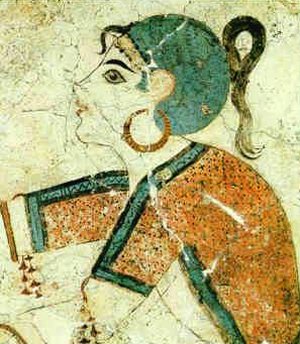 8.One of the most well preserved ancient tombs in Egypt is Bezier Resminet's who lived around 1500 BC, the approximate time the Minoan civilization destroyed. In the tomb there are frescoes depicting all the people Egypt had commercial relations at the time such as the dark skinned Libyans from the West and the black Nubians from the african South. A section of the fresco shows a Minoan delegation bringing gifts and various dedications. Their clothes, accessories and hair styles show clearly their descent. The professor of Egyptiology Yan Asman points out a detail: the lower part of the Minoan clothes has been repainted as if the artist had made a correction. This should have been a correction made after the arrival of the Minoan delegation so the date of the construction of the tomb should be more or less the same as the time the delegation arrived in Egypt. In frescoes painted later there are no other represenations of Minoans as if the relations between the Kingdom of Egypt and the Minoic State had stopped suddenly.
So was it the island of Thera or Santorini as it is called today the location of the mythical Atlantis? A lot of research regarding this theory is yet to take place.
REFERENCES:
- Friedrich, W.L. (1994) Feuer im Meer. SSpektrum Akademischer Verlag, Heidelberg, Berlin Oxford, 256 p.
- Galanopoulos, A:G: and Bacon, E. (1969)) "Atlantis. The Truth behind the Legend." Nelson, London
- Luce, J.V. (1969) "The End of Atlantis - New Light on an Old Legend." Thames and Hudson, London, 224 p.
|