Hello.
Answering all that has been said is not my intent. Much good has been
said that is helpful to the question that was ask. I may or may not be
able to add another view.
It is for the better understanding of this story that I need to make a
few points as clear as I am able to do with consideration to my limited
skills with the pen.
Second to be brought into light, is that I am only one type of spinner: A spinner of the longswool to a tight worsted cord, and tight-plied singles for weft cords. I also re-spin commercial yarns to double ply them and single yarn to a tight cording. It is said that need is the mother of invention. That is the truth of how "MySpindle" came into the light of a day that was in the year of 1968-9 or around that time, to the best of how I recall it now.
MySpindle's whorl is made from what was a sample piece of wood for a
lacquer finish.
The test finish of lacquer has held up well over time, by-the-way. |
It was pre drilled with a hole that will accept a ˝" dowel with a
small amount of fine-grit sanding.
So its staff, or 'distaff' as we were taught to call it since a time
from around 1908,
(from my research.) by the traders of the South West, and so miss-called
a Navajo distaff-spindle since that time, and in literature also, is
made from any straight-grained 36" or 48" dowel stick (cut down to
42"-44") that can be had from a local hardware for 16˘-24˘ each.
These are changed often for reasons i will attempt to explain in this story of "MySpindle."
What first comes to mind's eye, is while plying two yarns and it is needed to replace the full staff with an empty one, in order to continue, like the bunny. (keeps going..)
I use the short shaft to ply two yarns through a hook in the ceiling and with the spindle upright and in a bowl, as a true supported spindle.
While spinning the longswool to a lopi, or "fingerling", then to a yarn, and on to a cord, in order to make a warp, I find the longer shafts to serve best for spinning the true "Navajo" or Dineh spindle spinning.
Because a single cord is desired for a warp, without knot or splice to weaken it, a large tool is needed. Holding much cord for a large piece. (three to four pounds, total.)
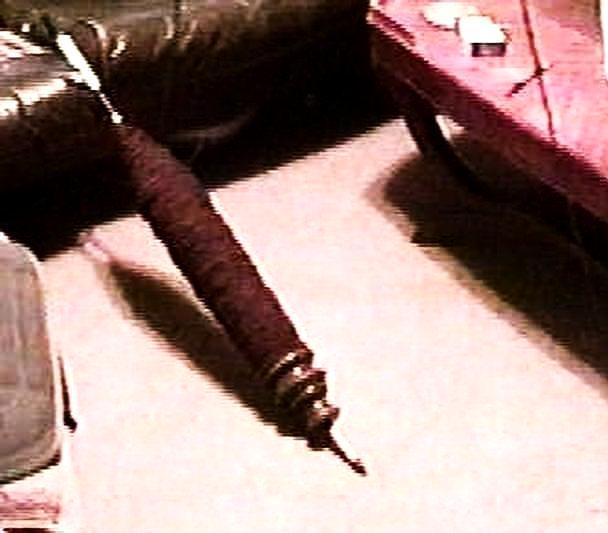
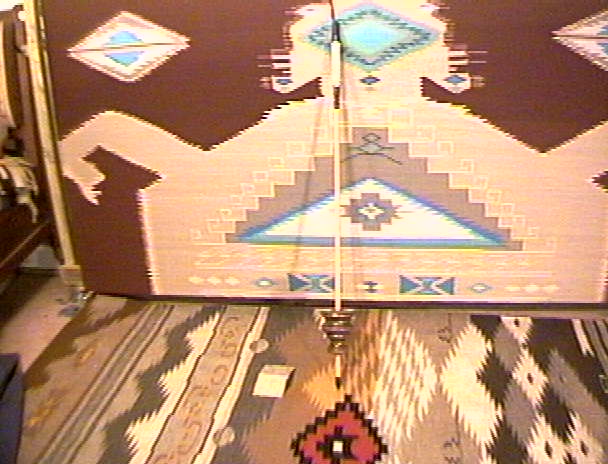
The two above photos show one pound of plied yarn.
Other reasons for replacing the shaft, is when it becomes warped, so must be straightened, or when it dries out and no longer fits well in the hole, as happens with many.
All the more reason to seek out the straight-grained heartwood sticks when making a purchase, and to take care and treasure those that prove themselves over time.
Also, finding center on each sticks bottom end, in order to drill and tap a hole to accept its point, is needed.
These 'points' were gleaned from some very good 'target' points I have had on hand, that have a male thread to go into a fiberglass arrow shaft. Which would also make a fine shaft for a spindle, if ever I run onto its matched whorl, and also have need for another spindle at that time. A reason for another one eludes me though.
These points help it to spin.
It is set-up for plying in this photo.
The large white area around the top, banded with black at each edge is
a friction pad.
I have large hands and when trying to spin the small ˝" shaft, my palm gets sore. Also, it will slip in the winter when they are dry and rough.
All this is really, is a band of the new type netted dry-wall tape that
is made of a plastic fiber. It is wrapped to a large enough thickness
and banded at each end with a true rubber electrical tape to keep it
from coming undone.
(Don't use the common plastic kind, though.)
As the netted tape frays, just take a wrap off and keep on like the bunny. Until you need to chunk it in the yard and re-do it all. (every fifty pounds, or so.)
Both types of tape cost about two bucks worth of dollar-bills, but will last a long time.
Next comes the hook or point or whatever. It has a large brass upholstery tack in it now, but changes also.
The type is the large domed-headed type with a long nail on its bottom.
Instead of being driven straight in, it is crooked so that only one
side of the head is touching the end of the stick.
A nice little wedge shaped place is on the other side to catch a little
piece of fiber.
The head is just a little smaller than the end of the stick and this
opening between the head and the stick is only about an eighth of an
inch.
I also like the half-hitch for tying on a yarn or lopi. I have also
used spit, postal tape, a rubber-band and a calf band.
Mostly over-kill on my part, looking back.
Over the last thirty or so years, I have probably invested a bundle in
dowels and tape and such, on "MySpindle." It has been worth each cent I
have invested, as it has returned to me, many-fold.
At this time I am not looking to invest more funds into a different, or a better one than "MySpindle", even though it may be out there somewhere.
There are many more words in this too-long story of "MySpindle" that my feebleness of mind forbids me to tell.
So I will say one more thing on the matter, then let it rest for a time, be it long or short.
I had a need for a simple tool that would allow me to take the longswool to a simple cord, so that I could take it to my loom for a simple covering, and "MySpindle" came into the light of that very day that need was on me and has stayed fast to this day we speak on.
Where could this better one be?
Chu'a
|
TwoHorns Chu'a ~^~^~^~"Let my armies be the mountain and the trees and the birds"~~^~^~^~
| |||||||||||
|
Page views: | |||
| Home | (Intro.) | )||