From:
[email protected]
Date:
Sat, Oct 14, 2000, 4:04pm
Subject:
Shuttle-Skiens or, My butterflies won't fly
Butterfly SKEINS:
��Throughout the weaving process, as well as the spinning
process.
It is necessary to use the simple skein that is also the
"shuttle" in
primitive weaving.
��It is a simple method for keeping a length of yarn
from
becoming tangled.
When thinking of how tightly this yarn is spun, so as to
have a tendency
to be very springy and twisted. It becomes apparent how
important this
is.
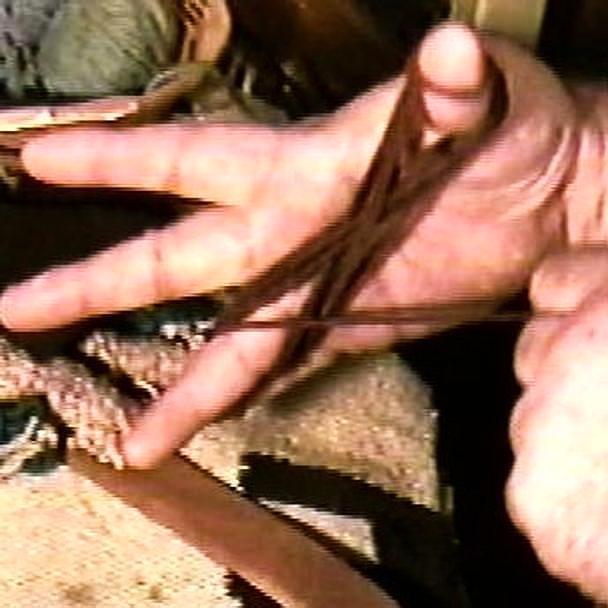
��The most common method used, is to place a few wraps
around the
thumb of one hand and then wrapping it in a figure eight
between that
thumb and the finger that is the furthermost from it and on
the palm
side of the hand.
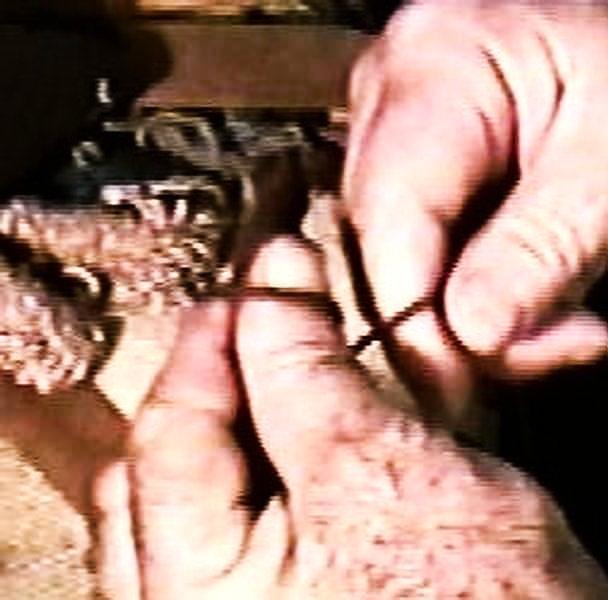
��Once a sufficient quantity is had, it is removed from the
thumb
and this bundle of loops is wrapped tightly from this end
to the other,
at the, next to "little" finger. Then it is removed from
this finger
also and wrapping continues until a sufficient quantity is
on this skein
to make it stiff and almost pointed at one end.
�
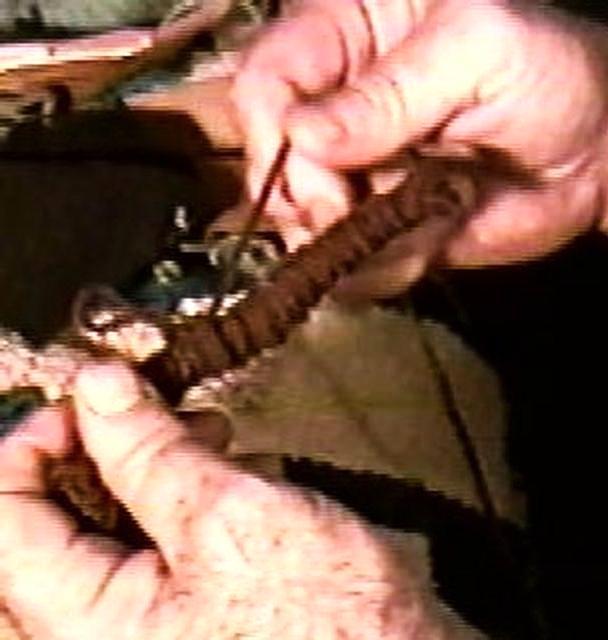
���To finish, a few wraps around the thumb and fore-finger, in order to pull a loop of the yarn through the
final few wraps
at the center of this skein and pull tight to lock. Similar to a
slip-knot.
This will keep it from unravelling and unrolling.
The fact that it is in this figure eight will prevent it
from tangling
or becoming twisted or knotted.
The fact that it is hard and pointed at one end will allow
it to be
passed through the shed opening with greater ease, as will
the loops of
exposed yarn at its other end aid in hooking a stick to it.
To enable
you to push it through long shed openings, when that is
what is needed.
�
�Having the slip knot at its center will help prevent the
skein from
un-spinning the yarn that is hanging down from the weave
when the
beater-bar is being slammed home, after each "pass" of a
woof.
��It becomes second nature for the weaver to take yarn from
the
figure eight loops and re-wrap and retie the skein as yarn
is used and
so it becomes necessary. Just as the skill of knowing how
long or wide a
skein may be, or how much yarn it may contain, related to
the part of
the pattern, or the place in the piece that it is being
used for, will
allow.
����I would be remiss to fail in the mention of the use of
this wrapping
and unwrapping of a skein, as it relates to a spinning or a
re-spinning
process, also.
��Even though a danger of adding confusion in the telling
at this point
is a possibility. It should be noted that a weaver has a
need to add or
remove some of the tightness of the spin of the woof yarn
as the weaving
progresses.
| � | �This is true for many reasons,
as listed in part, here.
|
��Perhaps the yarn of a coarse black wool is being used
with a lighter
bodied white wool, or perhaps one color dye added more body
than
another. It may just be that one is spun tighter or thicker
than
another.
��Regardless of what the reason is. A reason is always
present to require
the weaver to have a need to tighten and sometime loosen
the spin of the
yarn as the weaving progresses.
This, in order to maintain the woof on the same level and all in a straight line across the piece, regardless of one part of a pattern consisting of a thick or thin woof-yarn.
| �� | ��The main two methods for
doing this will be touched upon here.
|
��The first and most obvious is to hold the yarn between
the palms of the
hands with the skein hanging below, from the length of yarn
to be
re-spun.
��Allowing it to hang will allow it to un-spin from the
pull of the
weight of the skein.
��Spinning the yarn between the palms will cause the skein
to start
spinning as with a drop-spindle and there-by cause the yarn
to spin
tighter.
����It also becomes the natural tendency of the weaver to
wrap the yarn
around the skein in the same direction that it is spun. The
same
direction as the twist of the yarn, and always onto the
skein from the
small or 'front' of the skein. Then always to pull it from
the big or
'back' end of the skein. The simple act of wrapping it onto
the skein
and pulling it from the skein in this fashion is a spinning
process that
helps to tighten the spin of the yarn.
����More information on this will be mentioned as it comes
to mind and is
needed to progress in the understanding of the Navajo loom.
Or rather,
the lack of.
edit:July,16/01
|