Tragedy at Corregidor, PI |
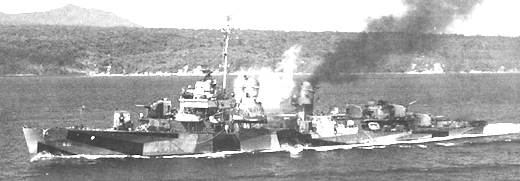
| Feb. 14, 1945, was a stormy, rainy day in the southwest Pacific Ocean. Willie Cole recalled how the whitecaps thrashed against the destroyer Hoppewell. Loved ones raced through the minds of the 342 men on the ship. It was Valentine�s Day � a day meant for cards, flowers and candy; a day of love, not war. The U.S.S. Hopewell was sailing near the Philippine peninsula of Bataan and the small island of Corregidor. Cole was below deck when he felt a sickening jolt. The ship had been attacked. Shells were flying everywhere. Before the battle would end, the ship would be hit with at least four 6-inch shells. �I ran up on deck to help my fellow shipmates, my comrades and my brothers,� Cole said. Cole paused, looked down and covered his forehead with his hand. The battle that ensued seemed like an eternity, but �� it lasted one full day and a half,� he said finally. Cole�s eyes tear up and he sighs. �I�ll never forget the blood running down the deck,� he said. �I was sick to my stomach, the eyes of the dead staring back at me � the pain shot clear to my bones. I never knew death could stare back, but it forever stays in my mind. The cries and screams of the injured are forever embedded in my mind also. �You feel so helpless. You feel so guilty.� He remembers his fallen shipmates. �Seventeen died that day and 31 were injured,� Cole said. �I helped bury 10 men at sea. We took the other seven to Subic Bay in the Philippines.� His fallen shipmates remain alive in his heart almost 60 years later. He wants all Americans to remember them, too. �I hope and pray that all Americans will remember my brothers, for they are truly heroes,� Cole said. Cole � and his three brothers � survived World War II. He believes it was a blessing, an answer to many prayers. He believes it is important to tell the story of that battle and the sacrifice that is war. Fifty-nine years later, Willie Cole and his wife, Jessie Mae, are members of the Disabled American | ||||||||||||||||||||||||||||||||||||||||||||||||||||||||||||
|
My uncle, William Earl Parrish MM3 USNR was killed by Japanese shore batteries while rescuing survivors on minesweeper YMS-48 that had been hit. He died in action on Feb 14, 1945 during rescue attempts at Corregidor. He was buried in military cemetery in Philippines. I am looking for any information on shipmates who knew him or about his death. He was Electricians Mate 3rd Class Thanks to websites as yours as well as the internet in general I am finding out information I have spent years wondering about. I am looking for as much info on this event as possible such as crewmembers who knew him, photos of shell damage, names of crewmembers killed, etc. I would like to locate a portrait of Hopewell as well as William Earl's service record to be used in building a plaque to honor his memory. The only information I have on him is as follows: William Earl Parrish, born: Dec. 11, 1914, Service # 8931013 (?), SSN# 254-05-4269 Any help with any information would be greatly appreciated. Thanks, Anthony Scott Parrish Sun, 11 Jun 2000 |
||||||||||||||||||||||||||||||||||||||||||||||||||||||||||||
| Wed, 5 Sep 2001 To Anthony Scott Parrish My name is James D. Hunter . I was on the Hopewell when it was hit off of Corregidor. I knew Rebel Parrish very well although I don't remember why we called him Rebel. We had been shelling Corregidor for days and the bombers had dropped hundreds of bombs on the island and it seemed impossible that anyone could still be alive. A minesweeper attempted to enter Manila Bay but it had to enter between Corregidor and the Battan Peninsula as the rest of the entrance was too shallow for ships to enter. As we watched there was a big puff of green smoke and the minesweeper was hit by Jap shore batteries. Our stupid Captain had us rush full speed into the narrow channel to rescue survivors. The Japs opened up on us and we were severely damaged. Rebel Parish was at his battle station on a deck around the forward mast. I was standing below just outside of the gangway leading to the mess hall. I was an RBA man. RBA (rescue breathing apparatus) repair party man. A shell hit the forward mast where Rebel was stationed. The mast was surrounded by cork life nets. I was blown backwards into a hatchway leading to the mess hall and landed on an Electricians mate who had a huge hunk of shrapnel imbedded in his skull. Don't recall his name. My eyes and face were full of cork and as soon as I scrambled out and cleared my eyes I looked up to see how Rebel was and saw he was hanging there obviously dead. The end of this story is we didn't rescue anyone and lost quite a few shipmates. Still learning to use the computer and being 80 years old I have a hard time learning anything. I was on the West Virginia when she was sunk at Pearl Harbor then went on a heavy cruiser, the Salt Lake City then transferred back to the West Virginia to bring her back to Bremerton to be rebuilt. I was immediately sent to San Pedro to catch the Hopewell but she had already had sea trials and was in San Diego. I boarded her in San Diego and never returned to the States until we were hit off of Corregidor and returned to Mare Island in Vallejo where we were quickly repaired and sent back out to the Pacific. I don't remember many off my old shipmates names now, but I do remember Rebel Parrish. Our first skipper was Commander Shute and we called him "No Shoot" because he wanted to see their slant eyes before opening fire. Then we had Commander Hayes who was a big improvement until Corregidor where I think he goofed bad. Our chief engineering officer was a mustang officer named Bill Carr and he was a good one. I can remember some of the other crew members but not too many. Hope this helps. I personally think the Captain should have gotten a reprimand or court action for rushing into a narrow channel without a smoke screen when it was obvious that there were still live Jap shore batteries that had their guns trained on that narrow channel. Incidentally I received a citation for bravery and cool courage from Admiral Kincaid after this action took place and would gladly trade it for just one of those who so needlessly lost their lives. Jim Hunter, USS Hopewell DD681 1945 PS: I type with my forefingers |
||||||||||||||||||||||||||||||||||||||||||||||||||||||||||||
| Dear Mr. Parrish: |
||||||||||||||||||||||||||||||||||||||||||||||||||||||||||||
|