Replenishment at Sea |
| Replenishment at sea was developed by the Navy during WW II. For a time it was considered a secret weapon. (The Japanese could refuel with a cumbersome method, but not highline all the other stuff.) A jeep carrier task force was launching close air support planes during the Okinawa campaign. It was at sea for 77 days. Every few days the force would move east and meet a large supply ship formation. Each ship with the carrier force would spend all day replenishing. They would successively go alongside an oiler, stores ship, reefer ship, ammo ship, and others. The navy supply corps performed miracles in the Pacific. Off Vietnam, the Hopewell would take oil from and oiler or carrier about every four days. We were supposed to not let the bunkers get below 60%. Fletcher class destroyers were faster (36 kts) than any other U.S. destroyer designed before or since 1940? It cruised for seven days at 15 knots; but ran out of oil in just 24 hours at 36 knots. |
 |
|
Hopewell's replenishment from stores ships and reefers
was a sometimes thing. The give-away that fresh vegetables were scarce was when the
cooks served brussel sprouts. For replenishment a distance line was passed to the oiler, and tended by a man on the main deck below the bridge. The line had markers every twenty feet. Destroyers tried to maintain a distance of 60 feet. If the distance was opening, the conning officer would tell the helmsman to steer one degree toward the oiler.; i.e.; The ordered course was 340 degrees and had been holding. The new order would be, "Come left one degree, steer 339 degrees." A helmsmen qualified for replenishment could do that . The conning officer would maintain fore and aft position by sighting a feature on the serving ship that was directly opposite the bridge. If moving ahead or aft of the reference, the EOT man would be ordered to tell main-control to add or subtract just one turn. (A two turn change meant the conning officer hadn't been paying attention.) If 123 turns had been holding position for a time, but our ship was moving aft of the reference, then an order might be, "Make 124 turns." The chief engineer told us that the tachometer really didn't read one turn changes. Conning a ship during replenishment was no great trick; there just wasn't much room for error --just like when I was landing an airplane on |
| my carrier during the Korean War. In both
cases, one did not have idle sexual fantasies. However, you guys had a fine
touch on the throttle, and it worked for me. Wayne Irwin Cdr. |
 |
 |
Memorial Day '00 Hey Shipmates, Sea-Story From the files and memoir's of Chief WO B.J. Freeman USN-Retired I always like to tell the story about when I was a Chief Machinist Mate in the Forward Engineroom of USS Hopewell DD-681 around 1963-64! Anytime the ship went alongside for fueling, |
| we always set the fueling detail which amounted to nothing
more than manning the 1JV to the bridge. We always manned the 2JV [engineering
circuits] with headsets on the sound powered telephones at all times. There were some
water tight hatches secured during the fueling event, and a lot of guys had to go to high
line detail for a station, but other than that, not everyone had to go to a station. We
would put another electrician on the after-engineroom switchboard and that was about it. The Oil King and the DCA set up their Fueling Organization in Chiefs Quarters! The rest of the operation was up to the Fueling Control and hopefully the Oil King had all tanks lined up for receiving the black "Bunker "C" fuel-oil." We never had any life threatening problems during any refueling operation that I knew of, but sometimes there would be an oil spill or a close collision call or even a breakaway if things got out of control! All ships had the Universal breakaway coupling or International fueling breakaway coupling at the fore and aft fueling stations and they had been trained what to do in case of an emergency and when ordered to sever or take a sledge hammer and strike the International coupling thereby breaking it for an emergency break-away. |
 |
|
Generally I was not involved in the topside refueling stations and the connections made at the fueling line/cable padeyes! Later on, when I became the MPA of a ship, I ended up running the whole fueling operation from the Engineering Logroom, so I probably do a much better job of explaining this particular account that actually occurred a number of times in Hopewell. The story that I like to tell involves the alongside events, especially where the Officer of the Deck [there were our favorite OOD's and then those that had to break in and/or qualify], would be required to stay alongside the Oiler with the least or minimum number of bells to the enginerooms Engine Order Telegraph or EOT. Sometimes we'd get a bell every 10 seconds and we thought that this was so dammed dumb. What the Officer of the deck didn't know was that with Boiler superheat lowered to 750 degrees fahrenheit, the throttles were very sluggish to response and the boiler pressure was not too steady! |
| Slight variations in boiler steam pressure at the drum most certainly affected the Engine/shaft RPM's and there wasn't much the throttleman could do about that. As the Engineering Officer of the Watch, it was my job to jump onto the Chief BT and tell him to teach his people how to maintain a constant 600 psi steam pressure at all times. I knew it was hard to do, but a good burnerman could do it, if he tried hard enough! Still, I must admit that maintaining constant steam pressure was hard to do and usually we'd be alongside at approximately 12 to 14 knots [depending on the sea state] for fueling operation and there would always be all of these engine order bells ringing down on the EOT. This also required an extra man at the throttle to simply write down the extra bells in the Bell Book Log. |  |
|
So, when the next fueling operation came up, I took it upon myself to climb the ladder to the top of the scuttle and poke my head up where I could see the side of the Oiler and I could also look back down into the engineroom and see the throttleman at the throttleboard on main control! When I seen that the Oiler was moving ahead just a tad bit, I'd signal the throttleman to open the throttle a tad bit, and then I'd watch the response. The ship was supposed to match the Oiler's speed. Still, even Oilers had their problems in maintaining RPM's constant! There was no problem in my keeping the ship right in step with the Oiler. In doing this, we didn't receive any bells at all and after the fueling operation, the OOD that had the Deck would get a slap on the back and a good "way to go" from the Captain! |
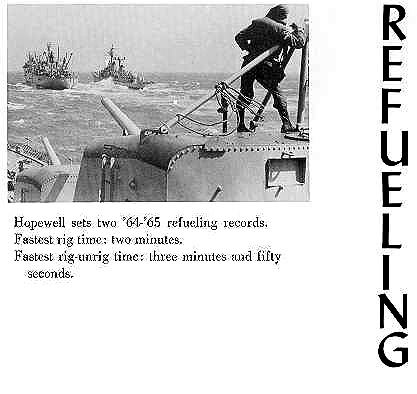
| No matter how we try, few of us will be able to forget refueling at sea. On the average of once every two days at sea, we were scheduled to go alongside an oiler, pass hoses between the ships and take on thousands of gallons of fuel. Day or night, while waves crashed along cocke knocking men from their feet, we took on fuel and ammunition. In spite of wind and waves, Hopewell carried out these operations with an outstanding safety record. | Little did they know that I was calling the shots from the
Forward Engineroom hatch/scuttle. I never told anyone about that, and as far as I
know, none of the engineroom watch actually understood what I was doing
anyway. Still, you never know, because sailors will do anything in order to
get a reward or liberty or simply just to do something different for a change. Ha... So,
just another sea-story from BJ that you may or may not have heard before.
Regards, Bob * * * * * * * |
 |
Please feel free to copy any of the pictures you want! If I can help further or if I find any other fueling pictures I will send them on to you... I myself was on two WestPacs, the last was the final WestPac in 1974-1975! We went to the same places you did --- ten years latter! I spent three years on the Guadalupe, December 1972- to April 1975. Sincerely, Frank Pucillo |
| Today at sea aboard USS John C. Stennis (CVN
74) Jan. 9, 2002 -- Seaman Tiffany Huddleston of Konawa, OK, stands by as
USS John C. Stennis takes on fuel and supplies during an underway
replenishment (UNREP) with fast combat support ship USS Bridge (AOE 10).
Stennis and her battle group are deployed in support of Operation Enduring
Freedom. U.S. Navy photo by Photographer's Mate Airman Tina Lamb.
The Port Hueneme Naval Surface Warfare Center (NSWC) will conduct the
development of a new underway replenishment (UNREP) transfer system
concept to meet expeditionary logistics objectives. The effort is part the
Office of Naval Research's (ONR) Future Naval Capabilities Program to
develop and demonstrate an advanced concept UNREP transfer system. The
objectives of the advanced UNREP transfer system is to reduce the current
UNREP time by 50 percent, and the transfer loads up to 12,000 pounds in
higher sea-states with a 40-percent reduction in manning.
"Heavy" UNREP will exploit the 1960's constant tension UNREP
technology. The plan will advance the UNREP state-of-the-art technology by
the use of constant tension methodology, coupled with tailored-transfer
options to safely and effectively meet the heavy UNREP operational
requirements for higher sea states, reduced UNREP time, and heavier
load-transfer.. |
 |


