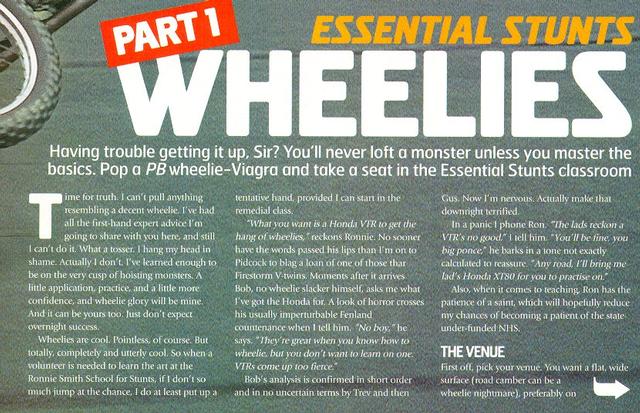
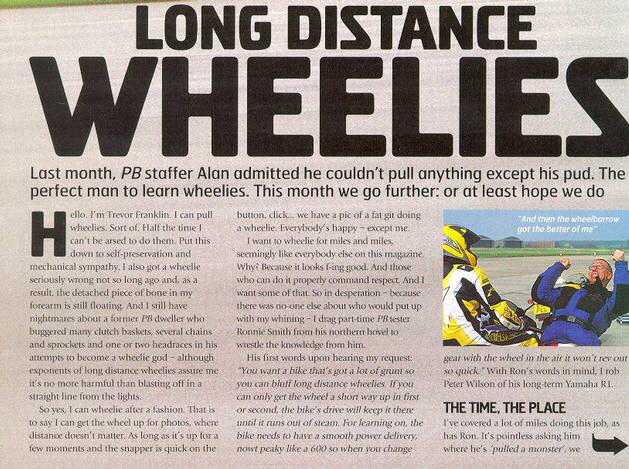
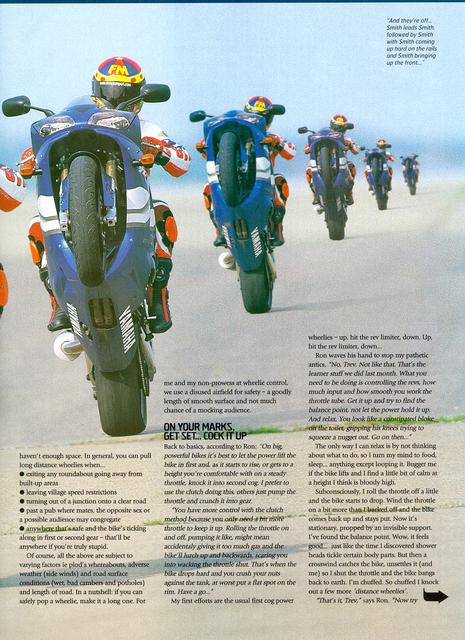
Wheelies Disclaimer: You absolutely must do them. They are unreal - an incredible buzz. They are completely safe and legal. Police especially appreciate them, as do old people, bus drivers and members of parliament. By reading these instructions, you undertake to implement or attempt to implement a wheelie upon every occasion an opportunity presents itself. eg. when departing traffic lights, uncontrolled intersections, school crossings, random breath test stations etc. Wheelies? Why would you bother? Motorcycles
have two wheels, have you ever considered why? Sure, you need at least one wheel to transmit drive to the ground (that's why unicycles have 1 wheel), but what's the other one really for? Aside from being an aesthetically pleasing addition to motorcycles, a front wheel serves three purposes.
This begs the question What should you do with the front wheel when not decelerating or turning. Well, I think the answer is fairly obvious, don't you? Even if you don't subscribe to the above, pulling a good wheelstand is a very satisfying experience. As with most everything, you yearn to go longer, higher and faster each time, but a good wheelie still provides that inner glow. Your first good one will live with you for a long time. How to ... ? Well gee, where to start? Firstly I must say that alot of this (if not all) has been covered in a fair amount of depth by Performance Bikes in an article called Know Lots About Wheelies. Unfortunately I can't quote the issue off hand - but I will endeavour to find out. In the interim - you can see if you agree with what "I reckon" below.
There are two types of wheelies that I can do (well, there's actually three if you count the front-wheel-comes-up-under-power type. (Which of course require no skill)) Using The Clutch (ugh!) 14K JPG (The white/blue blade is up on the clutch) Warning: not recommended for Yamaha owners. Firstly I really dislike using the clutch to wheelstand a bike. Believe it or not I do
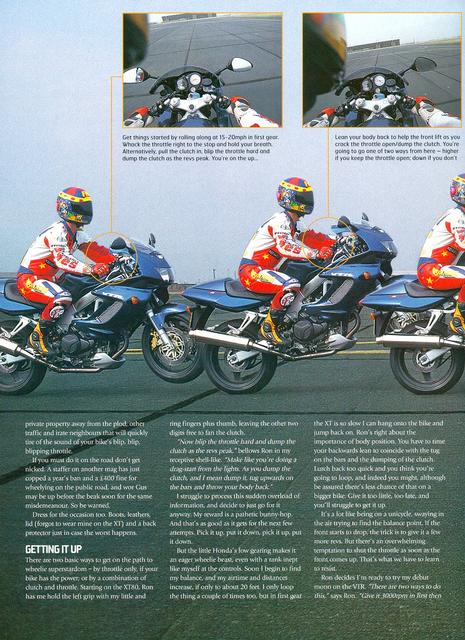
actually have a measure of mechanical sympathy for motorcycles. So I would suggest learning to clutch wheelie on either someone elses bike® or a demonstrater. (Well they get sold for less - it's obviously expected that they have been thrashed) First ensure that you are in first gear, and going quite slowly (the actual figures will vary from bike to bike - but I'll use a late model GSXR 750 as an example) - say around 3500rpm. Sit as far back in the seat as you can, and sit as
upright as possible (this is to move as much weight as possible backwards) Roll the throttle on to maximum, as the tacho moves through 4000-4500 rpm, pull the clutch in. The engine revs will rise rapidly ( well, derr), let the clutch back out (quite quickly) around 4000rpm later. Did the front wheel lift? If not - you'll have to increase the RPM differential. Ideally, you should be feeding the clutch back in somewhere around peak torque (or slightly higher). The larger/more
powerful the bike - the less critical it is. Pulling the clutch in at lower rpm is also another option. It's all a matter of experimentation. But beware - don't wind it up to the rev limitter at a stand still and just pop the clutch on the first attempt - it is better to fail 20 times, than flip it on the first. (Although if you survive - it'll make a great story for when you're older and wiser) Are you now in hospital? Gee bummer - looks like you
stuffed up. And it's all my fault too. I feel so culpable. Still, after you heal you could give it another go. Is the bike at the wreckers? Was it a Yamaha? (Not that I have anything against Yams - it's just they are renowned for week clutches) Well, either way, at least you've learnt something. Only mechanically insensitive idiots do wheelies. (Oh yeh - and really cool dudes®) Using The Throttle
Well, this technique requires a little more from the bike, and it is actually possible that your bike
cannot be brought up on the throttle alone. But it can't hurt to try... (Well yeh, I spose it can - but don't let that stop you.) Firstly, what your bike really needs is throttle response, because you'll be relying on the bike to load and unload the suspension quickly to help hoist the bike up. Of course, if you own a 916 or a ZZR-11 or something of that ilk, you can stop reading now. (Just back off and nail it in first gear.) As alluded to above, the idea is to use your suspension to help
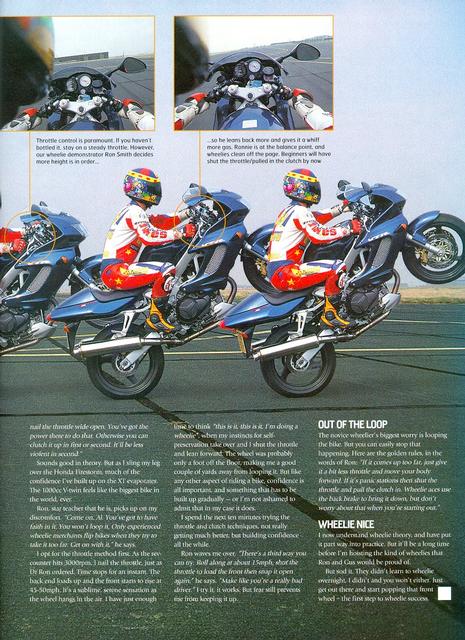
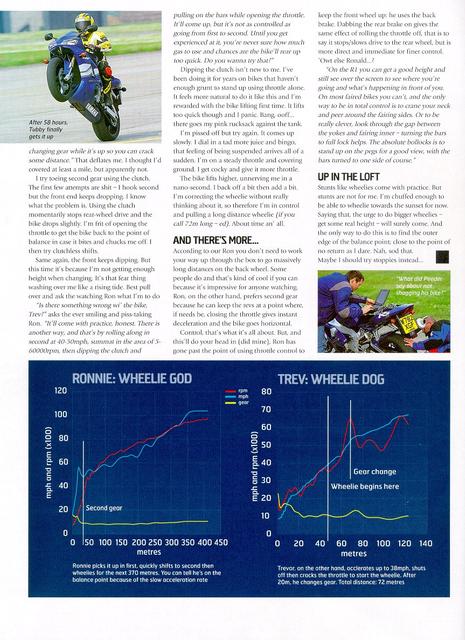
loft the front wheel. You do this by accelerating hard, shutting the throttle quickly (thus loading up the front) and as the forks reach their maximum compression, nailing the throttle again. (Pulling back, lurching back, standing up etc are all optional. They may be necessary for your bike) Now of course it is easy to say as the forks reach their maximum compression - but when you're trying to concentrate on everything else, it's all a bit much. So try remembering this, what you are
dealing with here is physics. Thus to a large degree everything is repeatable. If you open the throttle at a certain rpm, close it at a certain rpm, delay a certain amount of time and then open the throttle again, what happens will be pretty much the same from one occasion to the next. What you're really trying to do is learn what these variables are, with practice you'll develop a feel for when you've got it right. Through all of this though, remember the bike. You're not trying to kill
it, so don't go and spend the next 3 weeks solid attempting wheelies. If you stuff up, stop for a while. Think about what you're doing, and other ways you may be able to attempt something. Anatomy of a wheelie
Nail the throttle Note the position of the throttle. Absolutely wide open, this is one of the critical points of using the throttle alone - often you only use part throttle without knowing itModulate the throttle The bike is up now, so we are only using very light throttle to hold it around balance point. It is always safer to err on the low side of balance! Wave! Once everything is stabilized, it's pretty easy. You could read a book if it wasn't so hard to turn the pages while wearing gloves! My bike won't wheelie... Well, before you race off the local bike shop, here's a list of things you may want to check. You'd be surprised how little things add up to make a large difference. Shifting your weight back Small shifts rearwards can make quite a difference when you're attempting to unweight the front wheel. If you're big enough (or if you're bike is small enough) you can try sitting on the pillion seat (keep your feet on the rider pegs though!), otherwise just move your butt as far rearwards as you can. Low Fuel Fuel tends to be carried high and forward, and with larger tanks we're talking an additional 10kg with a full tank. Try running your bike down to reserve - you may be surprised (My stock fireblade would not wheelie with a full tank, yet could be pursuaded to quite readily while on reserve (That was when it was before it had loosened up fully...)) Chain Adjustment I discovered this one by accident. It is more critical with the throttle only technique, as you're relying on a surge from the engine. With a little extra slack, there is the opportunity for the engine to build a little more inertia before it starts driving the rear wheel. I know this sounds really marginal, but the difference between 20mm and 40mm of chain slack was very noticeable on the blade. Do not run your chain looser than recommended! (Especially not 'cause I told you to) A well lubricated chain also offers less resistance. Adding weight rearwards In its extreme form, this means get a pillion. However I do not for a moment recommend learning to wheelie with a pillion. Try carrying a gearsak or similar with a few kilos of weight in it Well, if it still won't wheelie, I'm out of ideas. A great majority of bikes will wheelie if you demonstrate a sufficient lack of mechanical empathy. Older bikes (and some more recent Eurobikes) tend to rebel against this sort of treatment. OK, I can wheelie. Now what? Now what, indeed. Once you can wheelie through one gear, the obvious next step is to change gears. Soon after that you're going to want to steer (lest you run off the road) then maybe add a little florish(sp?). Like looking around, or waving, or using the horn, or standing up. Once you can wheelie controllably, you really have to share your gift with the world. Sharing the Gift. Spreading the Word. Kids.
When I was little, and interested in bikes I would've killed to see a wheelie. Not necessarily a big wheelie, but any wheelie. Kids generally appreciate your effort (although be warned, they'll probably fry you if you fall off) Just think of it as a public relations exercise. Road Workers. Ever since I learnt to wheelie reliably, I don't think I've gone past a single flagperson (of the Stop/Slow
variety) on two wheels. I have always had a positive response. Waves or cheers are not uncommon. Put yourself in their situation, standing in the middle of the road all day, wouldn't you want someone to come by on the back wheel. Exercise some caution though - don't go wheelieing into a grader or a ditch - that'd look pretty dumb. Another example of a public relations exercise. Police.
Hey, just kidding. In fact I would strongly advise against it. While there is no specific charge for wheelstands (that I am aware of) there are enough general duty-type offences that you can get stung with. Sure, maybe you'll strike a rational officer who'll congratulate you on your exemplary bike control skills, but more likely than not you'll get pinged along the lines of "not being in control of vehicle". Also bear in mind that on the larger bikes, you can be well and
truly speeding by the time the front returns to terra-firma, so don't be surprised if you get done for speeding too! In private. The best places to practice are quiet and secluded. If you have a loud exhaust, try and do it well away from residential areas. Industrial estates on Sundays are a good time, little to no traffic, wide roads, no people to bother. Disused car parks are even better (because then you're breaking less rules). Stoppies Disclaimer: Stoppies are more dangerous to perfect than wheelies. (This probably accounts for the fact that you're more likely to get away with pulling them in front of the law. Sure, they may book you for something, but really..using the brakes too hard? Sounds like a pretty easy charge to defend.) But be aware that once you go past the balance
point in a stoppie, there is no coming back. Releasing the brake isn't going to do you squat of good. That said - the balance point is very high. (See the photo above if you don't believe me) A stoppie involves lofting the rear wheel under hard braking. On sports bikes, they are generally pretty easy to initiate. Other bikes can require a little more effort, or may prove impossible to stoppie. But don't be
discouraged, I have a friend who can stand a ZZR250 on its nose. (You may've already noticed this :) ) There again are two types. The Rolling Stoppie and The Stop Stoppie. Again Performance Bikes covered this topic very well in an article entitled "Know Lots About Stoppies". The Stop Stoppie A stop stoppie is generally easier to do than a rolling stoppie. Anatomy of a stop stoppie.
Hard Braking In the inital stage of the stoppie, note how the rider is sitting as close to the front of the seat as possible. The bike is under near maximum braking, and is still traveling forward at around 20km/h. Note also that the clutch is in!The Lunge Since the bike doing the demonstration isn't exactly over-braked, the rider now throws his weight forward as the bike comes to a complete stop. The timing of this lunge is crucial, although mainly from a gonad-preserving view point :) Hair Raising And this is the result of getting the timimg pretty much spot on. Make no mistake though, this is one high stoppie. In fact I thought he was going to go over the bars. Never-the-less it was observed by multiple people, and has become somewhat legendary. The Rolling Stoppie
Rolling
stoppies involve lofting the rear wheel while continuing forward progress. The world record for a rolling stoppie is around 400m (held by a mad englishman, I believe (Gary Rothwell?)), so there is certainly some scope for fine tuning your skills. Below is a rough guide. I intend to pad it out a bit when time permits. Accelerate to around 100km/h (lower gears) , shut throttle, pull in the clutch, progressively squeeze brakes. Continue to squeeze harder and harder until the wheel locks (then
stop and buy a decent tire) or the rear begins to lift. Once it starts to lift, squeeze harder - the back'll come up. Modulate the brake pressure to keep it wherever you're comfortable as you come to a halt. (Of course, what will actually happen the first 20 times you do this is you'll panic when the rear comes up, then you back right off the brakes, and the back thuds back down. But slowly you'll become accustomed to the sensation, and you'll be able to do it from higher speeds.)
Good Luck! The After-Stoppie. (nee. Aftermath) Perhaps one more point deserves a mention... So, you've come to a stop, the rear wheel is 1 meter off the ground, what now? Well, of course the rear is going to undergo gravitational acceleration. Ideally, this would occur in the same plane as the bike, however it often tries to pivot around the steering head. I have seen a guy fall off his RGV (at a training course, what's more!) after accidently pulling a major stoppie and then having the bike fall to the right. You should be able to counteract this by ensuring that you are in a balanced position on the bike, and correcting any deviation from straight-ahead early on. OK, I can stoppie. Now what? Now what, indeed. Unlike the wheelie, there seems a little less scope for flourishing while on the front wheel. Perhaps you should just be content with being able to stoppie past your mates on the freeway. Yeh, that'd be cool :) Sharing the (Stoppie) Gift. Spreading the Word. Where? Unfortunately there just isn't much of a scope for killer stops in everyday traffic situations (commuting excepted), and it seems that those places where it would be most beneficial (from an egotistical view point) are also the dumbest. For example, traffic lights and intersections should be an ideal place to practice the stoppie art, yet they are invariably the most marginal in terms of grip and surface consistency. Perhaps your best bet would be on the approaches to pedestrian crossings, although again slow moving cars may've deposited some anti-grip compounds. I personally limit my stoppies to the approach to my driveway, and specialist I'm going to do stoppies missions. Take care! |

 |
 |
 |
 |
 |
 |
 |
 |
 |

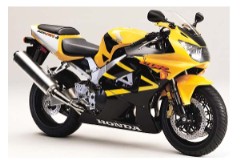
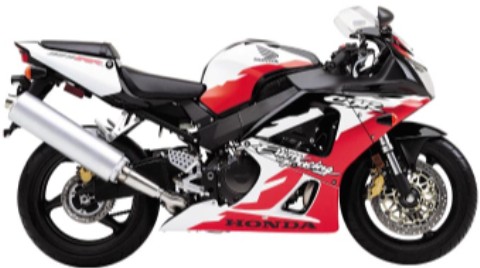
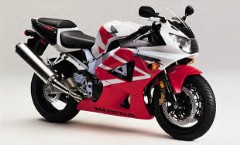
speed is just another way to say CBR 929 RR



About Us

Picture of the month will be posted here |





BEST PRICES

Trick Products