
| ||||||||||||||
| ||||||||||||||
|
| ||||||||||||||
Shree Amarnath Yatra
The Pilgrimage to Amarnath JI Cave via Pahalgam
 One
of the holy trinity, Shiva is a living god. The most sacred and most ancient
book of India, "The Rig Veda" evokes his presence in its hymns. Vedic Myths,
ritual and even astronomy testify to his existence from the dawn of time. But
Shiva, the destroyer, the mendicant, is indefinable. He is the great yogi, the
guardian of the absolute. His actions are the teems of the myths in which his
nature unfolds.
One
of the holy trinity, Shiva is a living god. The most sacred and most ancient
book of India, "The Rig Veda" evokes his presence in its hymns. Vedic Myths,
ritual and even astronomy testify to his existence from the dawn of time. But
Shiva, the destroyer, the mendicant, is indefinable. He is the great yogi, the
guardian of the absolute. His actions are the teems of the myths in which his
nature unfolds.
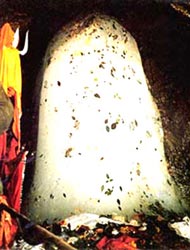
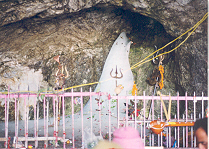
Legend has it that Shiva recounted to Parvati the secret of creation in a cave in Amaranth. Unknown to them, a pair of mating doves eavesdropped on this conversation and having learned the secret, are reborn again and again, and have made the cave their eternal abode. Many pilgrims report seeing the doves - pair when they trek the arduous route to pay obeisance before the ice-lingam (the phallic symbol of Shiva).
 The
trek to Amaranth, in the month of Sharavan (July - August) has the devote
flock to this incredible shrine, where the image of Shiva, in the form of a
lingam, is formed naturally of an ice-stalagmite, and which waxes and wanes with
the moon. By its side are, fascinatingly, two more ice -lingams, that of Parvati,
and their son, Ganesha.
The
trek to Amaranth, in the month of Sharavan (July - August) has the devote
flock to this incredible shrine, where the image of Shiva, in the form of a
lingam, is formed naturally of an ice-stalagmite, and which waxes and wanes with
the moon. By its side are, fascinatingly, two more ice -lingams, that of Parvati,
and their son, Ganesha.
 According
to an ancient tale, there was once a Muslim shepherd named Buta Malik who was
given a sack of coal by a Sadhu. Upon reaching home he discovered that the sack
in fact, contained gold. Overjoyed and overcome, Buta Malik rushed back to look
for the Sadhu and thank him, but on the spot of their meeting discovered a cave
and eventually this became a place of pilgrimage for all believers. Till date a
percentage of the donations made by pilgrims are given to the descendants of
Malik and the remaining to the trust, which manages the shrine.
According
to an ancient tale, there was once a Muslim shepherd named Buta Malik who was
given a sack of coal by a Sadhu. Upon reaching home he discovered that the sack
in fact, contained gold. Overjoyed and overcome, Buta Malik rushed back to look
for the Sadhu and thank him, but on the spot of their meeting discovered a cave
and eventually this became a place of pilgrimage for all believers. Till date a
percentage of the donations made by pilgrims are given to the descendants of
Malik and the remaining to the trust, which manages the shrine.
Yet another legend has it that when Kashyap Reshi drained the Kashmir Valley of water (it was believed to have been a vast lake), the cave and the lingam were discovered by Bregish Reshi who was traveling the Himalayas. When people heard of the lingam, Amaranth for them became Shiva's abode and a center of pilgrimage.
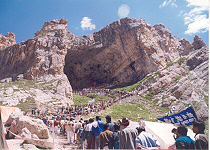
 Situated
in a narrow gorge at the farther end of Lidder valley, Amaranth stands at 3,888
m and is 46 km from Pahalgam and 141 km from Srinagar. Though the original
pilgrimages subscribes that the Yatra be undertaken from Srinagar, the more
common practice is to begin journey at Chandanwari, and cover the distance to
Amaranth and back in five days. Pahalgam is 96 km. Srinagar.
Situated
in a narrow gorge at the farther end of Lidder valley, Amaranth stands at 3,888
m and is 46 km from Pahalgam and 141 km from Srinagar. Though the original
pilgrimages subscribes that the Yatra be undertaken from Srinagar, the more
common practice is to begin journey at Chandanwari, and cover the distance to
Amaranth and back in five days. Pahalgam is 96 km. Srinagar.
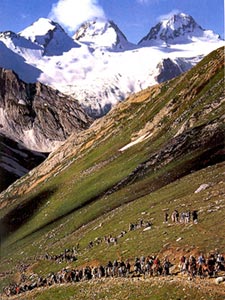
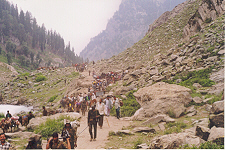 The
trek from Chandanwari to Amaranth cave is on an ancient peregrine route. The
30-km distance is covered in two days, with night halts at Sheshnag (Wawjan) and
Panchtarni. The distance from Pahalgam to Chandanwari (16kms) now be covered by
vehicular transport, and the trail runs along the Lidder river. Pilgrims camp at
Pahalgam or Chandanwari on the first night out.
The
trek from Chandanwari to Amaranth cave is on an ancient peregrine route. The
30-km distance is covered in two days, with night halts at Sheshnag (Wawjan) and
Panchtarni. The distance from Pahalgam to Chandanwari (16kms) now be covered by
vehicular transport, and the trail runs along the Lidder river. Pilgrims camp at
Pahalgam or Chandanwari on the first night out.
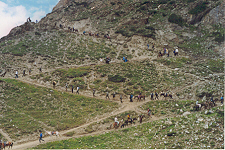 The
first day's trek of 12 Km, from Chandanwari is through spectacular, primeval
countryside, and the main center of attraction is Sheshnag, a mountain that
derives its name from its seven peaks, resembling the heads of a mythical snake.
The journey to Sheshnag follows steep inclines up the right bank of a cascading
stream and wild scenery untouched by civilization. The second night's camp at
Sheshnag (Wawjan) overlooks the deep blue waters of Sheshnag Lake, and glaciers
beyond it. There are legends of love and revenge too associated with Sheshnag,
and at the camp these are recounted by campfires, to the stillness of pine
scented, Himalayan night.
The
first day's trek of 12 Km, from Chandanwari is through spectacular, primeval
countryside, and the main center of attraction is Sheshnag, a mountain that
derives its name from its seven peaks, resembling the heads of a mythical snake.
The journey to Sheshnag follows steep inclines up the right bank of a cascading
stream and wild scenery untouched by civilization. The second night's camp at
Sheshnag (Wawjan) overlooks the deep blue waters of Sheshnag Lake, and glaciers
beyond it. There are legends of love and revenge too associated with Sheshnag,
and at the camp these are recounted by campfires, to the stillness of pine
scented, Himalayan night.
The Second day's 12 km trek steadily gains height winding up across Mahagunus Pass at 4,600 m and then descending to the meadow -lands of Panchtarni, the last camp enroute to the holy cave.
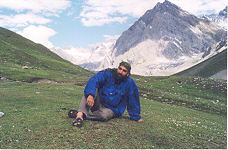 From
Panchtarni to Amaranth is only 6 km. But an early mornings start is recommended
for there is a long queue awaiting entry to the cave. The same day following
Darshan, devotees return to Panchtarni in time for Lunch, and continue to
Sheshnag to spend the third night out. They can also spend the night at
Panchtarni itself returning to Chandanwari / Pahalgam like the onward journey.
Entrance to the cave is regulated, and Darshan a hasty affair for there are many
others waiting outside to pay homage before the awesome Shivalinga. The devotees
sing bhajans, chant incantations, and priests perform aarti and puja, invoking
the blessings of Lord Shiva, the divine, the pure, the absolute. For those who
journey with faith, it is a rewarding experience, this simple visitation to the
cave-shrine, the home of the Himalayan mendicant who is both destroyer and
healer, the greatest of the Hindu Gods.
From
Panchtarni to Amaranth is only 6 km. But an early mornings start is recommended
for there is a long queue awaiting entry to the cave. The same day following
Darshan, devotees return to Panchtarni in time for Lunch, and continue to
Sheshnag to spend the third night out. They can also spend the night at
Panchtarni itself returning to Chandanwari / Pahalgam like the onward journey.
Entrance to the cave is regulated, and Darshan a hasty affair for there are many
others waiting outside to pay homage before the awesome Shivalinga. The devotees
sing bhajans, chant incantations, and priests perform aarti and puja, invoking
the blessings of Lord Shiva, the divine, the pure, the absolute. For those who
journey with faith, it is a rewarding experience, this simple visitation to the
cave-shrine, the home of the Himalayan mendicant who is both destroyer and
healer, the greatest of the Hindu Gods.
The Pilgrimage to Amarnath Ji Cave via Sonamarg-Baltal
The Second approach to the Amarnath Cave is from Sonamarg via Baltal. Sonamarg (3000 meters) is situated on the Srinagar - Leh highway 85 Kms North - East of Srinagar. About 15 Kms. further ahead lies the base camp, BALTAL, which is a little charming valley lying in the foothills of Zojila Pass. The Holy Cave of Amarnath Ji is just a days journey away from here. At Baltal, free langer facilities are provided by vouluntary organisations for Yatris. The traiil from Baltal to the Holy Cave lies along very steep hill sides and, therefore, great care needs to be taken whilesome tented tea stalls are established at "Bararimarg" and "Sangam Top". Several snow bridges on the fast flowing streams have to be crossed over, while during the Holy Cave is quite near, the trail from Pahalgam meets the Baltal route. At Baltal, riding / pack ponies, dandies, porters etc. are available on approved rates from the J&K Tourism, Government of Jammu and Kashmir.
| Home | Company Profile | Chairman's Letter | Jammu Page | Transport Tariff | Contact Us | E - Mail |
| Srinagar | Pahalgam | Gulmarg | Sonamarg | Amarnath Yatra | Ladakh | Accommodation Tariff|
You are Visitor #

Web Site Developed and maintained
by :
N I T S.
For Web Site related queries and
feedback please contact: N I TS
Srinagar.
Copyright © 2000 - 2003 Shah Travels Pvt. Ltd.
