ALGAE  

The algae are an ancient group of aquatic plants. Some taxonomists consider the algae to be Protoctists but this approach will not be followed here. There are thought to be about 23,000 species of algae. 

ALGAL CLASSIFICATION

Algae are largely classified on the basis of:-

  • colour (photosynthetic pigments)
  • storage material
  • flagella
  • cell wall

The algae are a very heterogeneous grouping. Traditional taxonomists have considered each group (greens, reds etc) a division which means that while all algae share the feature of being simple plants, "reds" are as distinct from "browns" as ferns are compared to flowering plants! One fundamental difference between algal groups is the structure of the chloroplast. Green and red algae have simple plastids with 2 outermost membranes while the other algal groups have complex plastids with 3 or more bounding membranes. 
There are 3 features which distinguish the algae from other plants;- 
¡@ Body plan:  There is no specialisation of the algal body into root, stem, leaves with vascular tissue. The photosynthetic portion of the alga is a thallus while the attachment portion comprises hair-like rhizoids. For this reason, old classification systems put the algae into a grouping known as the Thallophytes. 
 
¡@ No Embryo: For most algae, sperm and eggs fuse in the open water and the zygote develops into a new plant without any protection. For other plant groups the zygote develops into an embryo within the protection of the parent plant. For this reason, old classification systems termed all other plant groups Embryophytes. 
 
¡@ Reproductive structures: The gametes are produced within a single cell. There is no jacket of sterile cells protecting the gametes. 

Being aquatic, algae are

  • freshwater
  • terrestrial
  • marine

Terrestrial algae are effectively surviving in an aquatic environment on land. Soil algae survive in a film of soil water.
The other major group of terrestrial algae are those in lichen symbioses.  

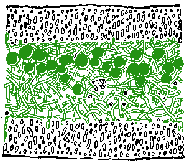
Lichens comprise algae and fungi in partnership. The fungus provides an outer weft of mycelia which creates a humid protected environment for the alga to live and photosynthesise (and feed the fungus!). Fungal layer 
 

Algal layer  
 

Fungal Layer 
 

Interestingly, lichens have distinctive morphologies and so these associations have traditionally been given genus & species names as if they were discrete organisms.¡@

As terrestrial plants the algae have a unique role as pioneer plants. They grow on bare rock, providing there is moisture. The rock weathers and crumbles. The algae die. The mineral contribution of the rock and the organic remains of the algae lead to formation of soil. This pioneering activity therefore paves the way for more demanding plants to invade. A succession such as this is precisely what would have occurred when the islands of the Caribbean first emerged from the sea. 

Within the aquatic environment, there are two broad niches;- 

planktonic - floating algae. 
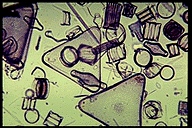
For micro-algae these often have strange shapes which help keep the algae 
suspended as well as serve an anti-predation role. 

benthic - attached algae. 
These are algae anchored to the substratum 


     A suspension of diatoms


Index    about    Animal Kingdom    birds    mammals    Amphibians   reptiles    fish    

Plant Kingdom    monocotyledons    dicotyledons   Gymnosperms    Ferns   Algae    Fungi    

    gaseous exchange    breathing system    Respiration Experiment ( ©I§l§@¥Î¹êÅç )   Smoking and your health    

Sign Guestbook    View Guestbook

Copyright (c)  2001 (http://www.geocities.com/hkbiology). All Rights Reserved

Hosted by www.Geocities.ws

1