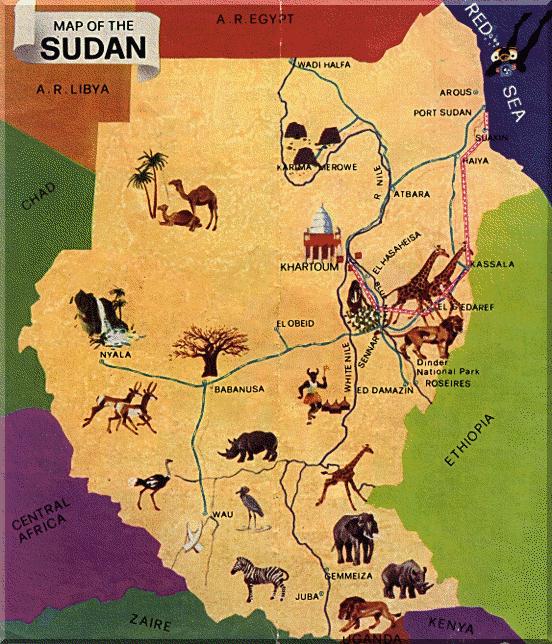
Sudan Tour Map
| When to visit | Cities To visit | Visas & permits | |
| DO and Don't DO | Roads & Railways | Sudanese food & Drink |
Visas & permits
Entry visas are required by all nationalities, and are valid for one month.
Evidence of a previous visit to Israel will result in a visa refusal.
Permits are required by visitors wishing to travel anywhere outside Khartoum, and can be difficult to obtain. Visitors arriving in any town or city in the Sudan must register with the police on their arrival, and show the necessary paperwork.
For those wishing to visit archaeological and/or historical sites, permits are again required. These are often fairly expensive, and can be obtained from the Department of Antiquities in Khartoum.
The Tourist Information Office in Khartoum will issue visitors with a photography permit. This is essential for anyone wishing to take photographs anywhere in the country, and is issued together with a list of items which may not be photographed. Having said this, it is probably better not to try and take photographs at all here, as permits are often ignored by those in authority, and cameras and film can be confiscated.
Do And Don't Do
Do try to see a Nubian wrestling match if the opportunity arises...Don’t try to carry any alcohol into Sudan. Those found with it are immediately arrested and subject to stringent penalties...Do follow all currency regulations: Declare all currency and other valuables in your possession upon arrival. Exchange currency only at official offices or banks, and keep all receipts. Don’t even think of changing money on the black market—penalties include death. Immediately report to the authorities if valuables or hard currency are stolen, so that your papers will still tally upon departure...Do keep in mind that all airlines and some hotels require bank receipts before accepting payment...Do take at least two extra passport-size photos if you plan to apply for a permit to travel outside Khartoum. There are frequent roadblock checks...Do take camping gear if you plan to camp, but don’t bother with a tent (they’re rarely used). A cot is recommended because the ground is often hard and thorny...Do be prepared for a variety of smells, not all of them pleasant. Garbage is routinely dumped in empty lots, and it’s not long before the heat speeds decomposition. Also be prepared for plenty of flies and mosquitoes...Don’t wear shorts (men and women) or dresses that could be considered immodest (bare shoulders, hem above the knee)...Do take a handkerchief or bandanna to cover your face should you get caught in a sandstorm...Do get a (free) permit upon arrival if you plan to take photographs. Don’t ever take pictures of military installations or personnel, bridges or transportation-related facilities. And always ask permission before photographing residents...Do be prepared to pull heskanit thorns out of your clothing and skin if you walk in the western desert area...Do take some time to learn a little about the local tribes, among them the Kababish (camel herders), the Jaalin and Shaigiyya (settled tribes living along rivers), the semi nomadic Baggara of Kordofan and Darfur, the Hamitic Beja in the Red Sea area, the Nubians of the northern Nile area, the Nuba of southern Kordofan, the Dinka in southern Sudan and the Fur in the western part of the country...Do expect a service charge to be added to your bill at the few finer restaurants
Khartoum and places to north are in a desert climate. The best time to visit, December-January, has an average high of 94 F/34 C (many days are hotter, of course). The second-best times are November and February-April, when days average around 95 F/35 C and nights are a pleasant 70 F/21 C. The rest of the year, it will hit at least 100 F/38 C every day. May-June is the worst, with daily temperatures reaching 120 F/49 C, often accompanied by dust storms (haboobs). The haboobs continue into September, and heavy rainstorms may also blow through July-September. Humidity is generally low, and nights are always cooler than days (take a sweater for evenings), though farther south, temperatures are a bit lower and humidity is higher.