The Chief Dispatcher has the responceablity to make the railroad accually move the cars. During the 1950s, the SP and Santa Fe used a system of freight symbols to keep shipments organized and flowing. The Chief Dispatcher had options of exactly how the cars were combined into trains. He could combine under-tonnage symbols and split over-tonnage symbols to move the tonnage over his division. If there was a number of local cars to a destination the Chief Dispatcher could issue orders to a through train to Pickup (P/U) or setout (S/O) the cars as long as the symbol doing the work did not have "hot" cars in the train.
An example of this is; a symbol with a loaded reefer block is not going to be delayed to P/U or S/O cement cars. A drag or low priority merchadise symbol may be instructed to may special moves.
One of the few exceptions to this is the ATSF's APE, BK, 49, and 59 symbols. These symbols moved high priority automobiles, auto parts, and loaded reefer cars and were not to be delayed for any reason. However SP's auto and auto part connection to the Bay Area was made at Bakersfield. Any eastward "hot" SP cars were transfered to the ATSF as soon as possible and the ATSF would send the cars east on a "hot reefer" BK symbol or form a APE symbol just for those cars. Likewise when the ATSF dropped off any Auto/auto parts cars for the SP, the SP would call a Altamont West (AW) and keep the cars moving to Oakland.
In a more general application of car movement, a block of cars at Bakersfield SP yard maybe for a destination beyond the end of the SP... basicly a SSE block. If the SSE symbol is hot or at capacity these cars could be combined with a VXE to LA were the cars would be sorted and sent with other SSE cars to the final destination. Likewise, cars heading for the Jawbone branch at Mojave or the Cement plant at Monolith could be put into a freight from LA and setout at Mojave for the various locals to haul to finial destinations.
Infomation gleened to compile this page comes from photo analysis, surviving train sheets, and historic documents. The research given on this page exists thanks to many hours spent by many people during years of research, both in La Mesa Club, SP Historical and Techincal Society, Santa Fe Historical and Techincal Society, and other indepentent researching. Credit where credit is due.
SP symbol originates from Roseville, Fresno, or Bakersfield to LA and points short or El Paso. Change to heavy engines at Bakersfield and add helpers. Pickup cut or originates at Bakersfield. Symbol for perishable reefer traffic moving east. May fill to tonnage with loaded or empty cars moving to LA and points short of El Paso.
SP symbol originates from LA and Terminates at Roseville. Change to “Valley” power at Bakersfield. Pickup cut or originates at Bakersfield with Roseville, Northern California, and Overland Route traffic. Symbol protects perishables, merchandise, and empties.
SP symbol originates from LA. Merchandise with perishables, merchandise, and some automobile cars. No work Bakersfield. Change to “Valley” power at Bakersfield. Terminate at Portland, OR, via Roseville.
SP symbol originates from LA. Merchandise with perishables, merchandise, and some automobile cars. No work Bakersfield. Change to “Valley” power at Bakersfield. Terminate at Portland, OR, via Roseville. Symbol moves earlier than schedule of NCP with earlier connecting symbol traffic. Symbol also protects westward “Banana Trains” from the Gulf Coast and Florida.
Combines VXE symbol reefers at Mojave to become long BK-OK-R and occastonally a ~20 car Adv-NCP banana train
SP symbol from Portland, OR, via Roseville, to LA. Change to heavy engines at Bakersfield and add helpers. No work at Bakersfield. Merchandise, light on perishable reefers and automobile cars. Train Originates at.
SP symbol originates from Roseville. Terminates at Bakersfield. Empties and eastward cars from roseville to points short of LA. Symbol used to move empty cars from Roseville yard to local destinations around Fresno and Bakersfield . May fill with cars from SSE or VXE.
SP symbol originates from Roseville. Change to heavy engines at Bakersfield and add helpers. May pickup cut at Bakersfield filling to tonnage with cars east of El Paso. Symbol runs to Tucumcari, interchanges with Rock Island and NKP, and to points east of El Paso.
SP symbol originates from LA. Terminates at Roseville. Empties and westward cars from LA to points short of Roseville. Change to “Valley” power at Bakersfield. Large setout for Bakersfield and Fresno. Symbol used to move empty cars from Taylor yard, LA, to local destinations around Bakersfield and Fresno. Symbol terminates at Roseville.
SP symbol originates from LA or El Paso. Terminates at Eugene, OR.
Lumber empties added to symbol
returning to Lumber mills in Eugene, OR and points north.
May run over 100 cars over Tehachapi Subdivision, may be split
for movement over Bakersfield Subdivision. Change to “Valley”
power at Bakersfield.
SP symbol originates from Eugene, OR. Symbol moves earlier than schedule of PSS with earlier connecting symbol traffic. Heavy lumber drag symbol. Change to heavy engines at Bakersfield and add helpers. May run up to 64 cars eastward over Tehachapi Subdivision. Terminates at El Paso and lumber cars forwarded to interchanges to east and north.
SP symbol originates from Eugene, OR. Heavy lumber drag symbol. Change to heavy engines at Bakersfield and add helpers. May run up to 64 cars eastward over Tehachapi Subdivision. Terminates at El Paso and lumber cars forwarded to interchanges to east and north.
SP symbol originates from Eugene, OR. Symbol moves later than schedule of PSS with late connecting symbol traffic. Heavy lumber drag symbol. Change to heavy engines at Bakersfield and add helpers. May run up to 64 cars eastward over Tehachapi Subdivision. Terminates at El Paso and lumber cars forwarded to interchanges to east and north.
SP symbol originates from Tracy and SF Bay Area. Symbol terminates at Bakersfield. Mostly autoparts/automobile cars, empty cement cars to Monolith, and empty ore cars to “Jawbone” Branch and Trona Railway.
SP symbol originates from Bakersfield. Symbol terminates at Tracy and SF Bay Area. Mostly autoparts/automobile cars, loaded cement cars to Monolith, and loaded ore cars to “Jawbone” Branch and Trona Railway.
ATSF local to Hanford with empty, iced reefers and return with perishable loaded reefers to forward on BK symbol east.
ATSF local to Porterville with empty, iced reefers and return with perishable loaded reefers to forward on BK symbol east.
Arvin “out and back” symbol connecting with Road Switcher assigned to Arvin. ATSF local to Arvin with empty, iced reefers, making connection with Arvin Road Switcher, and return with perishable loaded reefers to forward on BK symbol east. May handle light merchadise traffic to Arvin. Usually 20-25 cars.
ATSF roadswitcher to Arvin may move 20-30 empty, iced reefers. Symbol stays on duty for several shifts or “tricks” before returning to Bakersfield. May return with 20-30 perishable loaded reefers to forward on BK symbol east. May also handle light merchadise traffic to Arvin.
ATSF symbol freight Stockton to Bakersfield. Catch-all symbol of perishables, merchandise, or automobile cars.
ATSF drag symbol of empty, primarily SFRD reefers. Setout 30-50 reefers at Bakersfield for local perishable loading. Empty cars returning to Bakersfield distribute to Stockton, Handford, Porterville and Arvin. May run over 120 cars on Tehachapi Sub.
ATSF manifest symbol from Richmond, CA to Kansas City and Chicago. Heavy with auto parts cars from Bay Area. May carry merchandice from Richmond. Connects with SP symbol AE auto parts traffic at Bakersfield. Change to heavy engines at Bakersfield and add helpers. Tonnage limit 56 cars on Tehachapi Sub.
ATSF manifest symbol west to Richmond. Heavy with auto and auto parts traffic west to Richmond. SF59 has connection with SP symbol AW at Bakersfield. Change to “Valley” power at Bakersfield.
ATSF manifest from Belen, TX, and Gulf Coast. Symbol heavy with oil and petrolium products, stock cars, merchandise, and freight forwarder movements to Stockton/Richmond. Change to “Valley” power at Bakersfield.
ATSF local symbol from Bakersfield to Barstow. Heavy with ATSF empties for Monolith, Mojave, Boron, Barstow, and Saltus. Symbol recieves connection from ATSF symbol SCX at Bakersfield.
ATSF manifest symbol from San Diego, LA, and San Banardino to Richmond, CA. Connects with BAW traffic at Bakersfield. Change to “Valley” power at Bakersfield.
ATSF manifest symbol from Richmond, CA to San Diego, LA, and San Banardino. Connects with N-34 traffic at Bakersfield. Change to heavy engines at Bakersfield and add helpers.
ATSF local symbol from Barstow to Bakersfield. Heavy with ATSF loads from Monolith, Mojave, Boron, Barstow, and Saltus. Symbol has connection from ATSF symbol NCX at Bakersfield.
ATSF manifest symbol west to Richmond. Symbol originates from Kansas City. Change to “Valley” power at Bakersfield.
ATSF symbol freight Stockton to Bakersfield. Catch-all symbol of perishables, merchandise, or automobile cars.
ATSF perishables/manifest symbol from Richmond, CA to Kansas City. Combined symbol of BK and APE, protecting perishable and auto part traffic from WGFX. May connect with SP symbol AE auto parts traffic at Bakersfield. Change to heavy engines at Bakersfield and add helpers. Tonnage limit 56 cars on Tehachapi Sub.
ATSF mercahdise northbound transfering cars from the ATSF to the WP then to the GN. May be combined of filled at Bakersfield.
ATSF mercahdise southbound train transfering cars from the GN to the WP then to the ATSF. May be combined of filled at Bakersfield.
SP symbol originates from Bakersfield. Symbol protects all company material moves and local traffic Bakersfield between and Mojave eastward. The Chief Dispatcher has the option to send Mojave (Monolith and "Jawbone") cars to Bakersfield on the MLE, if the number of cars does not exceed the rating of the assigned power.
Power for the MLE is one to three RSD-5s, normaly two.
SP symbol originates from Mojave. Symbol protects all company material moves and local traffic between Mojave and Bakersfield westward. The Chief Dispatcher has the option to send Mojave (Monolith and "Jawbone") cars to Bakersfield on the MLW, if the number of cars does not exceed the rating of the assigned power.
Power for the MLW is one to three RSD-5s, normaly two.
SP symbol originates from Bakersfield runs to Mojave and returns to Bakersfield. This job normaly replaces the Mountain Local if there is not much work to be done between Bakersfield and Mojave.
Normal power is one or two RSD-5s.
A special "Cement Extra" maybe called by the Chief Dispatcher if a large number of cement and "Jawbone" cars accumulate and need to be moved. A special Valley Extra East symbol called when number of cement empties moving to Monolith exceeds normal Mojave Turn or Mountain Local East symbols tonnage capacity.
These optional trains usually run as a VXE east to Mojave or a VXW west to Bakersfield. Cement train is not a very high priority symbol and often will draw whatever power is avalible, "mallets", RSD-5s, F-units, "decks".
Cement and "Jawbone" blocks of cars may also be moved on slower VXE drags and TMW/VXW drags if room to fill exists and the train can afford the time to S/O or P/U in Mojave. The through train may also make P/U and S/Os to and from LA at Mojave as instructed by the Chief Dispatcher.
SP wayfreight symbol originates from Mojave, may work as far as Caliente and returns to Mojave. Symbol does work primarily at Monolith Portland Cement Plant and local traffic at Tehachapi.
Ussual power is one MK class engine for road power and a C class engine as a helper to Summit if needed. “KI” is the telegraph code for Tehachapi.
SP wayfreight symbol that works during sugar beet harvesting season to s/o and p/u “beet racks” along a Division or SubDivision. “Beet Hauler” on the Bakersfield Sub will run either direction on the "Main Valley Line" to Fresno or on the "Westside Line" towards Tracy and P/U loads and or S/O empties at beet dumps at any beet dump on either of the two San Joaquin Valley lines.
SP or ATSF local that works from Bakersfield out the Sunset Railway to Taft (or Buttonwillow) and back.
SP switcher that works on the Oil City Branch. Branch is in Yard Limits of Bakersfield. May men said that this was the prefered job out of all the locals working out of Bakersfield.
SP switcher that works Edison packing houses and winery, within Yard Limits of Bakersfield.
SP switcher that works the east end of the SP Bakersfield Yard. “Mt. Vernon” switcher preforms triming, P/U, and S/Os from the through trains, also some classification as required by the Bakersfield Yardmaster. Ussually assigned S-2, AS-616, FM switcher, C, or MK type engine.
The “Haley St.” switcher preforms misc. work at the west end of the SP Yard near the enginehouse, classifing cars from the west end of the yard. Ussually assigned a light switcher of S-1, SW-1, SW-8, S, M or C type engine.
The Haley St. job also handled the cabooses. Moving them from the caboose ready tracks on the south side of the mainline to the trains as required, and returning cabooses to these tracks to be cleaned and serviced for their next assignment. It should be noted that in the mid-1950's two caboose stubs were layed on the westend between the scale track and the icedeck.
SP switcher that works the industries from steel and lumber yards at Kern Junction, west to Baker Sreet and the freight house west of the SP Bakersfield Yard. “City” switcher preforms passenger switching work at the station. Ussually assigned a light switcher of S-1, SW-1, SW-8, or S class 0-6-0 engine.
If required other jobs could be assigned to Bakersfield Yard.
A "Rip Track" job could be called to work the car repair shed and the converted "Mallet Shed" as damaged cars were taken in for repairs, moved for the next step of repairs or ready for service cars sent back to the yard.
A extra job could be called to work as a westend trim engine, assisting the "Haley St." and "City" jobs in assembling trains and moving cabooses.
SP road switcher that runs 143 miles from Mojave to Owenyo one day on the “Jawbone” branch, returns the next day.
SP road switcher symbol on the “Jawbone” branch to Searles Station to interchange with the Trona Railway to Searles dry lake. Usually runs about 40 cars with 4000/4100/4200 mallet and a 3200 class helper if needed. Returns to Mojave on the same day.
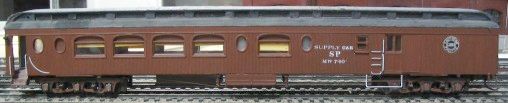
SP's Supply trains run continually over the entire system every 90 days. Moving about 100 miles per day and overnighting at division points to restock. The supply train that worked over Tehachapi was the LA based train, there was also one based out of Sacramento. Arriving at Bakersfield in the evening, restocking at the division store house, and the continuing the next day. Locals would do most of the supply and work needs on the branchlines.
Photo of Sacramento Supply train combine/caboose SPMW740
Up coming La Mesa Club Operation Sessions. New page for Guests and Club members on upcoming 1950s era Operating Sessions, including Timetables, Track Charts, and Lineups of trains to be run.
Operation Session Backeound. What goes into an Operation Session.
Examples of the documents used in Operation Sessions.