
Written by Jerry Stanley
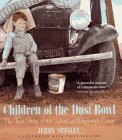
Life was hard for many during the Great Depression of the 1930s, but it was harder for those that were dealt a second blow by the drought of the Dust Bowl, and perhaps hardest of all for the children of the poor dirt farmers of Oklahoma, Texas, Arkansas, and Missouri, who were forced to leave their homes and all that they knew and relocate to California where they had hopes of finding a means to support their families. Jerry Stanley, in his first book, Children of the Dust Bowl: The True Story of the School at Weedpatch Camp, winner of the 1993 Orbis Pictus Award, accurately recreates for readers the plight of these "Okies" through a narrative that begins with their exodus from the drought stricken Plains and ends with their achieving some level of acceptance from the Californians due to the efforts of Leo Hart, the superintendent of education for Kern County, California.
Stanley immediately captures readers' attention in the introduction where he uses the reaction of the people of California to John Steinbeck's The Grapes of Wrath to illustrate their contempt for the Okies and all who sympathized with them. After establishing interest, he takes readers chronologically through the perils of the westward flight from the Dust Bowl to the disappointment encountered when the Okies discovered that California was not the nirvana that they imagined. Stanley then establishes the impetus for the story, Leo Hart, who, by making it possible for the residents of Weedpatch Camp, near Arvin, California, to build a school where their children would not be taunted by those who viewed them as their inferiors, succeeded in creating a sense of worth and purpose, not only in the students of Weedpatch School, but in their parents as well, as the school thrived and eventually became known as one of the best schools in Kern County. "Leo recalled, 'The community that had threatened to drive the migrants out, and who resented their presence, came to accept them as part of the community when they saw what had been accomplished'" (Stanley 1992, p. 71).
Utilizing simple, declarative sentences and a clear, straightforward narrative style, Stanley recounts the stories of the Okies using many first-person accounts derived from thorough research of the period, including the works of reporter and author, John Steinbeck, first-person accounts that were recorded in 1989 by many newspapers, periodicals, and journals during the fiftieth anniversary of The Grapes of Wrath, and from personal interviews with Leo Hart. Stanley's masterful use of the words of those who actually lived through this trying period lends immediacy to the text and instills in readers a sense of actually being there, without relying on sentimentality or drawing conclusions for his young readers.
Stanley's extensive use of photographs from the period complements the text, providing readers with visual references for people and places, reinforcing the words of Leo Hart who said of the children, "they were 'ordinary kids' with the same hopes and dreams the rest of us have" (Stanley 1992, p. 41). His inclusion of maps clearly establishes locales and reinforces geographic knowledge for both students and adults. A table of contents and thorough index facilitate finding specific information. An "afterword" completes the story of Leo Hart and his wife, Edna, for those who are curious about his life after Weedpatch. In his "Bibliographic Note and Picture Credits" Stanley generously shares the resources that he used in writing the book, giving readers insight into his research process. Liberal use of white space and an easy to read serif style font, further enhance the book's accessibility. School Library Journal says that Children of the Dust Bowl is "An informative and inspirational bit of American history" (Adams 1992).
Children of the Dust Bowl is an excellent read-aloud for older students studying the effects of the Great Depression. Pair it with Karen Hesse's Newbery Award winning Out of the Dust to give students additional information of the effect that the prolonged drought had on Dust Bowl residents.
Adams, Joyce. 1992. Review of Children of the Dust Bowl. School Library Journal. http://reviews.schoollibraryjournal.com/bd.aspx?isbn=0517587815&pub=sl (accessed February 27, 2005).
Hesse, Karen. 1997. Out of the dust. New York: Scholastic Press. ISBN 0-590-36080-9.
Stanley, Jerry. 1992. Children of the dust bowl: the true story of the school at Weedpatch Camp. New York: Crown Publishers. ISBN 0-517-58781-5.
By Laurence Pringle, Photos by Bob Marstall
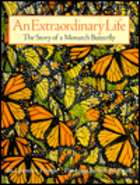
Laurence Pringle's 1997 Orbis Pictus Award-winning book, An Extraordinary Life: The Story of a Monarch Butterfly, is proof that nonfiction writing does not have to be merely a collection of facts bereft of emotion, but can be an engrossing story that simultaneously relates a wealth of factual information. As its name implies, Pringle's account of the life-cycle of a monarch butterfly goes beyond the ordinary, achieving the status of the extraordinary. Pringle adroitly captures readers' attention by stimulating their emotional involvement with a young caterpillar named Danaus. That he manages to accomplish this feat without resorting to anthropomorphism proves the genius of his writing. Having just told readers that the insect sounds of a Massachusetts hayfield masked the other sounds of the night, especially the tiny sound of a monarch butterfly who "lost her grip on a milkweed leaf and fell dead in the hay" (Pringle 1997, p. 11), he brilliantly gives readers a glimpse of the storyline - the life of an orphaned monarch butterfly. By drawing on human empathy for orphans, he creates an emotional link between readers and the orphaned monarch butterfly caterpillar, Danaus, which enables him to relate a plethora of factual information that is never dry or boring, but becomes real and vital to readers because of their emotional involvement with Danaus. "Rather than giving the usual survey of the habits, habitat, life cycle, and predators of butterflies, Pringle brings immediacy to his subject by focusing sharply on one monarch, whom he names Danaus" (Phelan 1997).
Following a chronological pattern, Pringle guides readers through Danaus' metamorphosis from egg to caterpillar, to adult butterfly, while also allowing them to experience her southern migration, a journey made by millions of monarchs each year as they follow the instinctive knowledge that is stored in their cerebral ganglion. "Danaus could not think or reason, but within her ganglion were stored bits of information that were vital for a monarch butterfly living in Massachusetts in the early autumn" (Pringle 1997, p. 26). With each stage of her life and migration, Pringle relates scientific information about monarch butterflies and their ability to make the daunting migration from northern parts of the United States to the interior of Mexico, a journey of more than three thousand miles.
Pringle incorporates his personal experiences with monarchs seamlessly into the text, adding details that further readers' interest in the life of Danaus. "Writing about the life of Danaus, I was happy to include a few of my own observations. My Siamese cat sometimes ambushed butterflies in the flower garden, and I had seen migrating monarchs dip down to investigate bright orange plastic cones at my kids' soccer practices" (Pringle in Zarnowski, et al 2001, p. 59).
Complementing Pringle's text are brilliantly colored, realistic paintings by Bob Marstall, some full page and others making use of the generous white space as captioned sidebars that highlight and reinforce the text by supplying additional information including maps of the migratory paths and the overwintering habitats of monarchs in Mexico. In the "Acknowledgements" that precede the text, Pringle outlines his research for this project which included consultations with experts from many respected universities and a journey to Mexico to observe monarchs in their winter habitat. Following the conclusion of the text, Pringle includes a section providing a detailed explanation on "How to Raise Monarch Butterflies," suggestions for further reading and an index for handy reference. A table of contents completes the access features.
Pringle states in an excerpt from Lessons Learned from a Butterfly that he took every effort to instill a sense of caring about Danaus while avoiding anthropomorphism, but one reviewer for School Library Journal found what she termed "a modicum of anthropomorphism" (Manning 1997) in An Extraordinary Life, but termed it "infrequent and low-key" (Manning 1997). While the book may have slight examples of anthropomorphism, they pale in comparison to the wealth of scientific information that is conveyed in an entertaining format, making the reading of the book more like that of a great suspense novel than a work of nonfiction.
An Extraordinary Life: The Story of a Monarch Butterfly should be included in all school libraries and utilized by teachers in the classroom for scientific information on the life of monarch butterflies that is "rich with connections to other life, history, geography, geology, etc" (Pringle in Zarnowski, et al 2001, p. 59).
Manning, Patricia. 1997. Review of An Extraordinary Life: The Story of a Monarch Butterfly. From School Library Journal. http://reviews.schoollibraryjournal.com/bd.aspx?isbn=0531300021&pub=sl (accessed April 28, 2005).
Phelan, Carolyn. 1997. Review of An Extraordinary Life: The Story of a Monarch Butterfly. From Booklist. Available at http://www.amazon.com/gp/product/product-description/0531300021/ref=dp_proddesc_0/104-2544126-1095920?%5Fencoding=UTF8&n=507846 (accessed April 28, 2005).
Pringle, Laurence. 1997. An extraordinary life: the story of a monarch butterfly. Illustrated by Bob Marstall. New York: Orchard Books. ISBN 0-531-33002-8.
Zarnowski, Myra, Richard M. Kerper, and Julie M. Jensen. 2001. The best in children's nonfiction: reading, writing, & teaching Orbis Pictus Award books. Urbana, IL: National Council of Teachers of English. ISBN 0-8141-0489-4.
Written by Dorothy Hinshaw Patent, Photographs by William Mu�oz
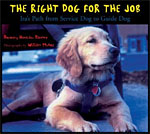
Dorothy Hinshaw Patent, author of over 100 nonfiction books for children, seeks to introduce younger readers to the often overlooked role that dogs play in aiding the handicapped in her latest book, The Right Dog for the Job: Ira's Path from Service Dog to Guide Dog. Following a golden retriever puppy, Ira, from his birth on Shy Bear Farm in Montana, through his training as a service dog to his eventual placement as a guide dog for visually handicapped Don Simmonson, Patent provides readers with an introduction to the training that dogs must undergo in order to serve. "The author keeps the focus tightly on this animal and the people around him, but manages to slip in an extraordinary amount of information about the raising and training of guide dogs" (MacMillan 2004).
Ira was originally bred as a service dog, a dog which helps "a person who has difficulty moving around on his own to lead a fuller life" (Patent 2004, unpaged), but was later trained as a guide dog for the visually handicapped when there was no demand for service dogs at the completion of his initial training. Patent focuses on the training that Ira receives, including his placement with his puppy raiser, Sandy Welch, a sixth-grade teacher. Young readers will be especially enthralled with Sandy's training of Ira which includes bringing him to her classroom two days a week where the students are allowed to play a role in his training. "When Sandy and the students work with Ira, they form a circle and bring Ira into the center. Then one of the children calls him. He knows he'll get a treat if he lays his head in the child's lap" (Patent 2004, unpaged).
Utilizing language and sentence structure that is readily accessible to young readers, Patent "brings life to the narrative through details-Ira learning to ride the bus, for example, and practicing the proper way to enter an elevator so that it won't close on his leash" (MacMillan 2004).
The Right Dog for the Job: Ira's Path from Service Dog to Guide Dog is beautifully illustrated with captioned photographs, sure to appeal to young dog lovers, tracing Ira's growth from shortly after birth to his graduation from the guide dog program of Guide Dogs for the Blind. While most of the photographs were made by William Mu�oz, a number of the photographs were shot by the author, providing readers with a detail of her personal involvement with Ira's growth and training. Further research into Dorothy Hinshaw Patent's background reveals that she lives in Montana where Ira was bred at Shy Bear Farm. The inclusion of an author's note on her relationship with Ira and those who train the dogs would have added depth and a personal touch to the book that it is lacking. Patent does include a listing of organizations that provide service and guide dogs plus a short bibliography for further reading on this interesting subject.
Patent's book is the "right book" for an introduction to working dogs for younger readers and should be considered for all libraries that serve children from ages six to ten.
MacMillan, Kathleen Kelly. 2004. Review of The Right Dog for the Job: Ira's Path from Service Dog to Guide Dog. From School Library Journal. Available at http://reviews.schoollibraryjournal.com/bd.aspx?isbn=0802789153&pub=sl (accessed May 1, 2005).
Patent, Dorothy Hinshaw. 2004. The right dog for the job: Ira's path from service dog to guide dog. Illustrated by William Mu�oz. New York: Walker & Company. ISBN 0-8027-8915-3.
911 Sartain Drive
Andrews, TX 79714
e-mail: [email protected]
Updated: May 1, 2005