
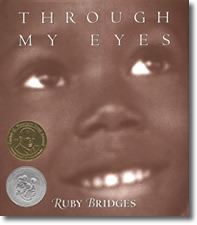

Ruby Bridges
Ruby Bridges was six years old when she was selected in 1960 to be one of the first black students to integrate the public schools in New Orleans, Louisiana. She states in her autobiographical account, Through My Eyes, "I don't remember everything about that school year, but there are events and feelings I will never forget" (Bridges 1999, p. 5). In a voice that rings true for a six-year old child who lived through the experience, she recalls what she terms "a serious racial crisis in the American South" (Bridges 1999, p. 5) allowing readers to relive the experience through her eyes.
Recalling her memories, Ruby Bridges chronologically takes readers back to the Deep South in 1960, where racial prejudice was the accepted practice and those who did not follow and adhere to the customs dictated by the ruling gentry were ostracized and worse. In addition to Ruby's own voice, readers are allowed to experience the ostracism of her Boston-born teacher, Barbara Henry, whose two page excerpt appears in the middle of the book. "Nobody at the school lifted a finger to make Ruby's life easier. The principal was a rigid, prejudiced woman who gave me no guidance or help. Ruby and I were both treated as unwelcome outsiders" (Bridges 1999, p. 43). Ruby and Mrs. Henry were given their own classroom where they developed a mutual respect and love for each other and Ruby blossomed as a student. Although most of the white students boycotted the school initially, many of them eventually came back, but they were not allowed in the classroom with Ruby. After Mrs. Henry threatened to go to the superintendent, a few white kids were finally allowed to come to Mrs. Henry's classroom so that Ruby would not have to go to the other classrooms with teachers who did not want to teach a black child. It was then that Ruby finally understood that all of the fuss was about the color of her skin when one of the other first graders told her, "I can't play with you. My mama said not to because you're a nigger"(Bridges 1999, p. 50).
Both Mrs. Henry's excerpt and the numerous other sidebars containing excerpts from news accounts, John Steinbeck's Travels with Charley, Robert Coles, the child psychiatrist who, with the help of the NAACP visited weekly with Ruby, and Dr. Martin Luther King, Jr., provide readers with additional perspectives on this period in history. These sidebars are highlighted with sepia-toned backgrounds that complement the numerous sepia-toned photos which appear throughout the book chronicling this period. "But Bridges' words, recalling a child's innocence and trust, are more vivid than even the best of the photos. Like poetry or prayer, they melt the heart" (Publishers Weekly 1999).
Since Through My Eyes is autobiographical, a bibliography is not included and access features are limited to an introduction by Harry Belafonte, a timeline of major events in the civil rights movement which immediately follows the text, and a section after this entitled "Let Me Bring You Up to Date" in which Ruby Bridges highlights her life since 1960, including her present work as a public speaker for the foundation that bears her name.
In an introduction written by civil rights activist Harry Belafonte, he says, "By this simple act of courage, Ruby moved the hearts and opened the minds of millions of people. Her story was and is an inspiration. You will find this book comforting, informative, and worthy of your attention" (Bridges 1999, p. 3). It should be included in the collections of all libraries, both as a chronicle of American history and an inspiration to all.
Bridges, Ruby. 1999. Through my eyes. New York: Scholastic Press. ISBN 0-590-18923-9.
Publishers Weekly. 1999. Review of Through My Eyes. http://www.amazon.com/gp/product/product-description/0590189239/ref=dp_proddesc_0/002-5008360-4716028?%5Fencoding=UTF8&n=507846 (accessed March 31, 2005).
Written by Robert Burleigh, Illustrated by Mike Wimmer
Readers will feel as if they are in the co-pilot's seat as they fly through the pages of Robert Burleigh's book, Flight: The Journey of Charles Lindbergh. In 1927, no one had ever flown alone across the Atlantic Ocean and it was a challenge that motivated twenty-five year old Charles Lindbergh to push his mind and body to their limits in achieving that goal. Using only two compasses and the stars to guide him, Lindbergh set out alone on May 20, 1927, to do what no other person had done. In the journal that he kept during the flight, he wrote, "Now I must cross not one, but two oceans: One of night and one of water" (Burleigh 1991, unpaged). With little room for error due to limited fuel supplies and having to force himself to stay awake for the entire thirty-three hours of the flight after having already been awake for more than twenty-fours hours before he departed, Lindbergh's will and determination allow him to achieve his goal, a non-stop, one person flight across the Atlantic Ocean from New York to Paris.
Burleigh's deceptively short sentences pack a powerful punch as they manage to capture the suspense, loneliness, doubt, and ultimate exhilaration that Lindbergh must have felt during his journey. Complementing and extending Burleigh's powerful text are Mike Wimmer's double-spread paintings: readers feel like they are sitting just behind Lindbergh in the close quarters of the cockpit, made even smaller by the addition of an extra fuel tank that blocked forward vision, and experience the ultimate thrill as they turn the page to glimpse the Eiffel Tower illuminated against the backdrop of the glowing lights of Paris. The text, superimposed over Wimmer's paintings, seems like an extension of each painting, never interfering with the aesthetics of the art, but giving it voice. "Even the awkward style here (a choppy, breathless tone is exacerbated by the relentless use of fragments and single- sentence paragraphs) conveys the excitement of Lindbergh's historic flight at the age of 25, but Wimmer's double-spread paintings steal the show: from the first glimpse of the aircraft through an arch formed by the pilot's determined-looking legs, they capture the feel of the cabin, the beauty of sea and sky, the drama of the nighttime arrival--all in impressionistic paintings peopled with realistic portraits, most notably of the weary hero appealingly sprawled in sleep on the last page" (Kirkus 1991).
Although the book is lacking access features, its authenticity is verified in a brief author's note that appears on the verso of the title page, crediting Lindbergh's own book, The Spirit of St. Louis, as the basis of the narrative. In the introduction, Jean Fritz, a respected author of children's nonfiction, recalls her thoughts when as a young girl living in Shanghai, China, her mother told her about Lindbergh's flight. "Her tone of voice said, 'This is history.' Of course, it was" (Burleigh 1991, unpaged).
With its outstanding illustrations, Flight: The Journey of Charles Lindbergh, is perfect for sharing with younger readers, but adults will also thrill as they enter the cockpit with Lindbergh on the flight. It is a must for every collection.
Burleigh, Robert. 1991. Flight: the journey of Charles Lindbergh. Illustrated by Mike Wimmer. New York: Philomet Books. ISBN 0399222723.
Kirkus Associates. 1991. Review of Flight: The Journey of Charles Lindbergh. http://www.amazon.com/exec/obidos/tg/detail/-/0399222723/qid=1112494506/sr=8-1/ref=pd_csp_1/002-5008360-4716028?v=glance&s=books&n=507846 (accessed April 2, 2005).
ALA Booklist Editor's Choice 2000
1986
Bruce McMillan
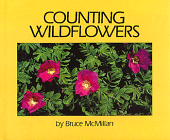
Bruce McMillan's stunning photographs of wildflowers in his counting/color concept book, Counting Wildflowers, beg to come alive under the eager fingers of young children mastering the art of counting. McMillan has chosen photographs of the wildflowers of Maine to introduce the concept of counting and color identification to young readers.
The book progresses numerically from one to twenty with each page showcasing a large photograph featuring centrally located wildflower(s) set against a backdrop of green foliage that is labeled with the name of the flower in the upper left-hand corner. The bottom of each page features either ten of twenty quarter inch circles, depending on the number, in green with the appropriate number of circles colored the primary color of the flowers depicted in the photograph. The corresponding Arabic numeral is printed in a large font on the lower left-hand side of the page and the number word is printed in all-caps in a slightly smaller font on the lower right-hand side of the page. The final two pages feature an application page showing three purple chicory flowers with the caption "How may?" (McMillan 1986, unpaged), and the last page is a field of maiden pinks with the caption "Too many to count!" (McMillan 1986, unpaged).
Additional features of Counting Wildflowers include a listing of the scientific names, blooming period, and common locations for each wildflower, and notes from the author/photographer, Bruce McMillan detailing where the flowers were photographed and notes on his photography.
Counting Wildflowers is a book that parents and educators as well as young children will delight in reading. The uncluttered pages, appealing photographs, and central theme of this book make it ideal for young readers by providing active participation and reinforcement of number concepts, colors, and flower names. "This carefully planned and executed counting concept book is rich in content, easily making it a book that can be returned to again and again" (Wood 1986).
McMillan, Bruce. 1986. Counting wildflowers. New York: Lothrop, Lee & Shepard Books. ISBN 0-688-02860-8.
Wood, Catherine. 1986. Review of Counting Wildflowers. School Library Journal online. http://reviews.schoollibraryjournal.com/bd.aspx?isbn=0688028594&pub=sl (accessed April 5, 2005).
Written and Illustrated by Aliki
"I hold the world, but as the world���A stage, where every man must play a part." (Shakespeare in The Merchant of Venice, I.1; Aliki 1999, p. 15)
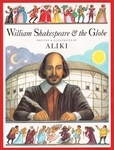
The world will be forever indebted to William Shakespeare for the part that he played in furthering drama as an art through the performance of the plays that he wrote and the impact that his writing has had on literature and language in the four hundred years since his death. Aliki's picture book biography of William Shakespeare and the Globe theatre is actually two separate but related stories in one, the life and times of Shakespeare and a tribute to Sam Wanamaker, an actor and director who fulfilled his lifelong dream of rebuilding a replica of Shakespeare's Globe theatre in London.
Following a chronological pattern, Aliki takes readers through the life of William Shakespeare, cautioning that little is known about Shakespeare's life and stating that what is known "comes from writings and drawings, from records of christenings, marriages, and deaths, from property deeds and wills" (Aliki 1999, p. 9). "These short phrases bring Shakespeare's voice to the book, and the text itself demonstrates a good sense of what to include and exclude as it details what is known and surmised about the writer's life" (Phelan 1999). Since little is known about Shakespeare's early life, Aliki fills in the gaps with a paralleled history of England during Shakespeare's era, emphasizing the role that Queen Elizabeth I played as an advocate of the theatre, and a brief history of the theatres that flourished around London at the time, and their primary participants. She points out interesting tidbits about the feelings of many Londoners and religious groups toward actors and the theatre. "Though the Queen and her Privy Council backed the players, the City Council and the Lord Mayor did not. They said playhouses lured lazy apprentices from work and the noisy crowds attracted pickpockets and too much drinking, and helped spread the plague. The Puritans, a religious group, didn't like them either. So playhouses had to be built in 'liberties' outside the city walls" (Alki 1999, p. 21). "With deft economy of words, Aliki covers a broad range of Elizabethan theater history in addition to Shakespeare's life" (Margolis 1999).
The second part of the book, details the efforts of Sam Wanamaker, an actor and director who became obsessed with the idea of reconstructing the Globe, which had been closed by the Puritans, and later torn down, as near its original site as possible. With the help of historians, archaeologists, and skilled craftsmen, Wanamaker's dream was realized in 1997, four years after his death, when the new Globe Theatre opened.
Aliki's book is a visual delight, with her captioned cartoon-like drawings providing sidebars that highlight every page, adding interesting details and visual references for the text ("Boys took the role of women because only men acted") (Aliki 1999, p. 22). The inclusion of maps of London pointing out the locations of all of the theatres outside the city walls and detailed diagrams of the Globe further increase readers understanding of the text.
William Shakespeare & the Globe is cleverly laid out in the format of a play, divided into five acts and further subdivided into scenes with the play program serving as the table of contents. The first four acts are dedicated to the life and times of Shakespeare and the final act is a tribute to Sam Wanamaker. Following the final scene, readers are provided with a listing of the entire works of Shakespeare that is divided into plays and poems, a chronology of the life of Shakespeare and the history of the Globe, commonly used words and expressions that were invented by Shakespeare, and a list of sites to visit in London and Stratford-upon-Avon. Lines from Shakespeare's plays are quoted throughout the book and on the end-pages, giving readers unfamiliar with his work a sampling of his genius.
Lucky students will have a teacher who will develop background and create interest by sharing Aliki's William Shakespeare & the Globe, perhaps in conjunction with Diane Stanley and Peter Vennema's Bard of Avon prior to embarking on a study of one of Shakespeare's works. "Students looking for an introduction to Shakespeare and his playhouse will find this an excellent starting place" (Phelan 1999).
"He was not of an age, but for all time" (Ben Jonson quoted in Aliki 1999, p. 33).
Aliki. 1999. William Shakespeare & the Globe. New York: HarperCollins Publishers. ISBN 0-06-02781-8.
Margolis, Sally. 1999. Review of William Shakespeare & the Globe. From School Library Journal. http://www.amazon.com/gp/product/product-description/006027820X/ref=dp_proddesc_0/104-3634887-6991116?%5Fencoding=UTF8&n=507846 (accessed April 9, 2005).
Phelan, Carolyn. 1999. Review of William Shakespeare & the Globe. From Booklist. http://www.amazon.com/gp/product/product-description/006027820X/ref=dp_proddesc_0/104-3634887-6991116?%5Fencoding=UTF8&n=507846 (accessed April 9, 2005.
911 Sartain Drive
Andrews, TX 79714
E-mail: [email protected]
Updated: April 10, 2005