
The broad genre of nonfiction can be broken down into categories by the ways that they are presented or organized. The main categories are:
1. Concept books - books that explore the characteristics of a class of object or an abstract idea
2. Photographic essays - books that use photographs to document the truth of the text
3. Identification books - books that present limited text with labels and diagrams to show how to identify objects and animals
4. Life-cycle books - books that show how animals, plants, people and inantimate objects live
5. Experiment, activity, craft, and how-to books - books that explain how to do something
6. Documents, journals, diaries and albums - books on any topic that rely heavily on primary sources such as newspaper and magazine articles, first-person accounts, journals, diaries
7. Survey books - books that provide a broad spectrum of information on a topic, but are so broad as to not be all-inclusive
8. Specialized books - books with a narrow focus
9. Reference books - encyclopedias, resource guides, dictionaries, atlases, fact books, almanacs, etc.
10. Life Stories - biographies
a. Picture book biographies
b. Simplified biographies
c. Partial biographies
d. Complete biographies
e. Collective biographies
f. Autobiographies
11. Informational picture storybooks - use invented characters or situations to carry factual information
While these categories are general, many books may fall into more than one category. This list is presented to promote awareness of the different categories of nonfiction and the wide scope that this genre encompasses.
Works cited:
Bamford, Rosemary A. and Janice V. Kristo. 2003. Making facts come alive: choosing & using qualitiy nonfictions literature K-8 (Second edition). Norwood, MA: Christopher-Gordon Publishers, Inc.
by Don Brown
Picture Book Biography
BccB Blueribbon Nonfiction Book Award
by James Cross Giblin
Simplified Biography
2001 Orbis Pictus Honor Book
by Kathleen Krull
Partial Biography
2005-06 Texas Bluebonnet Award Nominee
Written by Kathleen Krull, Illustrated by Steve Johnson and Lou Fancher
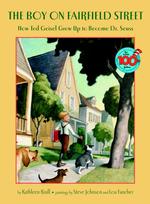
"Once upon a time, there lived a boy who feasted on books and was wild about animals" (Krull, p. 7). All who count the books of Theodor Seuss Geisel, better known as Dr. Seuss, among the first that they read "all by myself" and fell in love with his wit, fantastical creatures, and sometimes irreverent humor will find the same kind of romance in his biography, The Boy on Fairfield Street, written by Kathleen Krull and illustrated by Steve Johnson and Lou Fancher.
Krull masterfully takes readers through the first twenty-two years of Ted Geisel's life, from his childhood home on Fairfield Street in Springfield, Massachusetts, where he was born in 1904, to his first apartment in New York City in 1926. Children will delight in hearing that young Ted was very much like them, not a perfect child, but one who had his faults and odd quirks, and yet somehow managed to achieve greatness when he finally followed his own dream, drawing animals and writing funny things about the world as he saw it, instead of subverting his desires to fulfill those of others like his mother who once told him that "people who went to movies in the daytime ended up as failures, not doctors" (Krull, p. 24).
Using "her remarkable gift for witty, brief, and incisive biography" (Kirkus 2003), Krull treats readers to interesting bits of information about Geisel's youth: he loved to doodle and was often accused of fooling around; his constant companion was his stuffed dog, Theophrastus; he was taunted by his peers because of his German ancestry at the onset of World War I; he adored the comic strip Krazy Kat; and because he always broke the rules, his high school art teacher "warned him that he would never be successful at art" (Krull, p. 20).
The layout of the book, large, easy-to-read text enhanced on each two-page spread with glorious full-page paintings by Steve Johnson and Lou Fancher which are reminiscent of the era, makes it perfect for reading aloud to students of all ages. Although the text only covers the first twenty-two years of Geisel's life, Krull includes a four page afterward immediately following the final page that is aptly entitled, "On Beyond Fairfield Street" in an appropriate play on the title of one of Geisel's books, On Beyond Zebra. In the afterward, Krull continues her account of Geisel's life, giving the highlights of both his personal and professional life through his death in 1991 at the age of eighty-seven. She also includes a complete chronological listing of the "Great Works Written and Illustrated by Dr. Seuss" and both print and online resources for further reading on the life of this literary icon. The book is sprinkled throughout with illustrations from Dr. Seuss' books and a list of credits referencing page numbers for these appears on the final page.
In a starred review in School Library Journal, reviewer Anne Chapman Callaghan said, "This picture-book biography is a winner" (Callaghan 2004). The Boy on Fairfield Street is appropriate for both children and adults, bringing back fond childhood memories for the latter and creating the basis of enduring ones for the former.
Callaghan, Anne Chapman. 2004. Review of The Boy on Fairfield Street. School Library Journal. http://reviews.schoollibraryjournal.com/bd.aspx?isbn=0375822984&pub=sl (accessed February 19, 2005).
Kirkus Reviews. 2003. Review of The Book of Rock Stars. http://www.kirkusreviews.com/kirkusreviews/search/search_results.jsp (accessed February 19, 2005).
Krull, Kathleen. 2004. The boy on Fairfield Street: how Ted Geisel grew up to become Dr. Seuss. Illustrated by Steve Johnson and Lou Fancher. New York: Random House. ISBN 0-375-92298-9.
Written and Illustrated by Don Brown
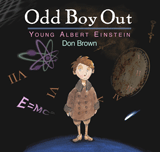
While being called an "Einstein" is now the ultimate compliment to one's intelligence, actually being Einstein in his youth was exactly the opposite. "For the world, Einstein comes to mean not fat baby, or angry child, or odd boy, but great thinker" (Brown, unpaged). In his new picture-book biography, Don Brown gives young readers an overview of the life of the odd boy who became one of the world's most renowned and respected scientists.
Brown portrays the young Einstein as a withdrawn child who fails to fit into what was considered normal behavior for young males of his time. He did not enjoy sports, often tormented his younger sister, and was himself tormented by other boys because he was Jewish. Even at a young age, his explosive temper was evident and his tantrums were so severe that a tutor hired to help prepare him for school ran away and was never seen again. Despite his unusual behavior, Einstein, even as a young boy was fascinated by math and science, constructing elaborate houses of cards, and puzzling over what made a compass work.
Brown's pen and ink and watercolor illustrations, in muted colors, complement the chronological progression of the text, showing young Albert with a perpetual frown on his face except when he is building a house of cards or gazing lovingly at a compass. All of the illustrations have a similar tone except for the two-page spread that follows "And as stars are joined into images called constellations, Albert's ideas make a picture of space and time and energy and matter that no one has ever seen before" (Brown, unpaged). Here, the artwork dramatically changes to brightly colored digitally created images of electrons orbiting a cell nucleus, far off galaxies, the number 186,000 for the speed of light, and a disproportionate clock face showing Roman numerals of increasing size as they approach the pinnacle of twelve (XII), apparently symbolizing the growth in man's knowledge of his own and other worlds due to Einstein's contributions in the fields of math and science through the medium of the dramatic changes in the possibilities of artwork with the capabilities of digital imaging. "Through eloquent narrative and illustration, Brown offers a thoughtful introduction to an enigmatic man. This book will pique the interest of readers with little or no knowledge of Einstein" (Taniguchi 2004).
Brown wisely shies away from actually explaining Einstein's theories to his younger readers, being content to state that "For the rest of us, his ideas mean automatic door openers, television, space travel, and atomic energy" (Brown, unpaged).
In an author's note, Brown gives additional information about the life and work of Albert Einstein, clarifying that he received the Nobel Prize, not for his famous theory of E=MC�, but for his thoughts on the nature of light. He also points out that Einstein's work was completed without the support of grants or university stipends, but in moments stolen from his busy schedule as a husband, father, and patent examiner. Brown also includes a bibliography for those interested in further information on Einstein. The book does not have an index, but because of its brevity, it is not necessary.
Odd Boy Out is a perfect read-aloud for introducing students to the genius of Albert Einstein and initiating discussions on tolerance and acceptance.
Brown, Don. 2004. Odd boy out. Boston: Houghton Mifflin Company. ISBN 0-618-49298-4.
Taniguchi, Marilyn. 2004. Review of Odd Boy Out. School Library Journal. http://reviews.schoollibraryjournal.com/bd.aspx?isbn=0618492984&pub=sl (accessed February 25, 2005).
Writtten by James Cross Giblin, Illustrated by Michael Dooling
"There never was a good war or a bad peace."
Ben Franklin (Poor Richard's Almanack, excerpt Giblin, p. 43)
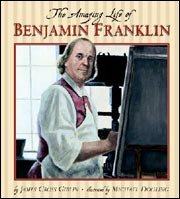
The title of a new book about Benjamin Franklin written by James Cross Giblin, The Amazing Life of Benjamin Franklin, says it all about this icon from American history. Franklin was truly an amazing man, but was also very human and Giblin manages to convey this to his readers by not romanticizing the man, but presenting him as he was by chronicling his achievements while showing his faults. "Like Jean Fritz's What's the Big Idea, Ben Franklin? (Putnam, 1976), the book does not romanticize or sentimentalize Franklin's genius or his contributions" (Chatton 2000).
Giblin immediately pulls readers into the book by utilizing a large typeface on the opening page to emphasize his point as he writes about the large size of the Franklin family; "Ben was one of seventeen children, and the youngest of ten sons" (Giblin 6). On the facing page, readers can see members of the Franklin family gathered for a meal in an oil painting by illustrator, Michael Dooling.
The following pages trace the long and glorious history of Ben Franklin in chronological order, beginning with his childhood and ending with his death at the age of 84. One of the most fascinating figures in American history, Franklin's interests and achievements are as varied as they are monumental. Giblin allows readers to experience first-hand Franklin's drive and determination as they follow his career from printer's apprentice to writer to budding entrepreneur, as the owner of his own print shop, publisher of The Pennsylvania Gazette and Poor Richard's Almanack. Giblin also details Franklin's contributions to education, health care, science, and the independence of the American colonies from England, relying heavily on Franklin's Autobiography, Carl Sandburg's Pulitzer-prize-winning biography, Benjamin Franklin, and personal visits to Philadelphia to research archives in the city where Franklin lived.
Readers glimpse the human side of Franklin through his despair at the death of his younger son, Francis, from smallpox, and his sorrow at the rift that grew into estrangement from his older son, William, when they chose opposite sides in the growing conflict with Great Britain, Ben siding with the revolutionaries and William with the British. "Their conversation turned into a cold discussion of family business matters, and they parted without any show of affection. It would be Ben's last meeting with his son" (Giblin, p. 36).
Informational pages following the text feature additional interesting information about Franklin and study guides to aid in further research. They include: a detailed time-line of Franklin's life, a listing and explanation of Franklin's inventions, excerpts from Poor Richard's Almanack, historic sites associated with Franklin, a bibliography and source notes, artist's notes, and an index.
In the artist's notes, illustrator, Michael Dooling, describes in great detail the extensive research that he conducted prior to painting the illustrations that complement and enhance Giblin's text. His paintings accurately depict life in colonial America, and include replicas of Franklin's Pennsylvania Gazette and an example of the type that was used in printing at that time.
The Amazing Life of Benjamin Franklin not only chronicles Franklin, but also provides an excellent narrative on the events of Revolutionary America through Franklin's involvement. It is an excellent resource that belongs in all collections for its accuracy of the events of early American history and portrayal of Benjamin Franklin.
Chatton, Barbara. 2000. Review of The Amazing Life of Benjamin Franklin. School Library Journal. http://reviews.schoollibraryjournal.com/bd.aspx?isbn=0590485342&pub=sl (accessed February 24, 2005).
Giblin, James Cross. 2000. The amazing life of Benjamin Franklin. Illustrated by Michael Dooling. New York: Scholastic Press. ISBN 0-590-48534-2.
911 Sartain Drive
Andrews, TX 79714
[email protected]
Updated 2-25-05