
When the Orbis Pictus Award for outstanding children's nonfiction was established in 1990, the committee set forth criteria to be used in judging nonfiction written for children. These criteria are:
1. Accuracy
2. Organization, including reference aids such as table of contents, bibliography, subheadings, index
3. Design
4. Style

2005 Newbery Honor Book
2005 Orbis Pictus Honor Book
Written by:
Russell Freedman

Written by Russell Freedman
Wow! The history of Marian Anderson, the vocal virtuoso who possessed the voice "heard once in a hundred years," told by Russell Freedman, a writer who possesses a pen equal to the voice of Anderson - it doesn't get any better than The Voice that Challenged a Nation: Marian Anderson and the Struggle for Equal Rights.
Freedman begins his account of the life of Marian Anderson by describing one of the many high points in her career: her free concert on the steps of the Lincoln Memorial on Easter Sunday, 1939, before a crowd of 75,000 admirers after having been denied the right to perform in Washington D.C.'s Constitution Hall because of the "white artists only" policy of the Daughters of the American Revolution (DAR). Establishing both Anderson's musical abilities and the social climate of America at the time in just two short pages, Freedman draws readers into his narrative on both the life of Anderson and the reluctant role that she played in securing equal rights for performers of color in America. "This inspiring work once again demonstrates Freedman's talent for showing how a person's life is molded by its historical and cultural context" (Gustin 2004).
Following the opening chapter, Freedman, in his classic, straightforward style, takes readers chronologically through Anderson's life, beginning in her childhood where "her uniquely beautiful voice delighted everyone who knew her" ( Freedman, p. 5). Raised in a multicultural neighborhood, Anderson was shocked when she attempted to apply to a music school and witnessed racial discrimination first hand when she was told, "We don't take colored" (Freedman, p. 12). Sickened, but determined, Marian Anderson studied with a black voice teacher, seeking to perfect the gift she had been given. This determination fueled her career, enabling her to eventually study with Giuseppe Boghetti, a well-known voice coach in New York City. Failing to achieve the recognition that she felt she deserved in America, Anderson traveled to Europe which was free of the racial prejudices that she encountered in the United States. In numerous trips to Europe, she achieved the acclaim that she so deserved, receiving the ultimate compliment from Arturo Toscanini in Salzburg, Austria, in 1935. "A voice like yours," he told her, "is heard once in a hundred years" (Freedman, p. 41).
Upon returning to the United States, Anderson found herself in great demand, eventually performing at the White House in 1936 for Eleanor and Franklin Roosevelt. Her friendship with Eleanor Roosevelt opened many doors for Anderson, eventually including the doors of Constitution Hall in Washington D.C. where she was permitted to perform in 1943 to an audience "with no segregation of any kind in the seating arrangements" (Freedman, p. 74). Although the shy and reserved Marian Anderson did not set out to be a civil rights activist, she found herself in a position where she could make a difference in the lives of people of color by refusing to sing in halls that practiced segregation, resulting eventually in the "white artists only" clause being removed from Constitution Hall contracts.
Extensive use of archival photos, including a two-page spread of the famed concert on the steps of the Lincoln Memorial, programs, and newspaper clippings lend a sense of immediacy to Freedman's book, allowing those not old enough to remember, to take a visual journey through this era in American history.
Freedman's narrative of the life of Marian Anderson is based on thorough research, including liberal use of quotes from her autobiography, My Lord What a Morning, and the use of Allan Keiler's definitive biography, Marian Anderson: A Singer's Journey. Extensive chapter notes provide sources for all quotes and an index, highlighting illustrations in bold type, guides those seeking specific information on the life of Anderson. In addition, a selected bibliography and discography link readers interested in further study of Anderson to additional sources.
For readers of all ages who want to fill in the gaps and pursue additional information on the life of Marian Anderson after reading Pam Munoz Ryan's superb biographic picture book, When Marian Sang, Freedman's book will more than satisfy.
Freedman, Russell. 2004. The Voice that Challenged a Nation: Marian Anderson and the Struggle for Equal Rights. New York: Clarion Books. ISBN 0-618-15976-2.
Gustin, Ginny. 2004. Review of The Voice that Challenged a Nation: Marian Anderson and the Struggle for Equal Rights. School Library Journal. http://reviews.schoollibraryjournal.com/bd.aspx?isbn=0618159762&pub=sl (accessed February 4, 2005).
Ryan, Pam Munoz. 2002. When Marian sang: the true recital of Marian Anderson, the voice of a century. New York: Scholastic Press. ISBN 0-439-26967-9.
Written by Seymour Simon
Few are able to set foot in the ocean without recalling the gut-wrenching fear they felt as they witnessed the repeated attacks of the rogue great white shark in Jaws and its sequels. Award winning author of children's nonfiction and former science teacher, Seymour Simon, seeks to dispel the myths and allay the unwarranted fears in his book, Sharks. "The truth is that there are only about a dozen shark attacks in the United States each year (about 100 worldwide), and most victims live to tell their stories" (Simon, unpaged).
After a brief introduction dispelling the myths about sharks, Simon, in subsequent pages, begins to do just that by replacing myth with facts about this often misunderstood animal. Simon's description of sharks flows from the general to specifics about different species of sharks. Young readers' high interest in sharks will make this a much sought after title and they will delight in repeating Simon's facts to their friends. "Some sharks can bite nearly 300 times harder than a human, enough to cut through a thick piece of steel" (Simon, unpaged).
Beautiful full-page photographs of different species of sharks, illustrating and extending the text on the facing page, grace each two-page spread, giving young readers a visual reference as they read about how some sharks deposit fertilized eggs on the ocean floor as they gaze at a baby swell shark emerging from its egg case after an eight month gestation on the opposite page. Throughout the text, Simon introduces and defines scientific terminology (oviparous, ovoviviparous, viviparous), providing an opportunity for his readers to learn about animal reproduction and birth, including the scientific terminology, through the medium of an engaging subject.
Simon concludes the text with simple rules to reduce the risk of a shark attack: don't swim in waters where sharks have been sighted; don't swim in the ocean with open cuts; don't panic and splash if you see a shark. "If we understand their behavior, we can avoid most dangerous encounters and live in harmony with these most awesome fish" (Simon, unpaged).
Although lacking a bibliography or other reference aids, with its engaging photographs of sharks in their natural habitat, Sharks, resting on the laurels of Simon's impeccable reputation as an author of children's nonfiction, is sure to offer the nuts and bolts facts of these mysterious creatures that young readers crave. "It's an introduction to the topic that combines seamless description with excellent photos to describe creatures that never fail to fascinate" (Millhouser 1995).
Millhouser, Frances E. 1995. Review of Sharks. School Library Journal. http://reviews.schoollibraryjournal.com/bd.aspx?isbn=0060230290&pub=sl (accessed February 12, 2005).
Simon, Seymour. 1995. Sharks. New York: HarperCollins Publishers. ISBN 0-06-023032-0.
Written by Milton Meltzer
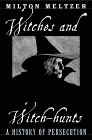
Why are humans sometimes eager to cast dispersions against those they perceive as somehow different from them, and how do individual accusations sometimes transform a group of otherwise rational people into a frenzied mob? Author Milton Meltzer examines this strange phenomenon of human nature by recounting the history of witch-hunts in his book Witches and Witch-hunts: A History of Persecution.
Meltzer provides readers with a journey through history, beginning with some of the earliest accounts of charges of witchcraft in the 1400s in Europe and following chronologically up through the Holocaust and the McCarthy era trials, which he feels can be attributed to the same mind-set as the earlier trials against purported witches. "Many people do not believe that chance plays an unavoidable part in human affairs. If something bad happens to them, they tend to blame it on the supernatural powers of witches" (Meltzer, p. 18). He focuses on the fact that the vast majority of those accused of practicing witchcraft were women, almost four out of five, and attributes this to the fact that women of this time were afforded few rights because "men held all the authority in the community and they tended to protect one another" (Meltzer, p. 52).
In his account, Meltzer, provides details of some of the more famous accusations of witchcraft, including those of Joan of Arc who was burned at the stake in 1431 for committing heretical acts, including practicing witchcraft, and the infamous witch trials of Salem, Massachusetts in the late 1600s where accusations began to spread like wildfire as many were consumed by the fervor of their neighbors and some began to accuse others "for sport" (Meltzer, p. 81). Meltzer contends that "the supposed persecution of witches was a desperate attempt to impose a system of thought on a bewilderingly unpredictable world - to restore order to chaos" (Meltzer, p. 47), as people faced the "social, economic, and political upheavals of the late Middle Ages and the Renaissance" (Meltzer, p. 46).
Although Meltzer adequately relates persecution of witches in Europe and America to the human need to seek order and understanding of events, younger readers may have some difficulty following Meltzer's rationale in asserting that the same mentality that prompted the witch-hunts of previous centuries was also what provoked and allowed such atrocities as the Holocaust and the hunt for Communists during the McCarthy era to flourish in the twentieth century. "He makes thematic connections between Salem, Massachusetts, and the twentieth century in chapters on Hitler's Germany and Senator Joseph McCarthy's hearings, in which the need for scapegoats led us down familiar historical paths" (Meyer 1999) .
"The slim volume's eerie jacket will draw some readers" (Meyer 1999). An especially evil looking witch graces the cover of Witches, inviting readers to see what lurks within. Although Meltzer's bias and personal disapproval of those who perpetuate mass hysteria based on innuendo is occasionally evident, his coverage of the material is generally neutral. Meltzer provides an extensive bibliography of sources used to aid those who desire further information on this dark side of human nature as well as thorough notes broken down by chapter citing individual references. An index is also provided to assist those seeking specific information. Meltzer utilizes text boxes with a gray background to highlight information on Joan of Arc, the possibility of the crazed behavior of some in Salem, Massachusetts, being attributed to a microorganism found in rye that causes reactions similar to those of LSD, and a summary of Professor Jeffrey B. Russell's thoughts on why humans choose to single out individuals and groups for persecution. The lack of illustrations may disappoint a few readers, but Meltzer's descriptions are in-depth enough to allow more mature readers to form mental pictures.
Paired with Elizabeth George Speare's The Witch of Blackbird Pond, or Chris Van Allsburg's The Widow's Broom, Witches and Witch-hunts: A History of Persecution can serve as an introduction to a dialogue on persecution with older students.
Meltzer, Milton. 1999. Witches and witch-hunts: a history of persecution. New York: The Blue Sky Press. ISBN 0590485172.
Meyer, Randy. 1999. Review of Witches and Witch-hunts: A History of Persecution. Booklist. http://www.amazon.com/gp/product/product-description/0590485172/ref=dp_proddesc_0/102-0448643-2479367?%5Fencoding=UTF8&n=507846 (accessed February 13, 2005).
Speare, Elizabeth George. 1958. Witch of Blackbird Pond. Boston: Houghton Mifflin Company. LC 58-11063.
Van Allsburg, Chris. 1992. Widow's broom. Boston: Houghton Mifflin Company. ISBN 0-395-64051-2.
911 Sartain Drive
Andrews, TX 79714
[email protected]
Updated: 2-14-05