
for
Nonfiction
Following the lead of the NCTE, several other awards for children's nonfiction were established, including the American Library Association's Robert F. Sibert Award, the Boston Globe/Hornbook award, and awards created by the National Science Teachers Association (NSTA) and the National Council for the Social Studies (NCSS).
Books reviewed on this page are award winners or written by award-winning authors.
Honor Book
2004 Sibert Award,
2004 Newbery Honor Book
Award
Award
Written by Jim Murphy
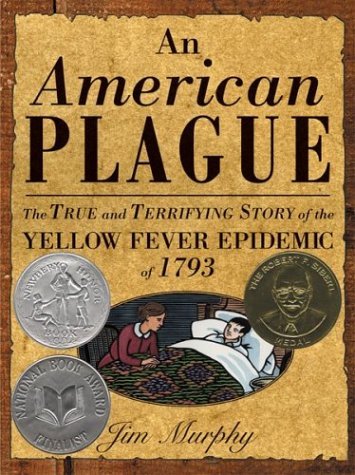
Still reeling from the Revolutionary War and trying to establish its place in the world, America was hit by a natural disaster in the form of the yellow fever epidemic that struck its capital city of Philadelphia in 1793. Jim Murphy depicts the harrowing experiences of the citizens of Philadelphia as they try to understand and cope with the disaster in rich detail in this winner of the 2004 Orbis Pictus Award. In addition, An American Plague was also honored in 2004 with the Robert F. Sibert Award and chosen as a Newbery Honor Book.
An American Plague reads like a good novel. Murphy's skillful writing, informative, but never tiresome, keeps readers turning pages as the epidemic becomes apparent. From the first case, the death of a young French sailor, to the thousands of cases that followed, Murphy takes readers on a journey through the disease-ridden streets of Philadelphia, allowing them to experience first-hand the confusion over the source of the disease, the professional jealousies of the doctors called upon to treat the epidemic, the willing volunteerism of the Free African Society in treating fever victims (it was first thought "that God had seen fit to grant blacks a special resistance to the dreaded disease"), the confusion of government as elected officials fled the city to avoid the disease, and the ability of the citizens to persevere, survive, and cope in the face of an elusive enemy.
Murphy's generous use of maps, drawings of typical street scenes in Philadelphia, and portraits add breadth to the text, giving readers a glimpse of living conditions and common practices such as bleeding those who were ill in the belief that it would restore the natural balance of fluids in the body. Authentic newspaper clippings, city directory pages, and pages from a list of the dead face the opening page of each of the eleven chapters, providing more details of life in the city during the epidemic.
The final chapter, entitled "A Modern-Day Time Bomb" contains perhaps the most chilling information of all: a warning that there are millions of pesticide-resistant Aedes aegypti mosquitoes, carriers of yellow fever which originates in tree-dwelling monkeys in African and American rain forests. Murphy warns that with the ease of today's global travel, the world is ripe for another epidemic that it will have difficulty combating because of past indiscriminate use of pesticides and the lack of vaccine to prevent a major outbreak for this sometimes fatal disease that presently has no cure. Murphy concludes the chapter saying, "Yellow fever as we know it now might be conquered, but another version of the disease will eventually emerge to challenge us again. And when it does, we will have to overcome our fears and be prepared to confront it."
"Jim Murphy has once again created a masterful, impeccably researched book that both enthralls and horrifies the reader" (Jansen-Gruber 2004). Murphy's extensive annotated bibliography, documenting the thoroughness of his research, is broken down into subheadings, facilitating its use in further research. An American Plague also contains a thorough index to aid in searches for specific information.
Pair this book with Laurie Halse Anderson's Fever 1793 to give intermediate students a more personal account of the epidemic or to stimulate interest in the topic.
Jansen-Gruber, Marya. 2004. Review of An American plague: the true and terrifying story of the yellow fever epidemic of 1793, by Jim Murphy. Kidsreads.com. http://www.kidsreads.com/reviews/0395776082.asp. Accessed January 28, 2005.
Murphy, Jim. 2003. An American plague: the true and terrifying story of the yellow fever epidemic of 1793. New York: Clarion Books. ISBN 0-395-77608-2.
Written by Steve Jenkins
Author Steve Jenkins transports young readers to some of the most amazing natural wonders in the world in his 1999 Orbis Pictus honor book, Hottest Coldest Highest Deepest. In the introductory page he invites readers to "travel the world and visit the planet's record holders."
Jenkins' artistic genius is exhibited throughout the book through his use of exquisite cut and torn paper collages in brilliant hues that breathe life into the sparse text introducing children to the highest mountains, longest rivers, hottest and coldest locales, deepest lakes and other awesome places on the face of Earth. Text boxes provide additional interesting information on each spot mentioned. Inset maps accompany each locale, providing readers with a mini-lesson in geography as they learn about the record holders of each category. Additionally, Jenkins includes visual references in inset boxes accompanying the illustrations about many of these landmarks, juxtaposing the height of the Empire State Building against the depth of Lake Baikal in Russia, or comparing the annual precipitation of Tutunendo, Colombia, of 463 inches against the average height of a man at 72 inches.
Fifth grade students who viewed Jenkins' book were impressed with each new fact, but many considered the fact that the Amazon River in South America contains one-half of all the water contained in rivers worldwide to be the most amazing.
"This eye-catching introduction to geography will find a lot of use in libraries and classrooms" (Callaghan 1998). Aspiring Jeopardy contestants and all who enjoy knowing the biggest and best natural wonders of the world will be mesmerized by Hottest Coldest Highest Deepest.
Callaghan, Anne Chapman. 1998. Review of Hottest coldest highest deepest. School Library Journal. http://reviews.schoollibraryjournal.com/bd.aspx?isbn=0395899990&pub=sl(accessed January 28, 2005).
Jenkins, Steve. 1998. Hottest coldest highest deepest. Boston: Houghton Mifflin Company. ISBN 0-395-89999-0.
Written by Jean Fritz
Jean Fritz thrills students of American history in her account of the life of James Madison, the fourth president of the United States, in The Great Little Madison, winner of the first Orbis Pictus Award in 1990. Her complete biography begins in Madison's childhood where she describes him as "a small, pale, sickly boy with a weak voice." Although his voice and stature remained diminutive, the great legacy that Madison left behind continues to be evident through his tireless contribution to the basis of all American law, The Constitution of the United States. It was during the Constitutional Convention that he earned the nickname "the Great Little Madison" for his steadfast support of a strong central government with a system of checks and balances and strong emphasis on personal liberty.
With accurate detail, Fritz allows readers to follow Madison from his youth through his illustrious political career, culminating in his being elected the fourth president of the United States in 1809. Allowing readers to come to intimately know the key players of the time, Madison and his wife, Dolley, Thomas Jefferson, George Washington, John Adams, Patrick Henry and others through the use of quotes, personal letters, and anecdotes, interwoven with a fast-paced text, Fritz brings American history and the foundations of our present government to life.
In her narrative, Fritz presents young readers with facts that they will find irresistible: the secret code that Jefferson and Madison used for correspondence, the abiding love between Madison and his wife Dolley, and her fascination with the trappings of worldly life despite her Quaker upbringing, the intense rivalry and bitter debate between Madison and Thomas Jefferson on one side and Patrick Henry and Alexander Hamilton on the other, and the deep bond of friendship that developed between Madison and Jefferson. "Neither man could stand Patrick Henry 'What shall we do with him?' James asked once when Patrick was being obstructive in his usual eloquent way. 'What we have to do, I think,' Jefferson replied, 'is devoutly pray for his death' " (Fritz 1990). "Fritz inspired me to find the 'story' in American history and to make it 'come alive' for my students. I'm certain that countless children and adults have likewise become history buffs thanks to her books" (Hulick 2001).
The Great Little Madison contains numerous illustrations, allowing young readers to put faces with the people and events Fritz so eloquently describes: a copy of a page of the copious notes that Madison took during the Constitutional Convention, portraits of all of the principle characters, paintings of important events such as the duel between Hamilton and Aaron Burr and the Battle of New Orleans, and the key to the secret code used by Jefferson and Madison.
Although younger readers might find the book too long, intermediate and upper level students will benefit greatly from Fritz' thorough research and vivid account of this pivotal period in American history, extending their learning far beyond the standard fare of school textbooks.
Fritz, Jean. 1989. The great little Madison. New York: The Putnam & Grosset Group. ISBN 0-698-11621-6.
Hulick, Jeanette. 2001. "True Blue." The Bulletin of the Center for Children's Books. http://www.lis.uiuc.edu/puboff/bccb/1101blue.html (accessed January 29, 2005).
Written by Jennifer Armstrong
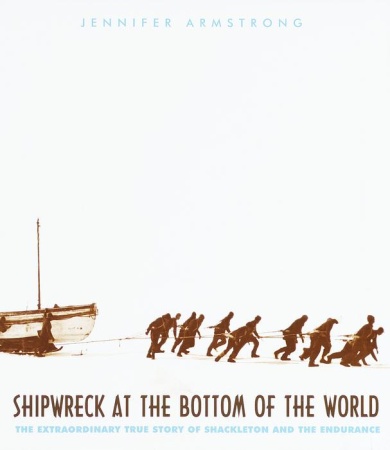
My palms sweated with nervousness, while the rest of my body experienced an inexplicable chill, as I trekked through the violent waters of the Southern Ocean, where "when winter descends on the southern continent, the seas surrounding the land begin to freeze at the terrifying rate of two square miles every minute," with Captain Ernest Shackleton and his crew of twenty-seven men in an attempt to conquer the most formidable continent, Antarctica, described as "the most hostile environment this side of the moon" in the Orbis Pictus Award winning book by Jennifer Armstrong, Shipwreck at the Bottom of the World: The Extraordinary True Story of Shackleton and the Endurance.
After a failed attempt to reach Antarctica in 1908 that was halted just ninety-seven miles short of his goal by severe weather, Ernest Shackleton was determined to be the first to reach the uncharted continent. But this dream, too, was dashed when a Norwegian explorer, Roald Amundsen, reached the South Pole in 1911. Shackleton then undertook to be the first man to cross the entire continent of Antarctica from "one side to the other." Despite his native England entering into World War I as the crew prepared to leave, Shacketon and his crew set out on August 8, 1914 with the blessings of Winston Churchill, the First Lord of the Admiralty. Although the first leg of their journey was uneventful, this was not to last, as the Endurance, an appropriate name for the ship and later for the crew, became icebound as "the fist of the Antarctic closed around the ship."
With gripping intensity, Armstrong relates the story of the crew and their fight for survival as the Endurance succumbs to the intense pressure of the surrounding ice and the crew is forced to abandon ship, seeking safety on a large ice floe that is drifting at the whim of the currents, with only three small, open lifeboats as the thread connecting them to civilization. It is a riveting story of the will to survive in spite of impossible odds and dismal conditions, led by the indomitable spirit of Shackleton whose fierce devotion to his crew was essential to the survival of all.
With historical accuracy gleaned from intensive research of the expedition, including Shackleton's own account in his book, South, Armstrong weaves a tale equal to any fictional survival story with her superb narrative and knack for well-placed anecdotes and explanations that quickens the breath of readers and keeps them turning pages to find what will happen next. "Filled with intriguing details and written with dramatic style, this riveting account of the ill-fated Imperial Trans-Antarctic Expedition reads like an adventure novel" (Sullivan 1999).
Complementing the fast-paced text are dramatic black and white photographs taken from the original glass photographic plates shot by Endurance's photographer, Frank Hurley. Many of the original plates, numbering in excess of four hundred, had been destroyed by Shackleton and Hurley when they were forced to abandon the Endurance. Armstrong also provides readers with detailed maps charting the voyage of Endurance, and the drawings of the ship's original plans. The book contains a categorized bibliography, broken down into selections about Antarctica, navigation, and general, and selections about Shackleton. There is also an extensive index with page numbers of photographs shown in bold type and a table of contents..
Shipwreck at the Bottom of the World is finely crafted story that will be enjoyed by readers of all ages, an excellent read-aloud for intermediate students that will undoubtedly provoke countless class discussions on a variety of topics ranging from geography and science, to ethics and loyalty. This is a must for all libraries.
Armstrong, Jennifer. 1998. Shipwreck at the bottom of the earth: the extraordinary true story of Shackleton and the Endurance. New York: Crown Publishers, Inc. ISBN 0-517-80014-4.
Sullivan, Edward. 1999. Review of Shipwreck at the bottom of the earth: the extraordinary true story of shackleton and the Endurance. School Library Journal. http://reviews.schoollibraryjournal.com/bd.aspx?isbn=0517800136&pub=sl (accessed February 1, 2005).
911 Sartain Drive
Andrews, TX 79714
[email protected]
Updated 2-1-2005