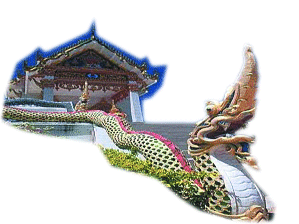
Samui is rich in
Buddhist culture and there's an interesting selection of sites to
visit and sights to see on the island. Please remember to dress
politely however (no beachwear or revealing costumes) and behave with
the appropriate respect in temple grounds.
Buddhism
plays an important role in the daily life of the Thai people.
Approximately 95% of the people in the kingdom of Thailand are
Buddhists. The first full moon of May, or Visakha Bucha Day, is the
most important day in the Buddhist calendar. Buddha's birth,
enlightenment and death were all said to occur on this day, which
falls on Tuesday 7 May this year. It is an occasion for most Buddhists
to go to the temple in the evening, hear the teachings of the monks
and make offerings of flowers and candles. The monks lead a procession
around the temple before offerings are placed around the temple's
bodhi tree. The ceremony is extraordinarily beautiful, and respectful
guests are welcome to observe or participate in most temples.
This temple is noted in part for the
mummified body of the Buddhist monk Loung Por Ruam, which rests here
in a glass case. This venerated monk was prepared for public viewing
upon his death 25 years ago, and his body remains in remarkably good
condition. Follow #4170 road south from Ban Saket, then turn right
between the two giant elephant statues and look for the temple 1km
farther along on the right.
The body of Samui’s most famous
mummified monk, Loung Pordaeng, is on display here in a specially
constructed building. After his death more than 20 years ago, he was
placed in a meditation position. He still holds that posture, and his
body shows few signs of decay. Wat Khunaram is on the #4169 ring road
between the Na Muang waterfalls and Hua Thanon.
This old temple is the guardian of the
ancient White Marble Buddha, believed by many, including the resident
monks, to be many hundreds of years old. It also harbours within its
grounds the Secret Hall of Buddhas. This building houses a fine
collection of revered and valuable Buddha images. So valuable are they
that the temple has recently suffered a spate of thefts, and so the
door now remains locked. A monk will open the hall for you on request.
Wat Sumret is located 200 metres down the second concrete road on the
left, west of Hua Thanon on the #4169 ring road.
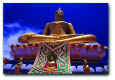

This temple is the home of the Big Buddha,
Samui’s most famous landmark. Most visitors, at some point during
their holiday, come to marvel at the sheer size and beauty of this
remarkable statue. Visible from several kilometres away, even from the
air when approaching or leaving the island, the 12-metre-tall golden
image stands proudly. It is especially impressive when lit up at night.
At the base of the structure, shops and restaurants cater to the needs
of devotees and tourists alike. Wat Phra Yai lies in Samui’s
northeast on route #4171 near the airport.
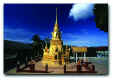

Said to contain a relic of the Lord Buddha, the golden chedi facing
the temple entrance is a popular place of worship. Many local
traveling shows and even visiting TV stars sometimes use the temple
grounds for their performances. Wat Sila Ngu is on the #4169 ring road,
1km south of Hin Ta/Hin Yai on the beach side.
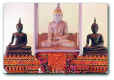

Formerly one of Samui’s main attractions,
this small, dilapidated statue is now only visited by Buddhist
devotees. Although it is in a state of disrepair, the Coral Buddha is
still revered, a place of worship for monks from nearby Wat Sumret.
The only direction sign is a tatty little roadside board, easy to miss
when driving past. It is on the #4169 ring road approximately 800
metres west of Hua Thanon on the right.


This ornately designed chedi (pagoda) sits
on the rocks at the water’s edge in the grounds of Wat Laem Sor.
Covered in countless little yellow tiles, it appears golden at a short
distance. It lies at the far south of the island off the #4170 road
between Ban Tale and Ban Pang Ka. Follow the track with a sign that
reads “Waikiki Bungalows” to the end.


There are actually four footprints here,
superimposed one upon the other, each of them artistically engraved.
They are housed in a modest shrine 150 steps up a steep hill, which
also offers a great view over the treetops and across the plains to
the mountains opposite and to the sea. The Lord Buddha’s Footprint
is not sign-posted. Go up the concrete slope on the left, 2km west of
the turnoff for the Butterfly Garden on route #4170.