 |
|
|
|
|
|
|
|
|
|
|
|
|
|
| Back |
|
Philip the Good |
|
|
|
|
|
= Filips de Goede / Philippe le Bon |
|
|
|
Born: 1396
Father: John the Fearless
Mother: Margaret of Bavaria
Duke: 1419-1467
Age: 23
Wives: 1. Michelle of France (1409)
2. Bonne of Artesia (1424)
3. Isabella of Portugal (1430)
Children: Antoine (1430-1432), Joseph (1432), Charles the Bold (3)
illegitimate by:
- Catherine Schaers: Cornelius, Lord of Beveren (?-1452)
- Jeanne de Presles: Antoine, "le Grand Batard de Bourgogne" (1421-1504)
- Jeanne Chastellain: Marie (1426-1462), David (1427-1496)
- Catherine Thiefries: Baudoin de Bourgogne-Lille
- Matilda van Praest: Philipp (1464-1524), Grand Admiral of Flanders
- Jacqueline van Steenberghe: Anna (?-1508)
- N de Belleval: Raphael (1463-1508)
- Marie Marguerite Scupelins: Johann (1438-1499)
- Isabelle de la Vigne: Marguerite
- Celine de Harlay: Marie (?-after 1467), Catherine
- Jeanette de Mairesse: Antoine, Josse
- unknown mothers: Philippe, Cornelie, Madeleine, Marie (?-after 1467),
Cateline (?-after 1515), Catherine, Josine, Yolande (?-1470), Jerome,
Baudoin, Arthur, Andre
Died: 1467
Age: 71 |
|
|
|
 |
|
|
|
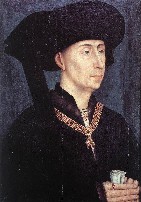
Philip the Good by Rogier van der Weyen, 1450 |
|
|
|
Philip the Good (1396-1467), duke of Burgundy (1419-65), creator of one of the most powerful states in 15th-century Europe. Born in Dijon, Philip succeeded as duke when his father, John the Fearless (1371-1419), was killed by a group of French nobles. In retaliation, Philip allied himself with Henry V of England, France's enemy in the Hundred Years' War. In 1430 he captured Joan of Arc, who had been leading the French, and turned her over to the English. Later, when the war began to go against England, he changed sides, concluded the Treaty of Arras (1435) with Charles VII of France, and received in return most of the province of Picardy. Philip extended Burgundian rule in the Netherlands, acquiring Holland, Zeeland, and Hainaut in 1428; Brabant and Limburg in 1433; and Luxembourg in 1443. In 1453 he conquered the rebellious towns of Flanders. By 1460 he ruled what is now Belgium and Luxembourg, together with most of the Netherlands and large areas of northern and eastern France. Philip's court was the most brilliant of its time. Known for his lavish entertainments and his devotion to the rituals of chivalry, he instituted (1430) the Order of the Golden Fleece, one of Europe's most prestigious knightly brotherhoods. In 1465 he handed the dukedom over to his son, Charles the Bold.
"Philip the Good," Microsoft (R) Encarta. Copyright (c) 1994 Microsoft Corporation. Copyright (c) 1994 Funk & Wagnall's Corporation. |
|