|
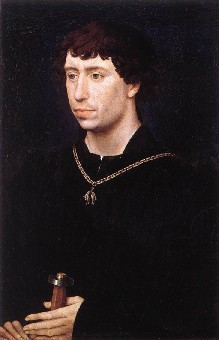
Charles the Bold (1433-77), last duke of Burgundy, the son of Philip the Good, duke of Burgundy, and Isabella of Portugal, born in Dijon. In 1452 he became count of Charolais. When King Louis XI of France forced Philip to cede some towns on the Somme River, Charles formed the League of the Public Weal, an alliance of noblemen. League forces threatened Paris and defeated the king at Montlh�ry, near Paris, in 1465. The result was the Treaty of Conflans, by which the towns on the Somme were restored and the counties of Boulogne, Guines, and Ponthieu were granted to Charles. Succeeding his father as duke in 1467, he became ruler of the territories that constitute the Low Countries as well as the duchy of Burgundy and Franche Comt�, or the Free County of Burgundy. In 1468, Charles married his third wife, Margaret of York, and formed an alliance with her brother, Edward IV, king of England. Richer and more powerful than any other prince, Charles planned to restore the old kingdom of Burgundy and fought a series of intermittent wars with France. In 1475 Charles made himself master of Lorraine. In March of the following year he invaded Switzerland and was defeated at Grandson. Three months later he suffered a still more severe defeat at Morat (now Murten). Nevertheless Charles refused to agree to peace terms and laid siege to Nancy in October 1476. There he was defeated and killed on January 5, 1477. His daughter and heiress, Mary of Burgundy, lost part of her possessions to France, but a large portion became part of the Holy Roman Empire through her marriage to Maximilian of Habsburg.
"Charles the Bold," Microsoft (R) Encarta. Copyright (c) 1994 Microsoft Corporation. Copyright (c) 1994 Funk & Wagnall's Corporation. |
|