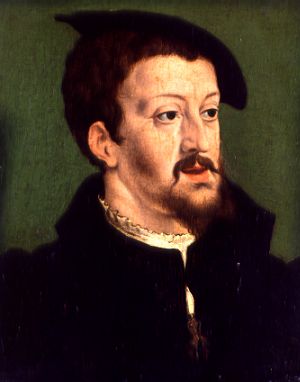
On January the 10th, Margaret was born in the palace on the Coudenberg in Brussels, as the second child and only daughter of Maximilian of Austria and Mary of Burgundy. Two years earlier, her brother Philip (known as "the Fair") was born. Margaret was baptised in the church of Saint-Goedele (today's cathedral of Saint-Michael and Saint-Goedele) in Brussels, under the view of Philippe of Ravenstein, Jean de Ch�lons, the Prince of Orange and her step-grandmother and godmother, Margaret of York.
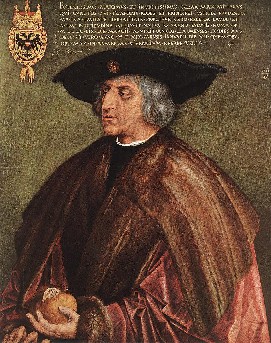
Father Maximilian was the son of Emperor Frederick III of Habsburg and Eleanor of Portugal. He was born on March 22nd 1459 in Wiener Neustadt. The Habsburg family were the archdukes of Austria, and had worked themselves up to be voted as Emperor of the Holy Roman Empire, and stayed that for more than four centuries.
Maximilian became Emperor himself, in 1485. Although described by some as handsome, well educated and able to speak several different languages, he was also a waster, was often abused by others without his noticing it, and was a megalomaniac, proven by the fact that he almost made himself a Papal candidate. He did little unless he could act a grand scale - which would lead him to bankruptcy.
Mary of Burgundy was born in Brussels on February 13th as the daughter of Charles the Bold of Burgundy and his second spouse, Isabella of Bourbon. Her father died in 1477, on the battlefield of Nancy. Mary was his only heir, and was the ruler of a sprawling, disjointed country at the age of twenty, but unmarried. Almost immediately, the French conquered some areas on the border. King Louis XI, wanted to force Mary into marrying his son and heir, Charles, who was only seven years of age. But, Mary's father already had an agreement with the German Emperor, Frederick III, that engaged Mary to Maximilian, Frederick's son. Mary was aware of this, and saw in this her rescue. On April 22nd, the marriage by proxy between Mary of Burgundy and Maximilian of Austria took place in the "Prinsenhof" in Bruges. It would last another four months before Mary would meet her husband, but on August 19th, their marriage was consecrated. This would save Burgundy from being taken over by France.
Maximilian was very happy with his new bride, as he wrote in a letter a few days after his wedding to his friend Freiherr Sigmund Pr�schenk: "I have a beautiful, pious and virtuous consort. I am very happy with her, thank God for that! She's small, has very pail skin and dark brown hair."
The marriage would bring them two children: on 22 June 1478 Philip the Fair was born in Bruges, and in 1480, Margaret.
The first years of her life, Margaret followed her parents to several courts in Brussels, Gent and Bruges. She spent a lot of her time together with her brother and mother, in the absence of her father, who frequently had to travel through Europe for his duties.
In March 1482, Mary of Burgundy fell off her horse during falconry. At the end of March Mary died, at the age of 25, leaving Burgundy in the hands of her husband, until her son Philip came of age.
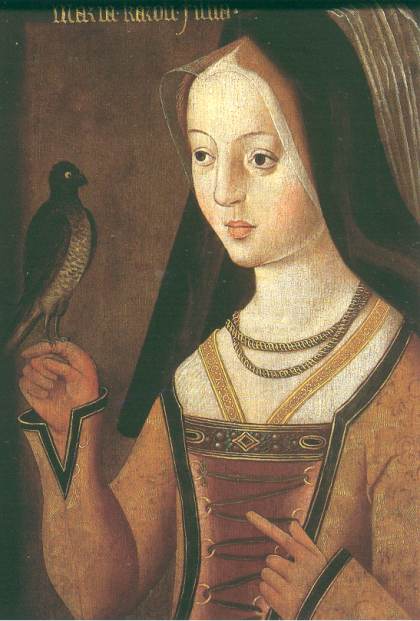
The same happened as with the death of he father: France was very glad to hear of Mary's death, knowing what would follow. Some cities, especially Gent, insisted on a peace with France, although Maximilian hated the French. However, peace would be beneficial to the cities� economy, and so Maximilian was forced to win the King of France over, by marrying his only daughter, two years old, to the king's son Charles. Charles was at that time 13, and already engaged to the daughter of King Edward IV of England. The engagement was immediately cut short. The king also commanded that Margaret had to leave her home country and be raised in France at the court, only that way, he claimed, she could be a good queen one day. The king intended to keep little Margaret as a hostage, to prevent Maximilian from ever attacking France.
Therefore, on 2 June 1483, Margaret and her retinue arrived at Paris. The little princess stayed at the court of Amboise, where her new sister-in-law, Anne de Beaujeu, raised her. Margaret's husband was a sickly child, with broad shoulders and a large head. On 23 June, the two wedded in front of the most powerful people of France. No doubt little Margaret had no idea what was going on.
Very unexpectedly, King Louis XI died on August 30th, leaving his son under the protection of his sister Anne, who was now regent of France. Maximilian used this to punish the rebellious cites, and took them all over in no time. In 1485, he was acknowledged as ruler of Burgundy and a year later he was chosen as new Holy Roman Emperor after his father's death.
At the French court of Amboise, Margaret received a highly distinguished education. Her governess, Madame de Serg�, looked after her as a second mother. Margaret matured into a sweet and educated young lady: she was taught music, art and literature.
Nevertheless, 1490 was to be a turning point in the careless life of Margaret.
In 1488, Francis II of Brittany died, leaving no male heir behind, but only one daughter, Anne. Anne was only 11 years old, when in 1490, Maximilian asked Anne to marry him. This would have meant a great loss for France. Anne de Beaujeu could not let this happen, and arranged that her brother the king would marry Anne of Brittany. The French army took over Brittany and on 6 December, Charles and Anne were wedded, after the Pope had given a special dispensation that would annul the marriage between Charles and Margaret.
Charles did not let Margaret go back to her home, because that would mean giving back the dowry. Instead, he declared a state of war between France and Maximilian, and therefore kept Margaret at the French court as a hostage. The outraged Maximilian started a war immediately. After three months, he regained Franche-Compt�, one of the domains belonging to the dowry. On 23 May, the Pact of Senlis was signed, and the biggest part of the dowry returned to Maximilian. Margaret was freed and went back home to Burgundy, after the new French Queen Anne of Brittany had given the girl special jewellery.
On 12 June 1483, the people welcomed Margaret as she reached Chambroi. Later that evening, she reached Valenciennes, where her step-grandmother, Margaret of York, waited for her, and would accompany her to Mechelen.
In Mechelen, her brother Philip, who she hadn�t seen for more than 10 years, greeted her.
In 1494, aged 16, Philip took power, ruling the Burgundian Netherlands. He and his sister lived carelessly in Mechelen at the palace of Margaret of York until 1495.
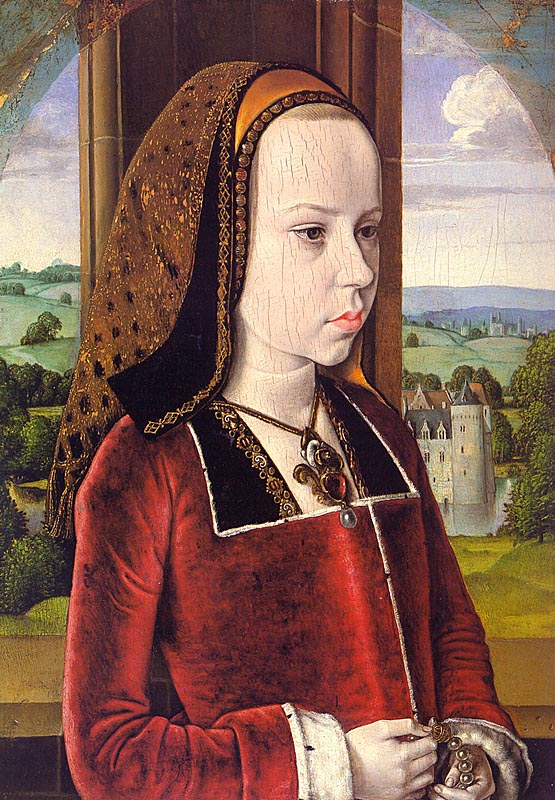
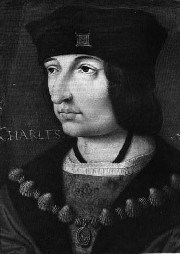
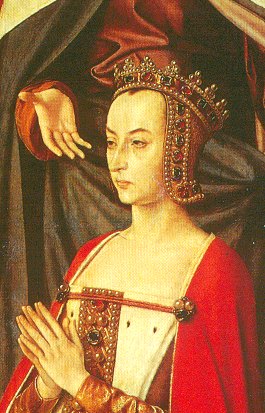
France remained the biggest enemy of Maximilian and his son Philip. Only a strong alliance could prevent France from trying to conquer the Netherlands again. Thus, Maximilian started negotiating with the Spanish Catholic Kings, Isabella of Castile and Ferdinand of Arag�n, for the marriage between his two children Margaret and Philip and the Spanish children Juan, the only male heir of the Spanish Kings, and Juanna. On November the 5th, Margaret was married by proxy in Mechelen. She wore a dress in cloth of gold and a golden crown on her head. In 1496, Juanna came from Spain to marry Philip; the marriage took place on 20 October in Lier. The Spanish armada that brought Juanna to Flanders would return to Spain with Margaret on board. She departed in January 1497 to Castile.
The first day everything went smoothly, until they were stopped by a thunderstorm in front of England. The English King Henry VII welcomed them in Southampton for a few days. When the company travelled further, they were harassed by more storms, and from then on, everybody feared for their lives and none believed they would ever reach the coast of Castile safely. During on of these storms, Margaret wrote her epitaph:
"Cy gist Margot, la gentil(le) demoiselle, qu'ha deux marys et est encore pucelle" (Here rests Margot, the sweet lady, who had two husbands, but still remained a virgin").
But finally, on 6 March, they arrived at the port of Santander. Only two heavily damaged ships would arrive.
None was waiting for Margaret, they all left to the Court after waiting for weeks. Someone was sent to warn them, and the train of noble people immediately went to greet Margaret. Here, Margaret met her new father-in-law and her groom. It is said to have been love at first sight. The largest crowd was waiting for her in Burgos, where also her mother-in-law, Isabella, was waiting for her new daughter. On 3 April 1497, the 17-year old Margaret married the 19-year old Don Juan of Castile, in the cathedral of Burgos.
Juan was a slightly built, timid and rather melancholic prince, who was immediately captured by the charm and impartiality of Margaret. Both were full of youth, love and innocence. But his love for Margaret would wear him out. Isabella tried to separate the two for a while, in order to let Juan regain his strength, but both were so desperate that she could not part them any longer. Isabella called upon Margaret to be more careful in the future, and his confessor warned Juan about the dangers of his reckless temper.
Nevertheless, this was in vain: Juan became very ill by all this, and after only five months of being happily married, he died on 4 October 1497.
Margaret, who was also struck by a fever, was not immediately informed of this. When she heard of it, her fever became worse, and twelve days later, she gave birth to a stillborn girl.
At the age of 17, Margaret lost her second husband, and was a widow without rights in a strange country, which she was supposed to be ruling one day. Still, she wrote in her diary a sentence of much importance:
"...et toujourt ay et veulx avoir espoir..." (Always I will keep faith).
Margaret will stay another two years in Spain, close to her dead husband. In 1499 she will finally return to the Netherlands.
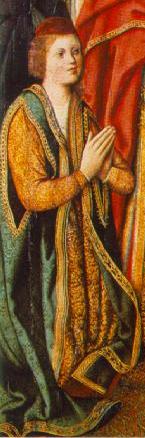
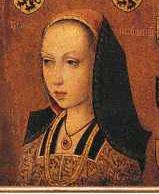
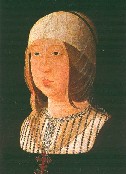
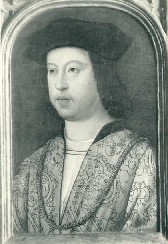
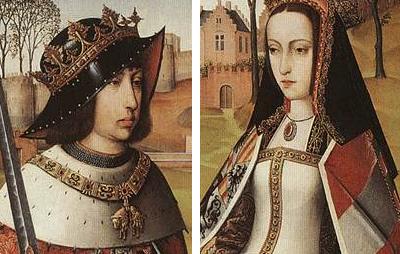
On 24 February 1500, Juanna gave birth to her second child and first son, Charles, in Gent. Margaret was his godmother. In 1501, Philip and Juanna went to Spain, leaving their three children, Eleanora, Charles and Isabella, under the protection of Margaret of York in Mechelen. The old Margaret took care of the children until her death, in 1503.
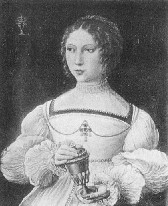
In 1501, Margaret of Austria was a beautiful, fashionable and cheerful 21-year old woman. She did not want to care bout the politics around her, and mostly she didn't want to marry again.
However, this was not what her brother Philip had intended for her. As sovereign of the Netherlands, he wished peace with France. And what better then a marriage of his sister and a French prince could make sure of this peace? Philip found in Philibert of Savoy the right candidate.
Philibert was only a few months younger than Margaret was. He was handsome, tall, and athletic, had blonde hair and blue eyes and was the indisputable hero and fairy-tale-prince of tournaments and court feasts. Margaret and Philibert were also raised together at the French Court, when Margaret was married to Charles, so they must have known each other. Perhaps that is why Margaret did not refuse to marry him, although she had said she did not want to marry again. On 26 September, she signed the contract, and the next day she departed to Savoy, where her handsome groom awaited her. Philibert was impressed by Margaret's looks. On 2 December 1501, the marriage took place in Romainmo�tes.
This was one of the most careless periods of Margaret's life. The two were very happy with each other. Philibert liked hunting and feasting more than his dull political duties. And this came in very handy for Margaret, since she took over the government with pleasure.
Nevertheless, all beautiful stories end. In September 1504, Philibert went hunting, although Margaret had warned him of the heat. He collapsed after drinking cold water. He had pneumonia, and on 10 September 1504, he died in the arms of Margaret in Point-sur-Aine.
This was too much for Margaret and desperately she threatened to jump out of window. A few courtiers could have prevented her from doing it, but Margaret cut off her long hair and put it on Philibert's coffin. Six days later, his body was buried in the family vault of his mother, but his heart remained with Margaret. After the funeral, Margaret went to live in Bourg-en-Bresse.
But her rest was not for long.
In 1505, Maximilian wanted his daughter to marry the old king of England, Henry VII. Her portrait was sent to the English king and his portrait to her. Margaret refused: she promised to remain a widow for the rest of her life. She showed that by always wearing widow-clothes from then on. She had only one goal left in her life, according to her, and that was building a cloister. This was a promise that her mother-in-law, Margaret of Bourbon, had done when she asked for the healing of her son Philibert after he was born.
But in 1506, her life would be changed for good.
On 25 September, her brother Philip unexpectedly died in Burgos. In 1604, Isabella of Castile had died, and Philip and his wife Juanna were now king and Queen of Castile. After Philip's death, Juanna remained queen, but her father, Ferdinand, had her declared feeble-minded, and made his grandson Charles the new ruler, together with his mother, but under Ferdinand's protection. In reality, Ferdinand had taken over Castile.
Charles was supposed to succeed his father in the Netherlands as well, but he was only 6 years old, and far too young to be the actual ruler.
The States General pointed Maximilian as guardian of the Netherlands, but he immediately handed it over to his daughter Margaret, who without being asked permission was appointed as regent, or "lieutenante-gouvernante" of the Netherlands.
Margaret was happy in the hospitable Savoy, and did not intend to be a political leader. However, compelled by necessity, she accepted the function.
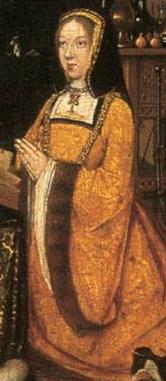
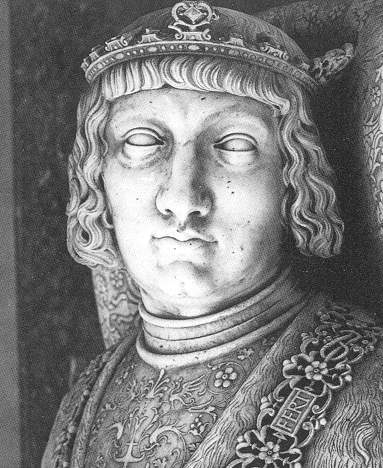
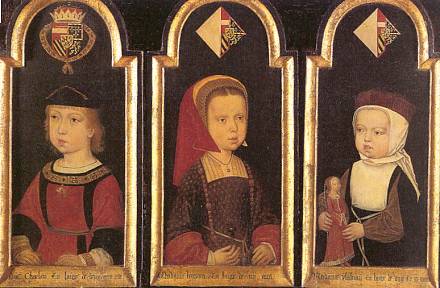
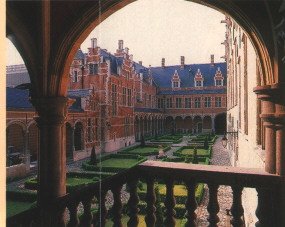
On 29 October 1506, Margaret left Savoy and travelled to the Netherlands via Germany, where she visited her father Maximilian. In March 1507, she arrived in the Netherlands, where the States General officially appointed her as regent. On 7 July 1507, she settled in Mechelen, in the palace of her friendly step-grandmother Margaret of York. Not only was she governess, she also had the task to raise the children of her brother, Charles, Eleonora, Isabella and Mary, who were still in Mechelen (Ferdinand was in Spain at the court of his grandfather Ferdinand and Catherine, who was born after the death of her father, was raised by her mother, Juanna). Maximilian did not want his daughter to live in such a simple residence, and bought everything that stood opposite the palace, so that Margaret would build a palace of her own. This happened under supervision of Rombout II Keldermans and in 1509 she settled in the finished parts of the palace. (The palace still exists today, in the 'Keizerstraat', and is now a judicial palace)
In the mean time, Margaret ruled the country with a firm hand. Her political insight was often better than that of her father or counsellors.
Margaret's task was sometimes hard and commanded a lot of her time and energy. Still she found the time to occupy herself with things she liked from her childhood: art, music and literature. Margaret turned Mechelen into the cultural and intellectual centre of the Netherlands. She collected objects of art by the most important Dutch artists, like Van Eyck's "Wedding of Arnolfini" (today in the National gallery of London, Great Britain). Her court became the meeting place of all the important contemporarily artists of the Netherlands: Jan Gossaert van Mabuse, Barend van Orley, Michiel Coxie, Jan van Battele, Conrad Meyts and Hans Vredeman de Vries, to name only a few. She also had famous guests: the musicians and composers Hendrik Bredemeers, Cypriaan de Rore, Philippus de Monte and Pierre de la Rue, the humanists Erasmus, Thomas More, Busleyden, Varennius and Lingolius, and a lot of ambassadors, magistrates, noblemen, bishops, monarchs and princes from every European country.
Margaret tried to pass these cultural and intellectual interests to her cousins and especially to the little Charles.
In 1515, the problems around Charles started. On January 15th 1515, Charles was declared adult. This was not according to the wish of Margaret, who found Charles too young for it. But Charles� educator, Willem of Croy, Lord of Chi�vres, arranged it all. By this, Chi�vres gained more power. Margaret had to give her power to Charles, but still wanted to advise him. Charles was a rather obstinate youth and was often in conflict with his aunt. Margaret felt very bad in this situation, also because her nieces were not at her court anymore to occupy herself with. Isabella married the king of Denmark, Eleonora married the king of Portugal and Mary married the king of Hungary.
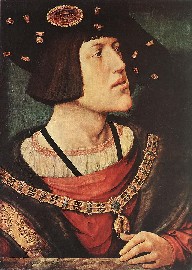
On 23 February 1516, Ferdinand of Arag�n died. Charles now became King Charles I of Spain, and urged himself to his new country. Margaret was again in charge of the government of the Netherlands. When in 1519 Maximilian died, Charles V was also voted Emperor of the Holy Roman Empire. Margaret now became again the official governor of the Burgundian Netherlands. Margaret was now almost completely in charge of everything in the Netherlands.
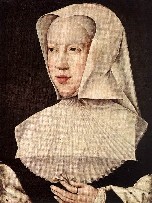
In 1520, Margaret started to have problems with her health. She had a leg wound, which would become worse throughout the years. On some days, she could not even walk anymore. Margaret thought about quitting her political life to rest in a cloister in Brugge. However, Charles could not miss his aunt in important political affairs. So Margaret kept her position, but grew discontented and bitter, for she desperately needed rest.
In 1523, Margaret had to occupy herself with another inconvenient affair. Christian II of Denmark, the husband of her niece Isabella, was driven from the throne and exiled from his country. He asked Charles for help and came to the Netherlands, staying in Lier. In 1526, Isabella died, after living a very unhappy life with her arrogant husband. Margaret immediately went to Lier and personally took Isabella's children to be raised at her court under her supervision. Margaret still did not trust Christian, locked some of his advisors in prison, and hired spies to observe his actions.
But in 1529, Margaret would experience her biggest triumph. Since 1520, Charles lived under a state of war with France. He and the king, Francis I, could not stand each other, especially after the candidature of Francis to be voted as Emperor. France also claimed some Italian regions that were a part of the Holy Roman Empire. French troops conquered Genua, Pavia and Napels. Charles re-conquered Pavia and Genua, but both troops were exhausted and the French troops suffered heavy losses to the plague.
In 1522, Margaret received a letter from Louise of Savoye, her sister-in-law and mother of Francis, with a request for negotiations for peace.
In 1525, Francis was captured by Charles and put in jail in Madrid. Louise wrote Margaret again and asked for his release. Charles and Francis made peace and Francis married Charles' sister Eleanora. Soon afterwards, the two began to fight again.
In 1528, however, a serious request for negotiation came from Louise, who sent a message along with Margaret's secretary Guillaume de Barres. The two would meet in Camrai (Kamerijk).
On 5 July 1529, Margaret arrived in Camrai, accompanied by 300 people. The 52-year-old Louise arrived as well, with her train. At 7 pm the two ladies met for the first time after more than 40 years; Louise was also raised at the French Court like her brother Philibert, so she knew Margaret. For the following three weeks, the two would hardly see their beds, both negotiating from dawn until dusk. The future of Europe lay in their hands.
On 24 July, they reached an agreement, but Margaret changed her mind. Louise became angry and prepared herself to leave. When she left town, Margaret sent a messenger after her. She was willing to compromise and on 29 July, they reached an official agreement.
On 5 August, the two women swore an oath of peace in the cathedral. The peace became reality and their hard work ended. Four days later, Francis personally came to thank Margaret. From being irreconcilable, they became friends. The "Paix des Dames" of 1529 was a fact.
During these negotiations, Margaret suffered heavily from the leg wound. She withdrew herself from public life. The only affair she joined to celebrate was the official crowning of Charles as Emperor by Pope Clemens VII.
But in November 1530, she felt the end coming. Her leg became worse and was infected. In the country, people were conducting processions for her health. But on 30 November, she dictated a letter to Charles, where she wrote that the end was near for her and gave him special advice. A priest administered the last sacraments. Everyone waited and prayed, but in vain.
In the early morning of 1 December 1530, Maragret of Austria, "Madame de Savoyes", died in a simple room in Cambrai, on a simple bed with a canopy, surrounded by a few crying women. In her hands lay a crucifix and a rosary.
Margaret's position in the Netherlands was given to Mary, her niece, and sister of Charles and widow of Lajos II of Hungary.
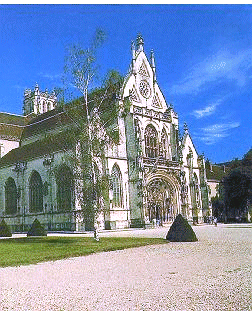
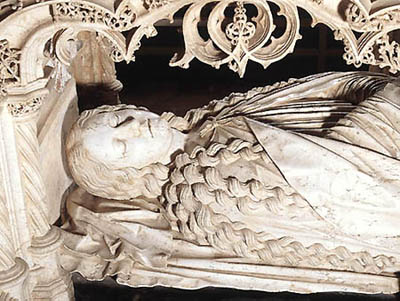
Margaret's entrails were buried in an urn, in the Saint-Peter's Church, in Mechelen. They are now in the new church on the same place, today's Saint-Peter-and-Paul's Church, right across Margaret's Palace. Her heart was given to the cloister in Brugge, the one she hoped to be spending her old days. During the centuries, her heart disappeared. Her body was buried in the church of Brou in Bourg-en-Bresse, in the mausoleum of her husband Philibert. Her she can be still found today, in a beautiful tomb designed by Conrad Meyt.