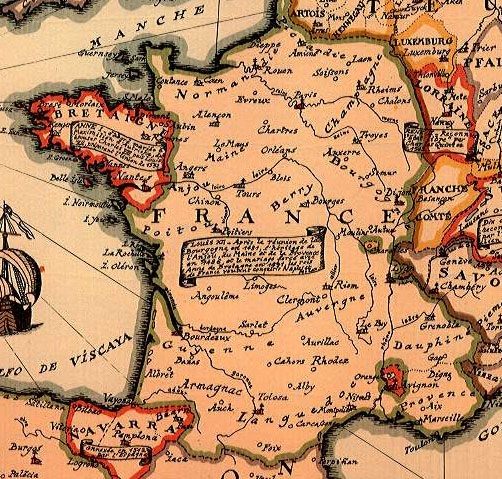
Prehistoric Cultures
The oldest identifiable cultures are those of the Old Stone or Paleolithic Age (50,000 BC-8000 BC). These cultures left to posterity a rich artistic heritage of paintings on cave walls; the most famous of these cave paintings are at Lascaux in the Dordogne region of southwestern France.
The Middle Stone or Mesolithic Age (8000-4000 BC) people were food gatherers like their ancestors but left relatively few remains. The peasants of the New Stone (Neolithic) Age (4000 BC-2000 BC), on the other hand, left several thousand remarkable stone monuments in France, including the menhirs in Brittany, the statue-menhirs of southern France, and the dolmens, or chamber tombs, of the Loire Valley, the Parisian Basin, and Champagne.
More sophisticated cultures emerged in the Bronze Age (2000-800 BC) and the Iron Age (8th-2nd century BC). By about 800 BC the techniques of working with iron had been introduced by the Hallstatt people�warriors and shepherds who had spread from their native Alpine region into much of France. In the period that followed, the Celts, or Gauls, became the dominant group.
Contact with Mediterranean culture began when the Greeks explored the western Mediterranean in the 7th century BC, established a colony at Marseille, and traded with the interior via the Rh�ne Valley. In the 5th century BC the La T�ne culture�characterized by finely crafted jewelry, weapons, and pottery�spread from eastern Gaul through the rest of the Celtic world.
Roman Gaul
In 121 BC the Romans established a protectorate over the old Greek colony at Massilia (now Marseille) and then founded another settlement farther inland at Narbonne, which in turn became the center of the flourishing province of Gallia Narbonensis.
Julius Caesar conquered the rest of Gaul several decades later, between 58 and 51 BC. The newly conquered lands were called Gallia Belgica, Gallia Lugdunensis, and Aquitania. The main center of administration was Lugdunum (modern Lyon).
After the Romans consolidated control over Gaul, their main problem was the long, exposed northeastern frontier with the Germanic tribes. Rome intended to conquer the German lands beyond the Rhine and make Colonia Agrippinensis (modern Cologne, Germany) a base somewhat equivalent to Lyon. After being defeated by the Germans in AD 9, however, the Romans limited themselves to defending the Rhine frontier. Many Gauls served in the frontier legions, and the first two centuries under Roman domination were generally peaceful and prosperous for the Gauls and the Romans alike.
In the 3rd century AD, as the Roman Empire began its decline, Gaul was afflicted by a variety of ills: political instability, a dwindling supply of slaves, plague, rising inflation and its complement of economic insecurity, mounting pressure from the Germanic tribes along the frontier, and a general breakdown of law and order. Temporary respite was gained in the time of the emperor Diocletian, whose military and fiscal reorganization was carried out in part from an imperial residence in Gaul at Trier (now in Germany).
Christianity, which had been introduced as a persecuted sect in the 2nd century, flourished under imperial protection in this period of personal insecurity and political disorder. By the 5th century, even the Gallo-Roman aristocracy was converting; men from old senatorial families moved rather easily into episcopal positions.
Throughout the 4th century small groups of Germans had been settling in Gaul with the permission of the Roman authorities. In 406 this movement became an invasion when the Vandals, Suevi, and Alans broke through the frontier, moved rapidly across Gaul on a southwesterly course, and crossed into Spain. In 412 the Visigoths freely entered southern Gaul from Italy, and about 440 the Burgundians settled in eastern Gaul. In the northwest, Celtic refugees from Britain, which had also been invaded by Germanic tribes, sought and gained refuge and gave their name to the region of Brittany. In 451 Germans, Romans, and Gauls united to defeat a new horde of invaders�the Huns under Attila.
The Emergence of France
In the last quarter of the 5th century, as Roman imperial authority collapsed in the West, Gaul was conquered by another Germanic tribe, the Salian Franks. Their leader Clovis was a tough warrior, unhesitatingly violent and, when he saw fit, treacherous. Married to a Christian Burgundian princess, he became a Christian himself in 496. By adopting the Catholic form of Christianity favored by the Gallo-Romans instead of the Arian Christianity espoused by the Visigoths, he was able to strengthen his hold over the country.
The Merovingians
Clovis's dynasty, the Merovingian, named after its founder, Merovech or Merowig (reigned 448-458), ruled until 751. According to Frankish custom all the king's possessions, including the royal title, were divided among his sons. Because of this practice, Merovingian France was beset by continual disunity and civil war in the 6th century. The kingdom was again unified in 613 under Clotaire II and Dagobert I. Thereafter it went into severe decline under a series of weak, incompetent kings. During this period power came to be concentrated in the hands of the mayors of the palace, royal officials who had charge of the king's estates. Struggles broke out among the mayors that were reminiscent of those among earlier kings. Late in the 7th century, one palace mayor in particular, Pepin of Herstal, a member of the Arnulfung family of Austrasia (in eastern France and western Germany), achieved superiority over his rivals, successfully extending his authority over the Frankish kingdoms of Neustria and Burgundy to the west and south. He was succeeded by his son, Charles Martel, whose glory was to rally a Frankish army that repulsed a Muslim invasion from Spain in 732. In 751 Martel's son and successor, Pepin the Short, deposed the last Merovingian ruler and had himself crowned king of the Franks.
The Carolingians
The new dynasty�eventually named Carolingian, for its most famous member, Charlemagne, or Charles (Carolus) the Great�was strengthened by Pepin's alliance with the papacy. In return for Frankish help against the Lombards, who were encroaching on papal territory in Italy, Pope Stephen II approved the Carolingian seizure of the throne.
In 754 the pope journeyed to France to anoint Pepin and his sons with holy oil as the biblical kings of Israel had been anointed by the prophets. Pepin in turn fought campaigns in Italy on the pope's behalf in 754 and 756. The king then turned over the lands he conquered in Italy to Pope Stephen II and these became the Papal States�territory governed directly by the papacy. Pepin's rule was divided, at his death in 768, between his sons Charles (the future Charlemagne) and Carloman. Carloman died three years later, however, and Charlemagne was the sole ruler of the Franks for more than four decades, until his death in 814.
Charlemagne
Military campaigns occupied Charlemagne in the early years of his reign. Like his father, he fought in Italy, both on the pope's behalf and on his own, conquering the Lombards and taking the Lombard royal title for himself. He campaigned in Spain against both the Muslims and the Basques and established a frontier territory called the Spanish March. In the east he fought the Bavarians and the Avars and absorbed them into his realm. For three decades he campaigned against the Saxons in Germany, eventually bringing them under his control and forcing them to convert to Christianity.
In the year 800, Charlemagne was crowned in Rome by Pope Leo III and received the title emperor of the Romans. There had not been a Roman emperor in the western provinces since the late 5th century. He established a vast administrative system, divided into some 250 counties, for governing his empire. He assembled the leading scholars of Europe and fostered a program of intellectual and religious reforms. Charlemagne established a principal royal residence at Aix-la-Chapelle, his favorite sulfur-spring spa (now Aachen, Germany).
Charlemagne's Successors
Even before 800, Viking raiders from Scandinavia had begun to attack the coastal areas of the Carolingian realm. The full impact of these raids, however, was not felt until the reign of Charlemagne's successor, Louis I the Pious, whom Charlemagne himself crowned emperor in 813. The Viking attacks and succession problems after Louis the Pious made a shambles of the Carolingian Empire.
Louis sought to provide for an orderly succession by decreeing in 817 that his eldest son, Lothair, would inherit the empire and that his two younger sons, Pepin of Aquitaine and Louis II (Louis the German), would hold subordinate kingdoms within the empire. The emperor then had a fourth son, Charles, by his second wife, who was determined that her son would not be excluded from the royal inheritance.
The sons fought bitterly among themselves and sometimes against their father as well. One temporary settlement among three of the brothers is of particular historical interest. By the Treaty of Verdun (843), Lothair was to get the imperial title plus a long strip of territory stretching from the North Sea at the mouth of the Rhine all the way down to and including Rome. Louis the German received the lands east of the Rhine, and Charles the Bald those west of the Rh�ne, the Sa�ne, the Meuse, and the Schelde. Louis's territory was a forerunner of modern Germany, Charles's a forerunner of modern France, and Lothair's a forerunner of the lands in between that have been so often fought over by France and Germany in modern times. Although this particular division did not prove lasting, the separation of Francia Occidentalis (the West Frankish Kingdom, or France) from Francia Orientalis (the East Frankish Kingdom, or Germany) became permanent at this time.
The Vikings and the Foundation of Normandy
The disunity of the Franks facilitated the raiding missions of the Vikings. Seaports, river towns, and monasteries situated near waterways became their victims. Rouen and Paris on the Seine River, Nantes, Tours, Blois, and Orleans on the Loire, Bordeaux on the Garonne, and many other towns were pillaged by the Vikings. The same was true for the abbeys of Saint Denis, Saint Philibert, Saint Martin, Saint Beno�t, and others. One of the few effective defenders against these raids was Robert the Bold, a magnate in the Seine Valley in the mid-9th century.
The Vikings set up bases for their operations, usually at the mouths of rivers, but eventually they sought to make permanent settlements. In 911 a large company of Vikings (French Normands), under their leader Rollo, accepted from the West Frankish king Charles III the Simple the territory in the lower Seine Valley that became known as Normandy.
In 888 the West Frankish crown was offered to Count Odo, or Eudes, son of Robert the Bold. After his death it reverted to the Carolingians, but they had little influence. By the time of Louis V (967-987), effective power had filtered down to the level of the castellan, a strongman with a retinue of fighters who controlled a castle and its immediate surroundings.
The Early Capetians, 987-1180
When Louis V died, the magnates turned to Hugh Capet, duke of France and descendant of Robert the Bold and of Odo. Hugh was elected king not because he was strong but precisely because he would not be strong enough to control the other magnates; in fact, he secured election only by giving much of his land to the electors.
The French nobles may have had no intention of installing the Capetians as a dynasty, but Hugh moved quickly to have his son Robert crowned. When Robert became king (as Robert II) in 996, he named his son Hugh as his successor, but due to Hugh's death, another son, Henry, became king in 1031. The Capetians eventually passed the crown through a direct male line for more than three centuries, from 987 through 1328.
The earliest Capetians remained subservient to the feudal princes, but the rebuilding of a royal administration, indicated by a new importance of royal provosts, was evident by the 1040s. Nevertheless, in the late 11th century, William the Conqueror, duke of Normandy, and Hugh the Great, abbot of the monastery of Cluny, although nominally vassals of the king, were far more powerful than the Capetian king Philip I (reigned 1060-1108).
Philip's successor, Louis VI (reigned 1108-1137), consolidated royal power once and for all in the �le-de-France, a region centering on Paris that covers about 160 km (about 100 mi) from north to south and 80 km (50 mi) from east to west. Here he systematically suppressed all feudal opposition to the royal government. He had his son, the future Louis VII, brought up at the abbey of Saint Denis, north of Paris, and in 1137 arranged for him to marry Eleanor, heiress to the duchy of Aquitaine.
Eleanor's possessions were far larger than the �le-de-France, and by making her his wife, Louis VII won control of extensive territories between the Loire River and the Pyrenees. In 1147 Louis went on a Crusade to the Holy Land, taking Eleanor along with him. While they were in the East it was rumored that she had committed adultery. Since the marriage had never been agreeable to Eleanor, and had not produced a male heir, both spouses wanted the papal annulment of the marriage, granted in 1152. Two months later Eleanor married Henry, count of Anjou and duke of Normandy, who in 1154 became king of England as Henry II. Thus, Aquitaine passed from the French crown to the English crown, and the lands controlled by Henry in France (the Angevin Empire) vastly exceeded in size those of his feudal lord, Louis VII.
The Later Capetians
The fortunes of the Capetian dynasty improved under Louis VII's successor, Philip II Augustus.
The Reign of Philip Augustus, 1180-1223
Through his first marriage, Philip acquired new territories in northern France�Artois, Valois, and Vermandois. He also secured royal control of the Vexin, a small but critical area on the Seine at the juncture of Normandy and the �le-de-France. Philip served briefly in the Third Crusade (1190-1191).
His chance to move against the Angevin Empire came when King John of England married a princess already betrothed to another of Philip's vassals. Philip summoned John to his court three times, and when John failed to appear, Philip was able to condemn John and declare his lands forfeited. In 1204 Philip undertook the military conquest of Normandy and Anjou. Ten years later he secured his conquests by defeating the combined armies of England and the Holy Roman Empire at the Battle of Bouvines.
An opportunity for northern French intervention in the south was furnished by the Cathari, or Albigenses, a dissident religious sect particularly strong in Provence and Languedoc. St. Bernard and others had preached against the Cathars in the 12th century, but without much success. Pope Innocent III (reigned 1198-1216) encouraged new preaching missions until one of his representatives in the region, Peter of Castelnau, was assassinated in 1208. Innocent thereupon adopted the weapon of the Crusade, which until then had only been used against Muslims, as a means of fighting the Cathar heretics. Crusaders were promised the land they succeeded in taking from the heretics, and northern French knights under Count Simon de Montfort rushed to participate. Philip Augustus was too occupied with the English to join in the first phase of the Albigensian Crusade, but his son Louis VIII led a successful campaign that resulted in the extension of the royal domain south to the coast of the Mediterranean Sea. One price of this political integration of the south into the kingdom of France was the destruction of the independent culture of Provence and Languedoc. Another was the life of Louis VIII, who was killed in the Crusade.
Louis IX
Louis IX (reigned 1226-1270) ascended the throne at the age of 12, with his mother Blanche of Castile as regent. Some of the French barons, thinking this an appropriate moment to rebel against the royal government, joined forces with the English, who were eager to regain their lost territories, but Blanche was able to put down all their plots and rebellions.
Louis's great accomplishment at home was to gain the loyalty of the conquered provinces by means of a just and humane administration. He was careful to guard against corruption or the abuse of authority by sending out investigators from his court to hear complaints from his subjects about royal officials. Under him, the royal government became larger, more professional, and more specialized.
A devoutly religious man, Louis wished to crown his career with a Crusade. He put his affairs in order in 1247 and left for the Middle East. He launched an attack in Egypt at Damietta, but his advance was soon halted by the Muslim defenders. He then went to the Holy Land to supervise the strenghtening of the Christian fortifications there. In 1270 he again went on Crusade; this time, along with many of his soldiers, he was struck down by disease and died while attacking Tunis. Despite these two ill-fated expeditions, Louis was loved and respected. After his death miracles were attributed to him and in 1297 he was officially declared a saint.
Philip III (reigned 1270-1285) was the fifth French king in a row to go on a Crusade�this one to fight the Moors in Spain�and the third in a row to die on one. He had, however, arranged for the marriage of his son to the heiress of the county of Champagne, thus adding to the possessions of the royal house.
Philip IV the Fair
Philip the Fair, last of the great Capetian kings, greatly strengthened the powers of the royal government. He chose capable and ambitious advisers to serve his late 13th-century administration, of whom the best known were William of Nogaret and Pierre Dubois. Together they sought to remove limitations on royal authority, a process that involved persistently chipping away at local practices, special privileges, or provincial prerogatives. Bishops, barons, and towns were compelled to cooperate with the king, whether in connection with the demands of royal justice or with those of the royal treasury. Philip successfully annexed Franche-Comt�, Lyon, and parts of Lorraine, but failed in his attempt to gain control of Flanders.
Philip's intervention in Flanders was one of the costly policies that led him to try to tax the clergy, and this in turn brought him into sharp conflict with Pope Boniface VIII. In 1297 Boniface conceded that for the exceptional purposes of the �defense of the realm� a king might place a tax on the clergy without consulting the pope. The papacy continued, however, to deny the king's right to arrest a priest on a secular charge. Legal arguments supplemented by slanderous propaganda attacks were exchanged. Nogaret led an expedition to Italy supposedly to arrest Boniface and bring him back to France for trial. A violent confrontation took place at Anagni, and shortly afterward the elderly pope died. The dispute was essentially over the issue of sovereignty, although that term was not yet in use. In 1305 Philip's influence secured the election of a French pope, Clement V, who moved the papal court from Rome to Avignon in 1309 and eventually cleared Philip and his counselors of any charge of impropriety in their dealings with Boniface.
Philip's insatiable hunger for money led him to expel the Jews from the kingdom and confiscate their wealth. For the same reason he persecuted and suppressed the Templars, a wealthy order of crusading knights.
Philip succeeded in strengthening the royal government, but by his high-handed methods he squandered much of the monarchy's store of goodwill and respect. The administrative system continued to function well through the 14th and 15th centuries, but the prestige of the monarchy was much reduced and its prerogatives often challenged. This decline in prestige was accompanied by a break in the line of succession: Between 1314 and 1328, three sons of Philip IV�Louis X, Philip V, and Charles IV�held the throne successively, and each died without male heirs (a posthumous child of Louis X reigned for a few days as John I in 1316).
France Under the Early Valois
On the death of Charles IV, the crown passed to Philip IV's nephew, Philip of Valois, who reigned as Philip VI from 1328 to 1350. The English king Edward II had married a daughter of Philip IV, and at first this marriage did not seem to pose any problem for the French succession. Later, however, Edward III (reigned 1327-1377) became the rival of Philip VI for control of Flanders, and Philip supported Scotland against Edward. In 1337 Edward put forward a claim to the French throne as the grandson of Philip the Fair. Philip VI replied by declaring void the English claim to Gascony, and the two kings began a war that was to last for more than a century.
The Hundred Years' War, 1337-1453
The English began by taking control of the English Channel with a smashing naval victory off Sluis in the Netherlands and then freely attacked northern France. The first major encounter on land took place near the channel coast at Cr�cy in 1346 and was a thorough victory for the English. The English subsequently undertook an exhaustive siege of Calais, which capitulated after two years.
The Black Death
In 1348 the bubonic plague entered France from the Mediterranean via Marseille. The resulting pandemic engulfed the country in two years, killing as much as one-third of the population. The value of the labor of those who survived was notably enhanced. Prices and wages rose sharply, and the government tried to impose wage ceilings.
The second half of the 14th century was a dismal period marked by various manifestations of social unrest. The plague returned in 1361, 1362, 1369, 1372, 1382, 1388, and 1398. Children born after an outbreak were especially vulnerable in a new outbreak, which further affected the already great decline in population. The psychological disruption wrought by these disasters was apparent in a pervading obsession with death and in the proliferation of fanatical and aberrant religious movements. Social disruption included fierce rebellions by peasants caught between high prices and landlords who tried to increase production and keep a lid on wages. The most famous and widespread peasant uprising was the Jacquerie of 1358. The countryside was also prey to French and English mercenary bands that lived off the land between battles. Urban unrest also resulted in violent uprisings, exemplified by the Parisian insurrection led by �tienne Marcel in 1358. In a depressed economy the costs of war continued to mount, including the ransom paid for King John II, who had been taken prisoner by the English at the Battle of Poitiers in 1356. During this period the Estates-General, an assembly of clergy, nobles, and commoners first summoned by Philip IV, acquired great power.
Joan of Arc and Recovery
France's fortunes were not improved by the 42-year reign of the insane King Charles VI beginning in the late 14th century. The English king Henry V invaded France in 1415, crushed the French army at Agincourt, and took control of most of France north of the Loire.
The French revival under Charles VII (reigned 1422-1461) was begun by the inspired and charismatic peasant, Joan of Arc. She made her way to Charles's court in 1429 and took the lead in lifting the English siege of Orl�ans. The war dragged on for more than 20 years, but the French never lost the momentum gained from the brief intervention of the dynamic young woman from Lorraine. In 1453 Charles entered Bordeaux, and the English lost the Hundred Years' War and surrendered all their territory on the Continent except Calais.
Economic and social recovery accompanied the political recovery. During the middle and later years of the 15th century the strength of the economy and the size of the population returned to their preplague levels. Louis XI (reigned 1461-1483) consolidated royal authority to a greater extent than ever before, creating a paid standing army and acquiring the power to levy a tax�the taille�without the prior consent of those taxed. He incorporated most of the duchy of Burgundy into the kingdom and used royal revenue to protect, facilitate, and stimulate economic development.
Charles VIII (reigned 1483-1498) succeeded to the throne at 13 years of age. His sister, who served as regent, arranged for his marriage to Anne, duchess of Brittany. By this marriage, the last independent feudal principality was incorporated into the French royal domain. When his sister's regency ended in 1492, Charles agreed to the Treaty of �taples, which settled France's outstanding difference with England.
The Renaissance and Reformation
By the end of the 15th century France had emerged from the divisions of its feudal past and had become a national monarchy incorporating lands stretching from the Pyrenees to the English Channel. The social structure was still dominated by the landed aristocracy, and land remained the principal form of wealth. In the next half-century, however, domestic peace, growing population, an influx of gold and silver brought to Europe from America by the Spaniards, and the government's public works and military orders stimulated economic growth, which raised wholesale merchants, bankers, and tax collectors to a more important place in society. The nobility, on the other hand, dependent on fixed monetary rents and dues, saw both their economic power and their social position threatened by inflation.
The first three monarchs of the period�Charles VIII, Louis XII (reigned 1498-1515), and Francis I (reigned 1515-1547)�took advantage of the nation's growing strength and internal security to lead armies into Italy to enforce claims to the kingdom of Naples and the duchy of Milan. In the 1520s the Italian wars merged into a larger struggle between France and the Habsburg dynasty of Spain and Austria over conflicting territorial claims, a struggle that continued intermittently for a century and a half. The Italian wars were finally terminated by the Treaty of Cateau-Cambr�sis (1559), negotiated by Francis I's son, Henry II (reigned 1547-1559). France gave up all claims to Italy but acquired three strategically located territories on its eastern frontier�the bishoprics of Metz, Toul, and Verdun.
Francis I
Francis I significantly increased both the power and the prestige of the Crown. He imposed himself as the monarchy's sole Lawmaker and never called the Estates-General. By the Concordat of Bologna (1516), negotiated with Pope Leo X, he won for the French king the power to fill all bishoprics and other benefices with persons of his choice, thus assuring a manageable clergy. In 1539 he banned Latin, the language of the church, from use in judicial acts and required the exclusive use of French. He was a generous and discerning patron of the arts and learning, and the flowering of the French Renaissance owed much to his support. Buildings surviving from his reign still attest to his influence and to the power and wealth of the monarchy.
The Wars of Religion
The latter half of the century was a succession of difficult and agitated decades in France. Rising population, without a compensating rise in productivity, and monetary inflation reduced much of the populace to poverty. The Protestant Reformation, spreading from Germany during the reign of Francis I, had attracted few followers, but in the 1540s and 1550s the French Protestant John Calvin created the doctrine and the institutions of a distinctively French form of Protestantism, and it won many powerful followers in the nobility and thousands of lower rank. Henry II considered Calvinism a threat to royal authority, and he tried to stamp it out. Under his three sons, who succeeded him, the country was torn by the Wars of Religion, wars in which religious, political, and dynastic conflicts were inextricably mixed. The fanaticism of the religious combatants and the brutality of mercenaries made it a struggle in which pillage, cruelty, and atrocities were normal.
The Regime of Catherine de M�dicis
The death of Henry II in 1559 brought to the throne his sickly 15-year-old son Francis II (reigned 1559-1561), who succeeded his father for only two years. His successor was his 13-year-old brother, Charles IX (reigned 1561-1574). The queen mother, Catherine de M�dicis, was the virtual ruler during most of their reigns and she continued to be influential in the reign (1574-1589) of her third son, Henry III. Catherine's first concern was the defense of her sons' royal authority. She repeatedly pressed the religious contenders to compromise on a settlement that would enable both to believe and worship as they pleased, but unfortunately for France she was powerless against their fanaticism. She herself became its tool in sanctioning the Saint Bartholomew's Day Massacre in Paris in August 1572, when Roman Catholics fell upon assembled Protestant leaders and their followers and murdered about 2000 of them.
The Rise of Henry of Navarre
Henry III's last surviving brother died in 1584, and Henry of Bourbon, king of Navarre, a descendant of Louis IX and the leader of the Protestant, or Huguenot, party, became next in line to the throne. Repelled by the prospect of a heretic king, some members of the Roman Catholic party plotted to forestall his succession by replacing Henry III with Henry, duke of Guise, the leader of the Catholic League. Warned of this, Henry III summoned Guise to a conference at Blois in 1588 and there had him assassinated. The following year King Henry himself�the last of the Valois dynasty�fell victim to an assassin's blade.
Henry of Navarre, as the legal heir, took the title Henry IV of France, but he was, in fact, only king of the Huguenots. He had to defend his claim to the throne against the Catholic League and against their Spanish allies, who occupied Paris. Henry understood that, although he and his followers were Protestant by conviction, most of the French were faithful Roman Catholics, and in 1593 he publicly converted to Roman Catholicism. The next year he was crowned in Chartres Cathedral and soon after was welcomed into Paris, establishing the Bourbon dynasty on the French throne.
"France," Microsoft (R) Encarta. Copyright (c) 1994 Microsoft Corporation. Copyright (c) 1994 Funk & Wagnall's Corporation.