In 1598, with the expulsion of the last Spanish troops from French territory, the long years of war were ended. In the same year Henry, seeking to assure the domestic tranquility of his realm, issued the Edict of Nantes, which granted freedom of religious conscience to all his subjects; it guaranteed the Huguenots freedom of public worship in specified castles and towns and assured them equal access to public office. Never before had a European ruler formally accorded freedom of religious conscience and worship to his or her subjects.
The reign of Henry IV after 1598 was for France a period of recovery from the devastation and disruption of the Wars of Religion and the beginning of renewed economic growth. During most of the period the country was at peace. The royal finances were restored. In aid of the peasantry, who made up 90 percent of the population and who had suffered heavily from the pillage and devastation of war, Henry canceled arrears in land taxes, forbade seizure of livestock or tools by creditors, made public lands available for purchase below market price, and restricted nobles' hunting rights over cultivated fields. To promote commerce he built canals, improved rivers, and restored and built bridges and roads. He brought foreign artisans to France to develop new industries and introduced the cultivation of mulberry trees, on which silkworms subsist, to ensure a domestic supply of raw silk for the silk industry.
By the close of the 17th century's first decade, the economy was thriving and royal authority was again firmly established. The Roman Catholic clergy, however, were united in opposition to the official toleration of the Huguenots. In 1610 a religious fanatic�or an agent of the Habsburgs (the record is not clear)�assassinated the king. Henry, rejected by his people as a heretic in 1589, was, in death, almost universally mourned. In succeeding decades and centuries he became the �good King Henry,� the most acclaimed and beloved of French kings.
Louis XIII and Cardinal de Richelieu
Henry was succeeded by his nine-year-old son, Louis XIII. For the first decade and a half of his reign the country drifted or slipped backward under the ineffectual direction of the queen mother, Marie de M�dicis, and later under the irresolute leadership of the inexperienced young king.
In 1624 Louis chose as his first minister Armand du Plessis, cardinal de Richelieu, who was the effective ruler of France for the next 18 years. Richelieu's primary goals were to eliminate all rivals to the royal power and to contain threats from abroad.
Internal Developments
To break the political power of the nobility Richelieu executed several of its eminent and dangerous members and battered down castles that could be used as centers of resistance. To undermine their local authority and to ensure faithful execution of royal policies in the provinces, Richelieu divided the country into 30 new administrative districts and over each placed an intendant, a royal officer appointed from among loyal middle-class officials. The intendants gradually assumed enormous police, judicial, and financial powers in their districts. Huguenots were deprived of the privileges granted by the Edict of Nantes, but freedoms of conscience and worship were reaffirmed.
Richelieu encouraged the development of a merchant fleet, chartered foreign-trade companies, and supported colonial expansion. Systematic colonization was begun in French Canada, and the first French trading posts were established in Africa and the West Indies. For the protection of trade and colonies he founded the French navy, building a galley fleet on the Mediterranean and a fleet of 40 sailing vessels on the Atlantic.
Inflation, mounting taxes, and, after 1635, the devastation wrought by invading armies reduced much of the peasantry to new depths of misery. Peasant revolts occurred in Burgundy in 1625-1630, in the south in 1636-1637, and in Normandy in 1639. All were mercilessly repressed.
Foreign Policy
When Richelieu became the king's first minister in 1624, the Thirty Years' War, a German civil and religious war that was becoming a general European war, was in its first decade. In 1635, when it appeared that the Habsburg Holy Roman emperor might unite all Germany under his rule, Richelieu took France into the war as the ally of Protestant Sweden and the Netherlands against the Roman Catholic Habsburgs. The peace settlement in 1648 brought most of Alsace to the French crown and ensured the continued division and weakness of Germany. In the peace with Spain in 1659 France acquired Artois in the north and Roussillon on the Spanish frontier. Habsburg ambitions had been blocked, and France emerged from the war as the great victor.
The Reign of Louis XIV
Richelieu died in 1642 and Louis XIII died in 1643, leaving the throne to Louis's five-year-old son, Louis XIV.
Mazarin and the Fronde
Richelieu's prot�g� and successor, Cardinal Jules Mazarin, continued his master's policies, bringing the war with the Habsburgs to a victorious conclusion and at home defeating the first concerted effort by disgruntled aristocrats and bourgeois to reverse Richelieu's concentration of power in the king.
In 1648 hereditary judges of the Parlement of Paris, the highest judicial court of the realm, in alliance with Parisian bourgeois protesting heavy taxes, and with support from the city's workers, set off a rebellion, called the Fronde, against the Crown. Soon after it was ended, disaffected nobles in the south rebelled, and again parts of France were ravaged by civil war before the revolt was suppressed. The Fronde failed to stop the centralization of power, and not until the 1780s did the privileged orders again seriously challenge the authority of the Crown.
Louis's Absolutism
On the death of Cardinal Mazarin in 1661 Louix XIV announced that henceforth he would be his own first minister. For the next 54 years he ruled France personally and conscientiously and established himself as the model of the divine-right, absolutist monarch in the European Age of Absolutism.
Early in the period of his personal rule Louis established the structure of the absolute state. He organized a number of councils to advise him and to carry out his instructions, and he staffed them with able men, completely dependent on him for position and income. The claims of the parlements to a veto over royal decrees were effectively silenced. The potentially dangerous nobility of the sword (descendants of the old feudal nobility) were attached to the court in prestigious but ceremonial offices, which left them no time for political activity. The wealthy bourgeoisie was kept politically satisfied by the government's assurance of order at home, its active promotion of commerce and industry, and by the opportunities to make fortunes from the state's expenditures.
Louis and the Church
The power to appoint bishops gave the king a firm grip on the hierarchy of the church. The king ruled as the representative of God on earth, and the obedient clergy provided the theological justification of his divine right. A dissident movement, Jansenism, which developed in the 17th century, was politically threatening in its emphasis on the supremacy of individual conscience, and Louis combated it from the beginning of his reign.
Patronage of the Arts
The great palace that Louis built at Versailles was�and remains�unmatched in size and magnificence, and it stands as a monument of French architecture, painting, sculpture, interior decoration, landscape gardening, and building technology. Louis was a munificent patron of the arts. He sought to raise standards of taste by founding the Academy of Fine Arts and the French Academy in Rome. He supported authors with pensions and by performance of their works, appointed a surintendant of music to develop French musical composition and performance, and established the Academy of Science.
Regulation of the Economy
Louis's minister for commerce and finance, Jean Baptiste Colbert, was the age's great exponent of mercantilism. He subsidized industries, raised barriers against foreign competition, established quality controls on industry, developed colonial markets closed to all but French traders, chartered overseas trading companies, rebuilt the navy, and at home constructed roads, bridges, and canals.
The Persecution of the Huguenots
Before the end of the reign the costs of Louis's wars had undone much of Colbert's work of economic development, and in 1685 Louis struck a blow at the economy by revoking the Edict of Nantes. Convinced that most Huguenots had converted to Roman Catholicism, he withdrew the edict granted by Henry IV. Public Protestant worship was forbidden; preachers were expelled from the country; and meeting houses were ordered demolished. Despite the threat of heavy punishment, between 200,000 and 300,000 Huguenots left France. They were skilled artisans, intellectuals, army officers�valuable subjects whom France could ill afford to lose.
The Wars of Louis XIV
Louis led his country into four costly wars. In all of them he followed established national policies of containing and reducing the power of the Habsburgs, extending France's frontiers to defensible positions, and winning economic advantages. His minister of war, the marquis de Louvois, provided him with a powerful army of 300,000 trained, disciplined, and well-equipped men. In 1667 he used it to enforce a claim, based on his marriage in 1660 to Maria Theresa, daughter of Philip IV of Spain, to a province of the Spanish Netherlands. A hostile alliance of maritime powers induced him to negotiate a compromise peace in 1668. France's reward was 11 fortified places on the northeast frontier.
In 1672 strategic and economic considerations moved Louis to attack the Dutch Republic, where he soon found himself confronted not only by the tenacious Dutch but also by a powerful coalition. France emerged from six years of war with two territorial gains�the Franche-Comt� on the eastern frontier and a dozen fortified towns in the southern Netherlands.
In 1689 an alliance of European powers went to war with Louis to put a stop to his practice of annexing territories adjoining towns ceded by earlier treaties. Eight years of war ended in a settlement in which both sides returned their conquests, although France did retain the city of Strasbourg in Alsace.
The combatants had been disposed to settle their differences because a new international crisis loomed on the near horizon. The sickly Charles II, king of Spain, had no direct heir. A month before his death he willed his entire kingdom to Louis XIV's grandson, Philip of Anjou. Although Louis had earlier advocated a division of the inheritance, he now chose to support his grandson's claim to all of it. The other European states feared the consequences of so great an extension of Bourbon power and joined in a coalition to prevent it. The consequent War of the Spanish Succession went on for 13 exhausting years. In the end Louis achieved his primary objective�his grandson was confirmed in possession of Spain and the Spanish colonies.
The End of Louis's Reign
The war, combined with a devastatingly cold winter in 1709 and poor harvests, brought to France crushing hardship, food riots, and angry demands for political and fiscal reform. A smallpox epidemic in 1711-1712 took in quick succession three heirs to the throne, leaving a single surviving heir in the direct line, Louis's five-year-old great-grandson. Louis died at Versailles on September 1, 1715, in the 73rd year of his reign.
France in the 18th Century
Louis XV (reigned 1715-1774) and his grandson, Louis XVI (reigned 1774-1792), were well-intentioned rulers, but both lacked the abilities needed to adapt their country's institutions to the changing conditions of the 18th century. Louis XV was indolent, bored by affairs of state, and quick to seek escape in the pleasures that wealth and position opened to him. He discredited the monarchy, and at his death he was so unpopular that his body was buried secretly. Louis XVI, only 20 years old when he began his reign, was weak-willed and easily influenced by those around him. His young queen, Marie Antoinette, frivolous and extravagant, intervened with him to block needed reforms.
The 18th century was, nonetheless, one of the great ages of the country's history. France was the richest and most powerful nation on the Continent. French taste and styles in architecture, interior decoration, dress, and manners were copied throughout the Western world. The political and social ideas of French writers influenced both thought and action throughout Europe and America, and French became the language of educated people around the world
The Economy
The century was a period of extraordinary economic growth. The population rose from 21 million in 1700 to 28 million in 1790. Agricultural income increased by 60 percent. French economic historians place the beginnings of France's industrial revolution in the 18th century, when the country was the leading industrial power in the world. The Corps des Ponts et Chausse�s (Department of Bridges and Highways), founded in 1733, had by 1780 given France the best highway system in Europe. The French merchant marine expanded to more than 5000 ships, which engaged in lucrative trade with Africa, America, and India and enriched the merchants of the French Atlantic ports. The income of urban laborers and artisans, however, barely kept pace with inflation, and most peasants, with little surplus to sell and heavily burdened by taxes, tithes, and feudal obligations, continued to eke out only a miserable existence.
Taxation
The government itself was excluded from the new prosperity. The tax system, which exempted the lands of the nobility and the clergy (about 35 percent of the cultivated land) from the principal land tax, failed to tap all the nation's wealth and put an inequitable burden on the peasantry and the bourgeoisie. Successive ministries from midcentury on attempted to establish equitable taxation of all fortunes, but they were foiled by the opposition of privileged groups and by the failure of the king to support reforms against such opposition.
Opposition to the Monarchy
The nobility of the robe (whose titles were originally purchased from the Crown) in the parlements led the opposition to the royal initiatives. They proclaimed the doctrine that the king's decrees were subject to their approval. They posed as defenders of public liberties against royal despotism, making their cause a popular one, but they were actually defending their own privileges and advocating a return to government by the aristocracy.
Intellectual opposition to the monarchy was led by the philosophes, French 18th-century writers on political, social, and economic problems. Rejecting custom and tradition as guides to action, they urged their compatriots to use reason to discover the natural laws governing human relations and then to shape new institutions of government and society in conformity with them. They also argued that all people had certain natural rights�life, liberty, and property�and that governments existed to guarantee these rights. Some, in the latter part of the century, advocated the right of self-government. These ideas were especially congenial to the bourgeoisie, which was growing in number, wealth, and ambition and coveted a voice in government. Through the bourgeoisie ideas filtered down to the lower levels of society and became part of the popular vocabulary of revolution.
The Financial Crisis
The government's financial problems were made worse after 1740 by the renewal of costly wars. The War of the Austrian Succession (1740-1748) and the Seven Years' War (1756-1763) were European wars over the domination of central Europe and colonial and commercial wars between France and Great Britain. At their end, in 1763, France lost almost all of its vast colonial empire in America and in India. In 1778 the French intervened against Britain in the American Revolution, thereby hoping to weaken its old colonial rival and to recover lost colonies. The hopes of the French were not realized, however, and their participation in the war increased an already burdensome national debt.
The tasks of coping with the worsening financial crisis fell to the irresolute young Louis XVI. After all his ministers' reform programs had been blocked by the parlements and an improvised Assembly of Notables, Louis in May 1788 forced the Parlement of Paris to accept edicts depriving the parlements of their political powers. Judges, nobles, and clergy resisted and tried to prevent application of the king's decree, winning support from the army and from the public, alienated by high unemployment and the highest bread prices of the century. In July the assembly of one of the southern provinces voted to withhold payment of taxes until the king called into session the Estates-General, dormant since 1615. On July 5, 1788, Louis agreed to summon the Estates-General and in August scheduled its opening for May 1789. The aristocracy had triumphed in the first stage of the French Revolution.
The Revolution of 1789
On May 5, 1789, 1200 deputies elected to the Estates-General met in Versailles. The government had no plan of action to meet the expectations of the deputies and the nation, and the members of the third estate, taking the initiative, on June 17 declared themselves the National Assembly of France. They invited the other estates to join them and took a solemn oath not to separate until they had given France a constitution.
The End of the Old Regime
When the government moved to disperse the assembly by force in July, the people of Paris rebelled, seized the royal fortress of the Bastille, and forced the king to accept the National Assembly. A peasant revolt spread across the countryside and moved the alarmed assembly�in a single, all-night session on August 4-5�to abolish all feudal dues and privileges, hereditary nobility, and titles.
The National Assembly, sitting from 1789 to 1791, remade the institutional structure of France. To deal with the pressing financial problem it confiscated the property of the church and issued paper money, using the lands as security. It reorganized the church under the Civil Constitution of the Clergy. It established a new provincial administrative system and a new judicial system, which shifted control to locally elected officials and judges, reversing the centuries-long process of centralization. The constitution adopted in 1791 created a parliamentary government with a hereditary monarch and an assembly indirectly elected by taxpaying citizens.
The constitutional monarchy lasted only one year. Louis was unwilling to play the role of constitutional monarch, and the militant Republicans were determined to establish a French republic. Successive defeats in the war with Austria and Prussia, which began in April 1792, provided the occasion for the overthrow of the monarchy by a popular insurrection on August 10, 1792. A new constituent assembly�the National Convention�was elected by universal male suffrage, and in September 1792 it established the First French Republic.
Jacobin Rule
In the crisis created by foreign invasion, domestic rebellion, food shortages, and uncertain loyalties among high officials, the convention permitted executive power to be concentrated in its Committee of Public Safety. The committee, dominated by the radical Jacobin faction, instituted the Reign of Terror to eliminate enemies and suspects and to coerce the undecided. The king was tried and executed in January 1793 and the queen in October, and thousands of nobles, priests, and commoners suffered the same fate. The committee instituted price controls, requisitioning, rationing, and conscription, and it also organized and equipped the new citizen armies.
The Directory
In 1794, when the victorious French forces were moving into enemy territory and domestic rebellion had been brought under control, the coercive regime was relaxed. The next year the National Convention adopted a constitution providing for a republic with the executive power vested in a five-man Directory and legislative power divided between two houses, indirectly elected in a way that ensured control by citizens of substantial property.
The Directory governed France through four difficult years of adjustment to the upheaval of revolution and continuing war. At home it was threatened from the Right by Royalists eager to restore the monarchy and on the Left by Jacobins determined to establish a democratic republic. A number of men in key positions saw the need for a more effective government, and they selected the young general Napoleon Bonaparte to stage a coup d'etat. In November 1799 he and his supporters overthrew the Directory and a month later established the Consulate.
The Consulate and the Empire
After his overthrow of the Directory, Napoleon Bonaparte quickly made himself master of the state and country. The new constitution, which he shaped, placed all essential powers in the office he assumed, that of first consul. He presented himself to the French as a man of peace who would end the long years of war, but once in power he insisted that the way to peace was through victory over the enemies of France still allied in the Second Coalition. He led an army into Italy and sent another into southern Germany, and their victories forced Austria to make peace in 1801. The coalition disintegrated, and Britain, without allies and losing trade with an increasingly French-dominated Europe, agreed to the Treaty of Amiens (1802), which ended hostilities between the two countries.
Napoleon's Internal Policies
First Consul Bonaparte sought to heal the wounds of the Revolution, to reconcile old enemies, and to create and consolidate the institutions of a stable government. He welcomed into his service all who would swear allegiance to him. He negotiated with Pope Pius VIII the Concordat of 1801, which reestablished the Roman Catholic church as a state church and provided for its support by the state but subjected it to strict governmental control. Napoleon's great codification of the laws confirmed the principal advances achieved by the Revolution, such as abolition of feudal privileges, equality before the law, freedom of conscience, the individual's free choice of occupation, and guarantees against arbitrary arrest and detention.
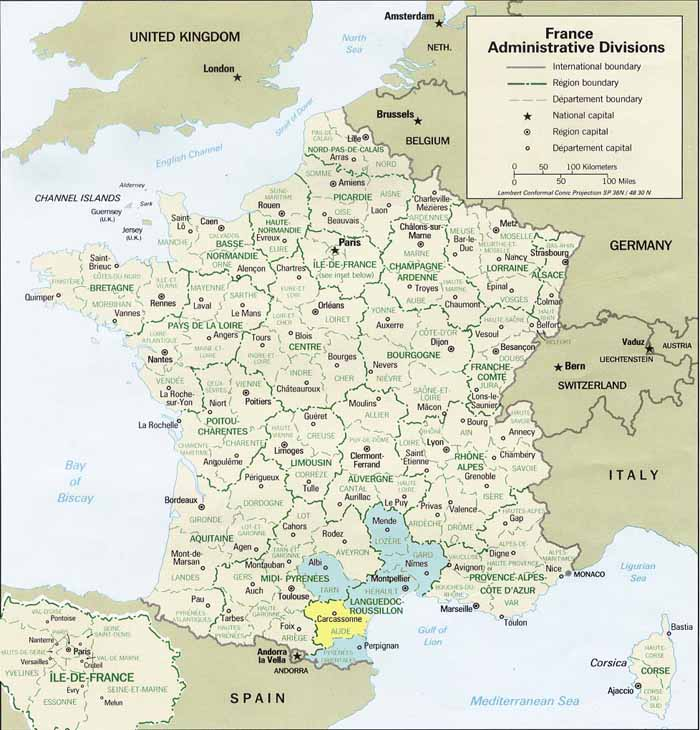
To ensure the administration's control of the 83 departments, the administrative units into which the country had been divided by the National Assembly, Napoleon placed each of them under a prefect appointed by the ministry of the interior. He established a central bank, the Bank of France; created a new unit of currency, the franc; and organized the Imperial University, an administrative organization to direct and control the nation's teaching corps.
Napoleon as Master of Europe
Although Napoleon posed as the defender of the Republic, in 1804 he established the French Empire and took the title of emperor. This action indicated that his ambitions extended beyond the limits of Bourbon France, and in 1805 he again took up arms. In the next two years he defeated Austria, Prussia, and Russia and made himself master of most of Europe. Britain remained in arms against him, secure in its control of the seas after destruction of the French fleet in 1805 off Cape Trafalgar. Napoleon undertook to bring the British to terms by closing Europe to their trade. His efforts to enforce the continental blockade led him to actions that eventually proved fatal to the empire�the invasions of Spain and Russia.
The End of the First Empire
After the destruction of his army in Russia, Napoleon's enemies formed a new coalition against him. Driven from Germany in 1813, Napoleon in the winter and spring of 1814 fought and lost a final campaign to save the empire. He abdicated in April 1814 and surrendered to the allies. The allied rulers were convinced by their French contacts that restoration of the Bourbons to the French throne offered the best promise of a peaceful France, and in May the younger brother of the executed Louis XVI entered Paris as King Louis XVIII.
The Napoleonic epic was not finished. The policies of the new government aroused much popular resentment in France, and the allies fell out among themselves as they tried to redraw the map of Europe. Napoleon, informed of these developments, perceived the opportunity to recoup his fortunes. In March 1815 he returned to France from his exile on the island of Elba. The army rallied to his support, Louis fled to Belgium, and Napoleon reestablished the empire. The quarreling European rulers set aside their differences, reassembled their armies, and on June 18, 1815, at Waterloo, near Brussels, they decisively defeated the imperial army. Napoleon gave himself up to the British, who shipped him off to the island of Saint Helena in the South Atlantic, where he died in 1821. Louis returned to Paris, and the Bourbon monarchy was restored a second time. See also NAPOLEONIC WARS.
The Constitutional Monarchy
Louis XVIII understood that France could not be returned to the prerevolutionary regime. He granted a constitution, the Charter of 1814, which established a parliamentary monarchy and reaffirmed the social reforms embodied in the Napoleonic law codes. The regime was representative but not democratic, the right to vote being limited to fewer than 100,000 substantial property owners.
In the first difficult months the government's own ineptness alienated much of the population, and when Napoleon returned to France in March 1815, Louis found that he had little active support in his own realm. The country accepted Napoleon without enthusiasm, and after he was defeated at Waterloo, it accepted Louis back without protest. The allied rulers, less ready to forget the country's return to the empire, imposed a military occupation of two-thirds of the country for five years and a heavy indemnity.
The Second Restoration in 1815 set off a wave of vengeance against Bonapartists and Republicans. Scores were killed and hundreds hurt, and many more were legally punished for their parts in Napoleon's return. The first parliamentary elections, in 1815, returned an ultra-Royalist, reactionary chamber. Within a year Louis dissolved it under pressure from the allied powers, who feared that it might attempt to undo the changes wrought by the Revolution and thus set off a new upheaval. In the new elections voters chose a majority of moderate Royalists. Economic productivity recovered and expanded. The foreign occupation was ended in 1818, and France was again accepted into the councils of the great powers. The years of rule by the moderates gave way, however, after the assassination of the heir to the throne in 1820, to rule by the ultra-Royalists, and the accession of Charles X in 1824 brought an ultra-Royalist to the throne.
Liberals protested that French liberties were in danger, but the Bourbons gave France a stable, honest, reasonably efficient, and unoppressive government. They provided a milieu in which industry and commerce thrived and in which France recovered its intellectual and artistic primacy of the preceding century.
The Revolution of 1830
After 1826 an economic slowdown, a general election that returned a liberal majority in 1827, and the imprudence of Charles X produced a political crisis. In August 1829 Charles appointed a ministry of ultra-Royalists repugnant to the liberal deputies and press. When a majority of the Chamber of Deputies in March 1830 petitioned for their replacement, he dissolved the chamber and called new elections. The elections confirmed the majority, but Charles chose to defy it. On July 26, 1830, he issued ordinances ordering new elections, reducing the number of voters, and restricting freedom of the press. Liberal journalists and deputies protested a violation of the constitution, and Parisian workers rallied to their support. In three days of street fighting they drove the royal troops from the capital. Charles, deserted by all but a minority of Royalists, abdicated, and the deputies called to the throne Louis Philippe, Duke of Orl�ans, head of the younger branch of the Bourbon family. The charter was revised to eliminate the king's power to issue ordinances, and the franchise was modestly extended.
Louis Philippe
The July Monarchy, the regime of Louis Philippe, was dominated by the well-to-do landed proprietors and a few wealthy businessmen and bankers. The first five years were turbulent, disrupted by riots and revolts of disappointed Republicans and impoverished urban workers, but by 1835 the regime was firmly established.
The political life of the period is less significant than its economic and intellectual life. The growth of industrial production accelerated rapidly after 1840, transforming France in a few decades from an agrarian into an industrial state. The Railway Law of 1842 provided for construction of a national railroad network, which accelerated industrialization and gave individuals unprecedented mobility. In the five years after 1846 rural population declined for the first time in the century, as the movement to towns and cities mounted. A school law passed in 1833 required every commune in France to maintain a primary school for boys, free to those who could not afford to pay tuition. The curriculum emphasized reading and writing, and in the 1840s standard French was beginning to replace the many local dialects spoken throughout the country.
The Revolution of 1848
Louis Philippe and his ministers resisted all pressures to adapt the nation's political institutions to the changing economy and society, particularly resisting an extension of the suffrage. The government's rigidity and the serious economic depression in 1846 and 1847 undermined the regime's support and caused many to look to a republic as an alternative. In February 1848 the government's clumsy effort to prevent a Republican rally in Paris led to a clash between troops and demonstrators that turned into revolution. Louis Philippe abdicated on February 24. A group of Republican leaders formed a provisional government and proclaimed the Second French Republic.
The Second Republic and Second Empire
During the first four months of the Second Republic, from February to June 1848, the moderate Republicans, who sought only political change, and radical Republicans, who wanted social reform as well, struggled for control of the Republic. Elections in April returned a majority of moderates and conservatives to the Constituent Assembly, and their measures against the radicals led to a new insurrection�the June Days, three days of bloody street fighting in Paris. The crushing of the insurrection ensured the conservative nature of the Republic and created among the bourgeoisie a fear of working-class radicalism that influenced French politics for the next quarter-century.
The constitution adopted in November 1848 established a presidential republic with a single assembly, both president and assembly to be chosen by universal male suffrage. Louis Napoleon Bonaparte, nephew of the Emperor Napoleon, won the presidency by an overwhelming vote, and parliamentary elections gave a majority to Monarchists hostile to the Republic and fearful of Louis Napoleon�a combination that made effective government difficult. Radical Republicans, who had won a third of the seats, alarmed property owners large and small by talk of winning control of the government in 1852, the year of the next presidential and parliamentary elections. Louis Napoleon, posing as the savior of society from radical revolution, took power into his own hands in a coup d'etat on December 2, 1851, and gave France a new constitution. A year later he restored the empire and took the title of Napoleon III (Napoleon I's son, Napoleon II, never reigned).
Until 1860 Napoleon III governed France as an authoritarian ruler, but beginning in 1860 he began voluntarily to shift authority from himself to the legislative houses. By 1870 France was again a parliamentary monarchy and had a responsible ministry.
Napoleon III's Regime
The Second Empire provided a climate congenial to economic development. The rapid industrial growth begun in the 1840s resumed. The railroad track tripled. New banking institutions provided a much needed national credit system. Trade treaties with Great Britain and a dozen other countries exposed the nation's overprotected industry to salutary competition. Extensive public works improved cities and ports. Paris was transformed by the cutting of broad avenues through the central quarters, the laying out of spacious parks, and the construction of public buildings.
Napoleon's achievements in domestic affairs contrast with his failures in foreign affairs. Victory over Russia in the Crimean War (1853-1856) and the prestige of having the peace conference in Paris were glories not matched again. In 1859 war against Austria in support of Italian national independence made possible the unification of Italy, with Nice and Savoy as France's reward, but at the price of having a new, more powerful neighbor on the southeastern frontier. An attempt, supported by an expeditionary force of 30,000 men, to establish a conservative, Roman Catholic empire in Mexico between 1862 and 1866 ended in disaster. Prussia's decisive victory over Austria in 1866 upset the European balance of power to France's disadvantage. Napoleon had failed to forestall Prussia's triumph and, after it was accomplished, failed to obtain for France compensations that would balance the great increase in Prussia's territory and power.
The Franco-Prussian War, 1870-1871
In July 1870, the Prussian prime minister Otto von Bismarck provoked France into war in a dispute over the succession to the Spanish throne. The French armies were no match for those of Prussia and the other German states in troop strength, organization, or command. They were routed in the field and on September 2 Napoleon surrendered himself and his principal army at Sedan. When the news reached Paris on September 4, citizen groups proclaimed a republic under a Government of National Defense to carry on the war. For four months Paris held out against German siege, and hastily organized armies engaged German forces in the Loire Valley. In January 1871, when Paris neared the end of its food supply and provincial military operations appeared hopeless, the French government capitulated. Bismarck granted a three-week armistice for the election of a national assembly with authority to make peace. The assembly met in Bordeaux and on March 1 approved a settlement that required France to cede Alsace and a third of Lorraine to Germany, pay an indemnity of 5 billion francs, and submit to military occupation until the indemnity was paid.
The Third Republic
The National Assembly had no sooner ended the war with Germany than it was faced with civil war at home. In mid-March radical Republicans in Paris rebelled and set up an independent municipal government�the Commune of Paris, 1871. They held control of the capital until two months later, when government troops recaptured the city in a week of bloody street fighting, leaving a legacy of bitterness that poisoned French politics for a generation.
The Royalist majority in the assembly intended to restore the monarchy but could not resolve differences between the Bourbon and Orleanist pretenders to the throne, and in 1875 Republicans mustered enough votes to win approval of a republican constitution. The Monarchists hoped eventually to replace the republican president with a king, but a move in that direction in 1877 was blocked.
Through the next three decades Republicans dealt with recurring threats to the Republic. In the 1880s the ministry of Jules Ferry undertook to break the influence of the Roman Catholic church over the education of French children. The Ferry Laws made primary education free and compulsory and forbade religious education in state schools. In the mid-1880s the Republicans parried a threat from Monarchists, Bonapartists, and ultrapatriots who had rallied behind a popular general, Georges Boulanger.
The Dreyfus Affair
In the next decade a more serious threat emerged. In 1894 an army court-martial condemned to deportation and life imprisonment a Jewish officer, Alfred Dreyfus, convicted of espionage for Germany. His family and friends, convinced of his innocence, forced the reopening of the case, and in the late 1890s the impassioned dispute over it split the country. Dreyfus's supporters, chiefly Republicans, held that an injustice had been done and that justice to the individual must take precedence over other considerations. The anti-Dreyfusards charged that the Dreyfusards were discrediting the army and undermining national security. Around them rallied the anti-Republican forces: Monarchists, ultrapatriots, and supporters of the church. Republican deputies united in 1899 to form the Government of Republican Defense. It sought to defuse the case by pardoning Dreyfus and by dismissals and reassignments of compromised army officers, and in 1901 it resumed the attack on the influence of the church. The Associations Law of that year was used to close some 1500 Roman Catholic religious houses and 3000 Roman Catholic schools. In 1904 members of all religious orders were forbidden to teach, and in 1905 church and state were separated.
The Economy and the Arts
The four decades after 1871 were years of steady although not spectacular economic growth and of prosperity for the bourgeoisie and peasantry. The industrial working class shared in the growing national product but was less favored. Labor unions were legalized in 1884, and a revolutionary labor movement�syndicalism�emerged. It rejected political action and called for direct action through strikes and sabotage to overthrow both the Republic and capitalism.
The decades of peace and prosperity after 1871 were one of the great creative ages of French art and literature. First the impressionist painters and then the avant-garde of Henri Matisse, Pablo Picasso, Georges Braque, and others made Paris the art capital of the world. A galaxy of writers including �mile Zola, Anatole France, and Paul Verlaine enriched French literature.
Foreign Affairs, 1871-1914
In the decades after the Franco-Prussian War national security was a constant concern. A united Germany was outstripping France in heavy industry and in population, and France after 1871 was without allies. Encouraged by Bismarck, the French government turned to colonial expansion and established a new colonial empire in Africa and Asia, larger than the empire lost in the 18th century and second in extent only to the British Empire. In the 1890s a cooling in relations between Russia and Germany gave the French a long-awaited opportunity to win an ally on Germany's eastern frontier. In 1894 France and Russia concluded a defensive alliance providing for mutual military assistance against attacks by Germany or Austria-Hungary. A decade later a common fear of Germany moved France and Britain to settle their colonial differences and to begin consultations on joint military and naval operations in Europe. In 1907 Britain and Russia resolved their differences, and France, Russia, and Britain were then joined in the Triple Entente, facing the Triple Alliance of Germany, Austria-Hungary, and Italy. The threat of war hung ominously over the decade before 1914, and recurring crises brought its outbreak near in 1905, 1908 and 1909, 1911, and 1913.
The assassination of the heir to the Austro-Hungarian throne by Serbian nationalists in July 1914 precipitated a new crisis. France's interests were not directly involved in a Balkan quarrel between Austria-Hungary and Russia, but the government backed its Russian ally, fearing that anything less would weaken the alliance on which French security depended. Germany, supporting its ally, Austria-Hungary, declared war on Russia on August 1, and two days later, after France had refused to promise to remain neutral, declared war on France.
World War I
When France went to war in August 1914, the French people almost without exception rallied to the defense of their country, setting aside the bitter class and political conflicts of the preceding decades. The German armies marched across Belgium and into northern France and advanced to within a few kilometers of Paris before being turned back in the Battle of the Marne in early September. They withdrew some 50 to 100 km (30 to 60 mi) and entrenched themselves on a line running from the English Channel to the Swiss frontier, deep within French territory.
During the next four years military operations on the Western Front were essentially efforts to break through the opposing trench lines and resume a war of movement. The machine gun and heavy artillery favored the defense, and attacks usually gained only a few square kilometers at a frightful human cost. By the end of 1914 France had lost 300,000 dead and another 600,000 wounded, captured, or missing. The defense of Verdun alone cost 270,000 French lives in 1916. After the bloody failure of the spring offensive in 1917, some French units refused to move into front-line positions, and the disobedience spread to more than half the French divisions. At the same time the security of the home front was threatened by war-weariness, strikes, and growing demands for a negotiated peace. General Philippe P�tain took command of the army and by a wise combination of punishment and concession restored discipline and morale. At home a new ministry headed by Georges Clemenceau silenced defeatists and renewed the will to continue the war.
In July 1918 a unified Allied command, the entry of large numbers of American troops into combat, and the attrition of the German war machine enabled the Allies to mount an offensive that forced the German government to ask for peace. On November 11, 1918, the newly established German Republic accepted an armistice and on June 28, 1919, signed for a formal peace treaty. France recovered Alsace and Lorraine. The German army was limited to 100,000 troops, a strip 50 km (30 mi) wide on the east bank of the Rhine River was demilitarized, and Germany agreed to pay reparations for damage done to French civilian property. France was the great Continental victor in the war, but at a staggering cost. About 1,394,000 men, a quarter of all Frenchmen between the ages of 18 and 30, had been killed, and the northeastern departments were devastated.
Internal Affairs Between the Wars
The most pressing domestic problem after the war was the stabilization of the franc. When price controls were lifted at the war's end, the value of the franc plummeted from 20 U.S. cents to 6 and eventually to 2. In 1926 it was stabilized at one-fifth its prewar value. The bourgeoisie, who had been the core of the Republic's support and who depended on their savings, were especially hard hit by the devaluation. The late 1920s and early 1930s was a brief interlude of prosperity and calm. It was ended by the Great Depression, which, beginning in 1932 in France, brought new threats to the Republic, as did the resurgence after 1933 of a militant, aggressive Germany. In 1934 the threat of fascism at home and abroad moved the Radical-Socialist, Socialist, and Communist parties to join in the Popular Front to defend the Republic and to press for overdue social legislation. Winning control of the Chamber of Deputies in 1936, the Popular Front government led by L�on Blum dissolved Fascist organizations and won enactment of laws establishing vacations with pay, the 40-hour week, and compulsory collective bargaining. It had not completed its program when it foundered in 1938 in party quarrels and the growing threat of war.
The Search for Security
Throughout the 1920s and 1930s national security continued to be a primary preoccupation of the government. Britain and the United States failed to give the expected guarantees of military support against Germany. France sought security, therefore, in armaments and in alliances with Belgium and eastern European states that could, like Russia before 1914, threaten Germany with a two-front war should it attack France. France's army, however, lacked the mobility and offensive power to come to the aid of its eastern allies if they were attacked. Adolf Hitler won power in Germany in 1933 and began to rearm. When France failed to react against his aggressive moves, the eastern alliance system disintegrated. Britain again became France's one dependable ally, and France's policy was increasingly tied to Britain's. Following the British lead, in 1938 the French consented to the dismemberment of Czechoslovakia, then in 1939 joined Britain in a guarantee to aid Poland against German aggression. In September 1939 Germany attacked Poland, and France and Britain declared war on Germany, but without either an offensive army or a strategic air force they were powerless to save the Poles from quick defeat.
World War II (1939-1945) and the Fourth Republic
On May 10, 1940, German forces invaded the Netherlands, Belgium, and France. The main weight of their armored forces struck at a weakly defended position in the French line and on May 15 broke through and raced on to the Channel coast. Forty-five French and British divisions were cut off in the north. Most of the troops were evacuated to Britain, but they left behind all their heavy equipment.
On June 9 the Germans attacked across the Somme River and pushed on to the south. As their armored columns spread across the country, the roads became clogged with fleeing refugees, and the French army disintegrated. On June 17 a ministry newly formed by the aged Marshal P�tain asked Germany for an armistice. Under the terms, concluded on June 17, about two-thirds of French territory was occupied by German forces at French expense. France was permitted to establish a government in the unoccupied zone.
On July 10, 1940, the Senate and the Chamber of Deputies met at Vichy in central France and voted full powers to P�tain to govern the country and to draft a new constitution. For the next four years P�tain was the figurehead of the Vichy government, a regime that represented the forces that had opposed the Republic in the preceding decades and sought to return France to a simpler, more rural, more patriotic past.
Resistance and Liberation
On June 18, Charles de Gaulle, an unknown French general who had fled to London, appealed to all French soldiers and sailors to join him in continuing the war beside Britain. He soon had a small armed force and a shadow government in England, and he established contact with Resistance movements inside France. They accepted him as the leader of a united movement in opposition to Vichy and the Germans. In 1943 he moved his headquarters to Algiers and brought the North African resisters into his movement.
When the Allies landed in France at Normandy in June 1944, officials from de Gaulle's organization in Algiers and local Resistance leaders took over the administration. On August 25 the Americans liberated Paris. De Gaulle entered the city on August 26 and organized a national provisional government representing the Resistance both within and outside France but firmly under his control. He dominated the government for the next 15 months, but stepped down in January 1946, when the newly elected constituent assembly disagreed with his views on the need for a strong executive.
The Postwar Period
The Fourth Republic began to function under its new constitution at the end of 1946. The regime's greatest accomplishments were in social reform and economic development. In 1946 it established a comprehensive social security system that assured medical care, disability and old-age pensions, and unemployment insurance to all citizens. An upsurge in the birth rate raised the long stagnant population from 40 million in 1946 to 49 million in 1966. Agriculture was revolutionized by the consolidation of holdings and by the adoption of modern machinery and new methods. A national plan for the modernization of industry, aided by the U.S. government's European Recovery Program (Marshall Plan), produced a second industrial revolution. The index of industrial production doubled in the decade between 1948 and 1958. In 1957 France joined with five other Western European powers to form the European Economic Community, a common market of 165 million people unencumbered by tariff barriers.
The Fourth Republic was destroyed by intractable colonial problems. A nine-year battle to hold Indochina against nationalist rebels, costing France 92,000 dead and 3 billion francs, was abandoned in 1955. Algerian nationalists began a war for national independence in 1954, and the army, humiliated in France in 1940 and in Indochina in 1955, was determined to hold that last major imperial possession. The Algerian war proved costly, savage, and unpopular in France. In May 1958 militant army officers and European civilians, fearful that the civilian government in Paris was preparing to negotiate with the rebels, seized control of Algiers. The army command supported them, and the spread of the military coup to the mainland seemed imminent. A new ministry in Paris could not impose its control. In this critical situation General de Gaulle, who had been living in political retirement, emerged as a savior. In June the National Assembly voted him full powers to govern the country for six months and to prepare a new constitution.
The Fifth Republic
In September 1958 de Gaulle submitted the newly drafted constitution of the Fifth Republic to a popular referendum. Eighty-five percent of the eligible voters came to the polls, and 79 percent of them recorded their approval, an overwhelming vote of confidence in de Gaulle. The constitution vested executive power in an indirectly elected president, who selected the government's ministers and had power to dissolve Parliament and to govern by decree in emergencies. The National Assembly's power to overthrow a ministry was narrowly restricted. In 1962 an amendment proposed by de Gaulle instituted direct popular election of the president, further enhancing presidential power.
Colonial and Defense Policy
The most pressing problem facing de Gaulle in the autumn of 1958 was Algeria. In the first months, while he restored the army to obedience, he did nothing to suggest disagreement with officers whose protests had brought him to the presidency, but he soon concluded that a military solution was impossible. In 1960 he opened peace negotiations with the Algerian rebels, and�undeterred by renewed revolts of army officers in Algeria, by assassination attempts against himself, and by terrorist violence�he pursued these negotiations to an agreement granting independence to Algeria. In a referendum in April 1962, 90 percent of the voters approved.
Under France's new constitution the colonies were to become self-governing members of the French Community presided over by the president of France, but native nationalists were eager to gain independence, and in 1960 the constitution was revised to permit amicable separation from France. In that year and the next the empire dwindled to a few islands and coastal strips.
De Gaulle was determined to raise France's international prestige and to restore its independence in foreign affairs. In 1959 he ordered the closing of U.S. bomber bases in France and withdrew the Mediterranean fleet from the North Atlantic Treaty Organization (NATO) command, and then in 1966 he removed all French forces from NATO. To reduce dependence on the American nuclear umbrella he developed a French nuclear force. On the other hand, de Gaulle worked for a strong Europe, strengthening his country's commitment to the European Economic Community and, in cooperation with the chancellor of West Germany (now part of the united Federal Republic of Germany), virtually ended the centuries-long enmity between France and Germany.
The Economy
Economically the 11 years of de Gaulle's presidency were a golden age for France. After 1961 the country was at peace, the drain of wealth and human lives into colonial wars was ended, the central government was stable. Between 1959 and 1970 the index of industrial production nearly doubled, and the yield of cereal crops increased 50 percent. The gross national product increased at an average of 5.8 percent annually between 1960 and 1975, a rate exceeded only by that of Japan. Purchasing power continued to rise, and the French people achieved an affluence unmatched in their past.
Nonetheless, in the mid-1960s signs of malaise appeared. Monetary inflation continued. Unemployment revived. A surplus of university graduates, products of the democratization of higher education in the 1950s, were growing angry at a society that offered them no suitable jobs. To many youth who had grown up in an age of affluence and knew little of stagnation and deprivation, the consumer society seemed unfulfilling.
The End of de Gaulle's Presidency
In May 1968 all the forces of discontent burst forth in revolt. Students at the University of Paris, protesting police brutality, went on strike and occupied university buildings. Their example set off strikes of students and workers throughout the country, and by the third week of May the country was virtually paralyzed by a general strike. The government's efforts to end it by persuasion and concession failed, and the fall of de Gaulle's government appeared imminent. In this extremity de Gaulle, after assuring himself of the support of army divisions stationed in Germany, dissolved the National Assembly and called new elections. The electorate, fearful of growing disorder, rallied to de Gaulle and gave his party an absolute majority in the new assembly. De Gaulle, however, felt the need for additional endorsement of his presidency. In the spring of 1969 he announced a referendum on two constitutional reforms and declared that he would resign if the voters should reject his proposals. In the voting on April 27, 1969, 53 percent of the voters cast negative ballots, and de Gaulle resigned the next day. He retired to his private estate in eastern France, took no further part in political affairs, and died in 1970.
The Pompidou Administration
In the elections held after de Gaulle's resignation, Georges Pompidou, prime minister from 1962 to 1968, was elected to succeed him. In foreign affairs he continued de Gaulle's emphasis on French independence of the two superpowers. He continued close cooperation with West Germany, tried to maintain friendly relations with the former colonies, and supported the European Common Market. In style, however, he was less imperious and more conciliatory. He dropped his predecessor's opposition to Great Britain's entry into the European Community (now called the European Union), and he involved the National Assembly more fully in the formulation of policy.
In 1973 the French economy was hard hit by the Arab oil embargo and its disturbance of the world economy. France had no significant oil deposits in its own territory, and French coal reserves were nearing exhaustion. The rapid industrial growth of the postwar years was suddenly slowed, unemployment rose, and the inflation rate spiraled. Before the government could deal with the new situation, Pompidou died in April 1974.
The Election of Giscard d'Estaing
Pompidou's death came suddenly, and the political parties were unprepared with candidates and programs. A dozen candidates entered the election. In the first round of voting the Socialist candidate, Francois Mitterrand, who was supported by the Communist party as well as by his own, won the largest vote but fell short of the required majority. Centrists and rightists rallied to the runner-up, the Independent Republican candidate, Val�ry Giscard d'Estaing, and in the runoffs he won the presidency with a very small majority.
Giscard planned to associate all centrist parties with the government, to end outdated ideological conflicts, and to remove old barriers to change. The parties rebuffed his advances, however, and the worsening recession precluded the adoption of new social programs and increasingly preoccupied the government. In 1975 the index of industrial production fell for the first time since the end of World War II in 1945, and unemployment rose to 900,000, a 45-percent rise over the level of 1974.
The Giscard-Barre Administration
In August 1976 Giscard named a new prime minister, Raymond Barre, an economist without party affiliation, and charged him with ending industrial stagnation, the foreign trade deficit, and inflation. Barre undertook to move France sharply toward a free-market economy, reversing three centuries of government direction. All price controls were gradually removed. Ailing companies would receive financial assistance from the treasury only if they demonstrated ability to modernize and to adapt to changing market conditions. Industries no longer competitive in the European or world markets were obliged to retrench. High-technology, competitive industries were encouraged. To cope with the energy problems created by rising oil prices, construction of nuclear power plants was accelerated. To safeguard France's vital sources of petroleum, the foreign ministry took a more pro-Arab stance. Continuing increases in the price of oil, however, upset many of Barre's calculations. Private investment did not rise as expected. Foreign trade remained in deficit, and inflation and unemployment continued at high levels.
The Presidency of Fran�ois Mitterrand
In 1981, following a Socialist victory at the polls, Fran�ois Mitterrand replaced Giscard as president, and Pierre Mauroy became prime minister. Repudiating many of the policies of its predecessor, the Mitterrand government nationalized major banks and industrial firms, raised taxes, expanded social benefits, increased the number of public jobs, abolished the death penalty, and ended the centralized prefectural administration system established by Napoleon. In 1982 and 1983 an economic slowdown and the poor performance of state-owned enterprises led the government to impose currency devaluations and austerity measures. In July 1984 Mitterrand reshuffled his cabinet; the Communists, who had held four portfolios in the previous cabinet, declined to participate in the new one. Laurent Fabius at age 37 became the youngest prime minister in French history. In 1986, after rightist parties won a narrow victory in elections for the National Assembly, Mitterrand chose a new prime minister, Jacques Chirac, a founder of the moderate party Rassemblement pour la R�publique (RPR) and mayor of Paris. It was the first time opposing parties had governed together since 1958. Chirac lost the 1988 presidential election to Mitterrand, who then chose a fellow Socialist, Michel Rocard, as prime minister.
After France failed in diplomatic efforts to get Iraq to withdraw from Kuwait, the French military fought as part of coalition forces in the Persian Gulf War. In May 1991 Rocard resigned, and Mitterrand appointed Edith Cresson, also a Socialist, as France's first woman prime minister. An outspoken, controversial figure, she was replaced by Pierre B�r�govoy in April 1992, after the Socialists suffered losses in regional elections. In the parliamentary elections of the following year, the Socialist party lost its majority in the New Assembly to the Conservatives. The Union for France, a coalition of Chirac's RPR, the Union for French Democracy (led by former President Valerie Giscard d'Estaing), and several minor conservative parties, won a total of 484 seats to the Socialists' 54 seats. President Mitterrand appointed as prime minister �douard Balladur, a member of the RPR.
In May, an audit commissioned by Balladur's new government, revealed that former prime minister B�r�govoy had either mismanaged the economy or misled the French people regarding the economic situation of France, which was actually poor. It was feared that the high budget deficit, much worse than previously believed, could jeopardize the country's plans to become part of the European Community. Earlier, voters had narrowly approved a treaty strengthening political and monetary integration within the European Community. Prior to the publishing of the audit, B�r�govoy committed suicide. Balladur and his coalition government won reelection in March 1994, garnering 45 percent of the vote compared to 29 percent for the Socialist party and its allies. In May, the $15-billion rail tunnel underneath the English Channel was officially inaugurated. The Eurotunnel connecting France and England was finished one-and-a-half years behind schedule and at more than twice the estimated cost of $7 billion. It is scheduled to begin full passenger service in the summer of 1995.
"France," Microsoft (R) Encarta. Copyright (c) 1994 Microsoft Corporation. Copyright (c) 1994 Funk & Wagnall's Corporation.