VILLAGE LIFE
While you read from chaper 2, 'VILLAGE LIFE',
listen to "THE TINKER" (c)1998 David Star.
Recorded at
Dreamtime Studio.
THE TINKER
In the mountain village of Zeit, the tinker was busy fixing the
clocks that didn't keep time. Time, after all, was most important in a
region renowned for its fine time pieces. According to folklore, a local
tinker created the first mechanical clock near the end of the 15th
century. Soon after, the tiny village became populated with metal
smiths, wood carvers, and artisans, who loved working on the
timepieces.
Together they invented clocks of all kinds. Some depicted
revolutions of the moon and planets. Also popular were clocks with
figures chopping wood, watering a garden, riding animals, or dancing,
as the music played. Great care was also taken in composing the tunes,
since it became ingrained in the listener's mind.
The smaller models usually didn't have a musicbox, but a lovely,
wood carved frame was a pleasant hallmark of each clock. Many
children grew up watching a woodpecker spring through the doors of a
brightly-painted birdhouse clock, and tap out the time of day.
Another
favorite bird often chosen for the wooden timekeepers, was the Kuckoo.
The joyous repetition of "kuckoo!" came as a welcome, cheery greeting
for many.
Zeit's tinker was often referred to as "Doc" since he worked on
sick clocks - like the ones that ticked without a tock. Doc might have
been a somber fellow with all the discordance and failures of the
instruments, but he loved the challenge of solving the problems of
otherwise desirable clocks. He especially enjoyed seeing a clock
owner's delight when a cherished timepiece was properly
reconditioned. People considered him the best tinker around.
When the elected officials of Zeit were preparing for its 500th-
year celebration, they called on Doc for a very special task. The old
clock that graced the tower above town hall was an attractive gold
centerpiece that had, throughout the years, kept perfect time.
However, the tinker (from whom the first mechanical clock originated)
had planned a more elaborate model before donating the tower's
clock. This was a secret that had been long forgotten.
When the village was new the original tinker spent years working
on a huge clock - meant to be the first of several. The smaller devices
were used as working models while the details were carefully planned
out. As the wall clocks brought him fame and fortune, the tinker
invited artisans and crafts people to work on the large project.
According to a recently discovered journal of the tinker: "After the
twelve life-sized dancers were created there was a mechanical failure,
and the project was abandoned."
The personal notes explained how
the tinker, not wanting to be humiliated by his inability to make the
musical clock work, donated the one that was used ever since the early
years of the village. The artisans were well paid and asked not to
discuss the flawed project. The work, performed behind a panel in the
tower, was boarded up and forgotten.
The officials of Zeit realized that if Doc was unable to make the
clock work, it would bring disappointment to many and possible
humiliation to a respected tinker. Thus, the project was discussed in
secret.
Finally, six weeks before the village celebration, the comittee
officially offered Doc a modest wage to begin repairing the old clock.
 |
The tinker, intrigued by the proposal, went to town hall the next
day. With a pack full of tools, he trudged up the narrow, winding stairs
within the tall structure. Reaching the tower, the tinker tapped walls
until he found a hollow-sounding panel - and by late afternoon, after
removing the panel, was looking at twelve delightful, wooden figures.
They were dressed in traditional costumes; the girls with skirts and
aprons, the boys with fine lederhosen. The characters, standing on a
large, round platform, were perfect in every detail.
If not for their
glazed, wooden eyes, he would have thought them to be alive.
Doc immediately began his work, but after nearly a month of
checking over the fine details of the instrument, he was utterly
perplexed.
|
The clock was designed like the classic wall models that he
was familiar with, only on a larger scale. He knew that he had done
everything he could. But the clock still did not work, and he could not
find a problem.
That afternoon, as Doc took a nap, he had a strange dream. He
was looking at the elegantly dressed dancers standing very still as they
had for hundreds of years. Frustrated, Doc shouted, "Why don't you
dance for me?!" One by one the figures turned their heads toward each
other and smiled. Then one of the handsome lads turned to the tinker
and said in a gravelly voice, 'I will not dance until my cuff link is
found."
Waking from the strange dream Doc thought about the dancer's
words. He climbed up the steps to the clock and went directly over to
the figure who spoke in the dream. He found that a cufflink was indeed
missing. Looking around the round wooden platform he noticed a
small crack between the planks beneath his feet. Using a chisel and
hammer, Doc was able to pry up the plank - and solved a 500 year old
mystery! The cuff-link, lodged in a large cog, was impeding the rotation
of the platform, which was to signal the hourly dance.
For the next, two weeks the artisans worked on minor details,
oiling the cogs, and repainting the weathered face of the tower.
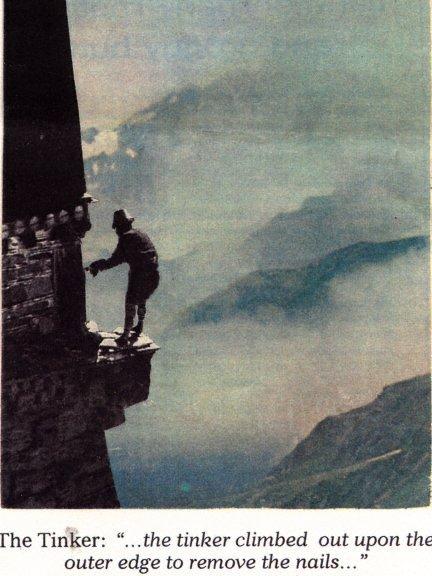 |
On the
final day before the unveiling, the tinker climbed out upon the outer
ledge to remove the nails and planks covering the doors to the musical
clock, which was directly below the one being used.
Then, at noon, exactly five-hundred years after the original
unveiling was to have taken place, over two thousand people gathered
to witness the first performance of the dancers. With the hypnotic
effect of a dream, the dancers came forth announcing the time with a
wonderful swirling motion. The villagers were transfixed as they
swayed and sang to the tune of the village song.
The smiling, costumed dancers continued to entertain the gleeful
crowd with detailed gestures, bows, and swirls. Then, near the end of
the performance, the tinker had another strange vision. One of the
wooden lads seemed to turn his head towards the proud tinker, and,
giving him a mechanical wink, twirled around and disappeared inside
the beautiful clock.
|
Site Map
Solstice
| Galatea
| Doorways
| Color| Seasons
| Greetings | Black
and White | About
the Artist