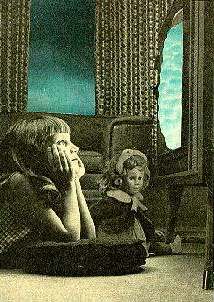
With the advent of modern technology and a social dependency on media - via television, motion pictures, periodicals, and computers - the principles of photo-collage have begun to play a greater role in society. As photographic materials became readily available, periodical editors in the United States and throughout Europe began using photo-collage in advertising, news, and propaganda. Since achieving global acceptance with editors and artists in the 1920's, photo-collage and its progeny have become a standard for visual language in contemporary society.
Since the beginnings of humanity, images (as with storytelling and music) have been dynamic in promoting understanding and social connections . While true today, societies share many of the same images simultaneously, rather than slowly spreading from village to village. In this regard, it might be said that modern communication, with its ubiquitous nature, is superior. However, because of the large volumes of images presented through media (often in an incohesive fashion), people are more apt to suffer from attention deficits and the inability to focus.
David Watson in his article, Against Forgetting, states that
'... modern communication is poised to shape everyone's story, making them
all a fragment in one long photomontage.' 1
Commercial television, often presented as a hodge-podge of choppy,
discombobulated ideas, illustrates how a haphazard approach in connecting
ideas can be counterproductive and disruptive. Yet, when there is
integrity in the act of gathering, splicing, and juxtaposing images and
concepts, the results can be deeply rewarding.
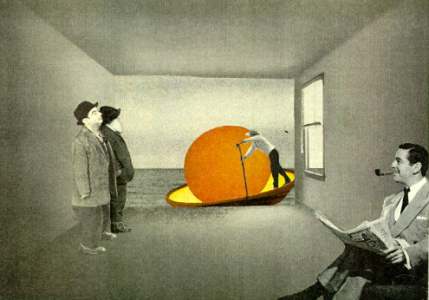
Collage is provocative when the theme is consistent with the style of the composition. When it was practiced 'in the post-war German rubble' 2 of the 1920's, the 'Dada-ists' found a way to express the disarray of their culture. The strength of an artistic endeavor is, in part, the ability of the individual to communicate with passion and in developing a personal connection with the medium. This is quite relevant when collage, as an art form, relies on historical and cultural images tocomment on its social environment.
With the massive amount of photographic images published since the 1920's, the language of the medium has a broader potential for the modern communicator. The photocollagist has more opportunity to blend both shape and tone as well as the ability to vary images. However, the searching, filing, and retrieval time can affect the spontaneity of a composition unless one is intimately connected with collected images, and maintains an effective filing system.
Media images from a culture's recent past provide an apt vehicle in
defining its essence through visual stories, poems, and statements.
Photo-collage proved to be highly effective as a social soapbox during
WWI, and has since been building momentum as a visual language, as mounds
of visual archives outpace the written word. Periodical editors began
cutting and pasting photos during the 1860's in the United States, but it
was photo-collagists like Max Ernst and Hannah Hoech, and photo-montagist
John Heartfield (who applied airbrushing to conceal edges), that led the
way for numerous graphic artists.
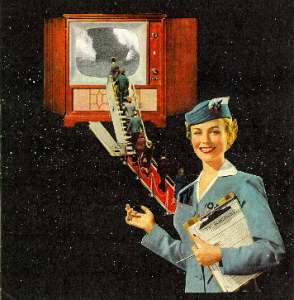
Today many graphic artists apply a similar practice using computer- manipulated images. With new technology, photo-collaging often takes on a smooth form of realism or surrealism, displacing the airbrush technique of montage. The result of this medium can be unique and visually stunning. Unfortunately, because computer art is often accomplished in an environment driven by consumerist goals, photomontage themes can be trivial and lack compositional integrity.
In the beginning of the 1900's, when artists began using elements of photography in collage, they knew that they were exploring a ubiquitous, social language. A photographic composition, when executed well, has the ability to cross the boundaries of culture and time. Photo-collage can be an intimate experience and as engrossing as a great piece of music. Today, as the vocabulary of this language has reached a phenomenal level, it is time for the modern visionaries and visual poets to embrace the concepts of photo-collage.
Watson, David. Against Forgetting. Utne Reader. ed. Eric Utne. Mar. '94, pp. 112-115 Header, Steve. Passionate Collagists. Print. Sept. '83, pp. 22-25.
Site Map
Solstice
|Starcollage Home| Doorways
| Color| Seasons
|
Greetings | Black
and White | About
the Artist