Robbie's Story
|
Robbie's Story |
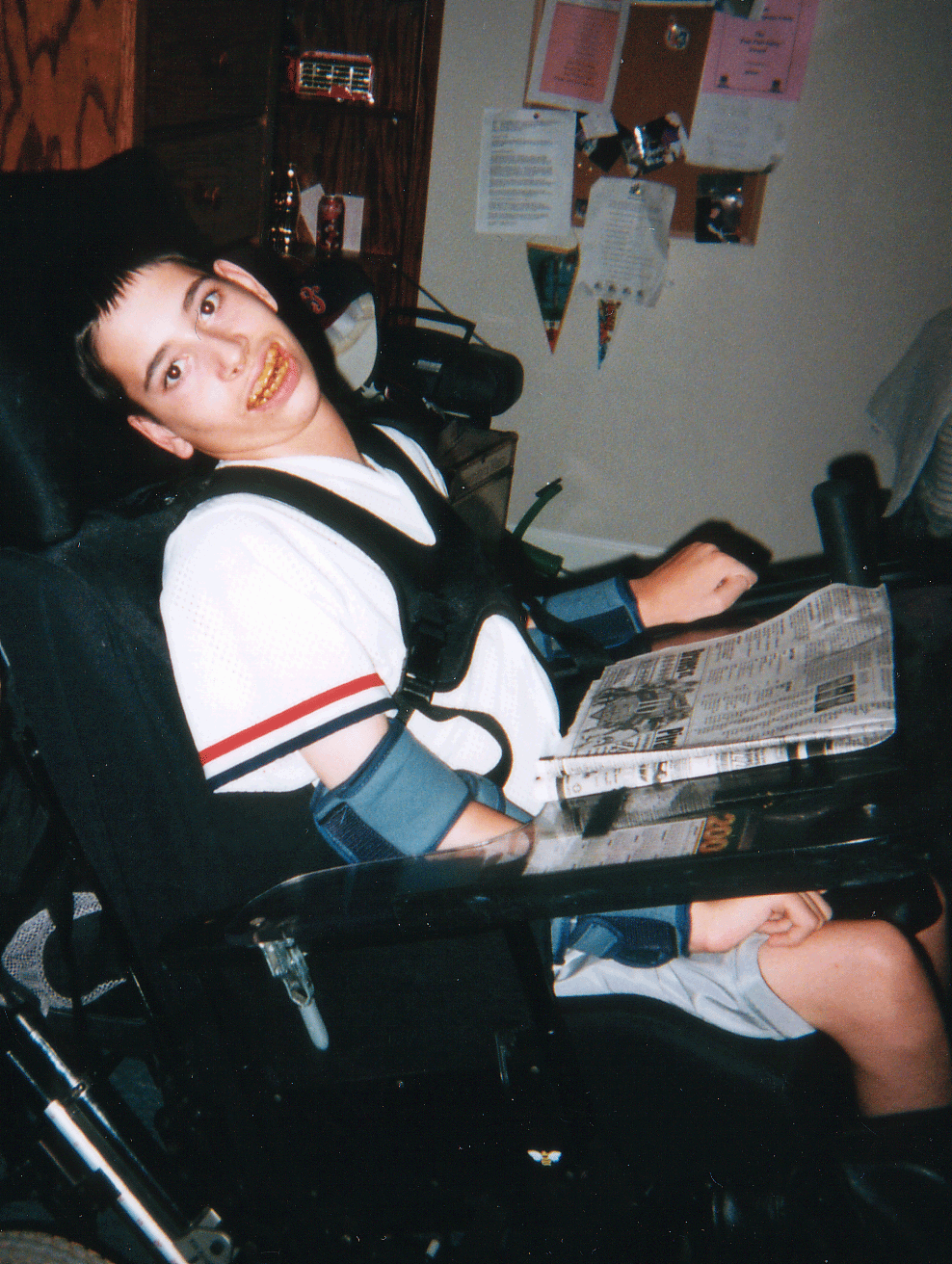
Self Injury Wheelchair Needs Toileting Behavioral Issues Medical Issues Mental Health (Family) When Robbie was about 2 1/2 years old, he started bringing his fingers to his mouth occasionally and bite down. At first we thought it was a behavioral problem, but we realized this was happening more and more and showed no signs of going away. We went to see the geneticist, and he suggested we test him for this disorder, because of the biting; although he felt Robbie was bright and didn't fit the general criteria found in the literature at the time. (A recent well written summary of LNS, its cause, symptoms , and general information can be found at the Special Child Website). The test came back positive for LNS. To help him with this biting problem, we initially covered his hands with socks, thinking out of sight, out of mind. This did not work so we tried making some leather gloves, which we used for a while. We used these gloves for a while, except when we got to summertime, they just got too hot. Since he was about 1 yr. old, Robbie has received physical, occupational, and speech therapy. The occupational therapist recommended we make him some arm splints; these were homemade, molded to the size of his arm and when finished, attached Velcro straps, to wrap around his arm. These arm splints have worked well for Robbie, even though they prevented him from continuing in trying to feed himself, and also after a while, have restricted him from being able to have complete flexion, even without the splints on. He had been wearing these type arm splints up until last year, with new ones being made at least once a year, as he grew. Last year a new occupational therapist Robbie started seeing, mentioned to me about some commercial arm splints, already made, different sizes. We switched to these since then, mainly because they looked better-both of these splint types have worked well in preventing the fingers from going into the mouth area. At bedtime, the splints come off, to relieve the arms from them, but we needed to provide safety here also, so we developed the "bed splint". The same splinting material used for the arms was molded in such a way that Robbie would lay on it and we would either Velcro his arms down at the wrist or use a belt instead to keep his arms from coming up. Robbie had no problem sleeping on this, and never complained, he was just happy he was safe. Unfortunately, after a while after using the splints and successfully preventing the finger injury, he figured out he could bite in the mouth area. This was harder to deal with- but we realized that what was hurting him was the cutting action of the teeth, so we called his dentist and asked about some kind of softer teeth covering , so that even if he pressed down, he wouldn't cut. It took a while, but impressions were made of his upper and lower teeth, and soft mouth retainers were made and used when needed. In talking to other LNS families and hearing what they have gone through, there is no question in my mind, that Robbie to this day has all his teeth, because of these retainers. Like the arm splints, these retainers have to be made every few months, because they tend to get loose. For bedtime, I would use some of the older ones and sew elastic through them so they could go around his head and have the retainer stay in place in the mouth. This was done to prevent a retainer coming out while laying down, which could cause choking. At the age of 4 1/2, we looked into him using a motorized wheelchair. We use a very good wheelchair vendor here in Atlanta, who by the way has had considerable experience in wheelchair seating and placement for kids with this disorder. We have had quite a few wheelchairs since he was four, but it was exciting to see him in a motorized wheelchair, moving on his own, with the use of a joystick. Over the years, he has used this occasionally. He used it for some supervised driving in school, elementary and middle school, and for outside fun driving outside our house. The disorder did get in the way at times, and he would run into walls and outside curbs; we felt he would not be able to use it independently without supervision; the last time he used it was a couple of winters ago, he joined a wheelchair soccer team, which he enjoyed, but have been unable to continue since we have been trying to come up with a good seating system for it, and also redoing the driving joystick, so he has not used it much lately. The chair he uses mostly is a push chair which reclines; This feature relieves occasional back and leg pains he suffers from and helps a lot since he is in his chair for almost 12 hours a day. At the present time, we are trying to get an attachment for drinking from a cup with a straw on his own just by bringing his head to the side and reaching for the straw. We go to the beach every year, and 2 years ago we purchased a sand wheelchair we use to push Robbie down the shoreline by the ocean. It is virtually impossible to push a regular wheelchair down the sand, plus it is not a good idea to expose it to the elements.Robbie has been toilet trained since he was 4 years old. We basically put him on the potty chair, morning, afternoon, and evening, unless he says he need to go at other times. We do use diapers for bedtime and anytime when his potty chair is not available. The potty chair sits over the toilet, and we also added some side supports for his head. The vendor we use for diapers supplies a variety of diaper styles, sizes and absorbencies; they are also convenient in that they deliver on a regular schedule. As mentioned in the introduction, the negative behaviors Robbie has exhibited and still does are yelling out, spitting, and as he has gotten older, the use of inappropriate language including name calling and cursing. All the literature on this disorder explains how ignoring these behaviors, at least initially helps- there is no question that this is true. This is a strange way of disciplining, but with these kids, it is effective. We teach anyone, who deals with Robbie about this, especially not to use the word "don't" with the negative behavior-if they do, it usually makes it worse, and has the opposite effect, causing an increase in the behavior. Positive reinforcement techniques have worked well with Robbie also, instead of harping on the negative issues. If at all possible, we don't tell him something or someone new is about to happen until absolutely necessary, because the anticipation of these, causes an increase in these behaviors. We have noticed these behaviors have improved as he has gotten older, except for the inappropriate language . The behaviors increase when new situations, or new people are involved, and when some exciting events come up, like holidays. Our approach has been at first to ignore it, if it persists, we help him through it by encouraging relaxing, breathing, etc. If these fail, then we remove him from the situation and let him have some quiet time. As Robbie has gotten older, we are making him assume more responsibility for these, but initially we are still ignoring. The negative behaviors are part of the self injury, but in an emotional way. They are trying to hurt themselves by getting in trouble with mom or dad and by feeling bad that they have done so. Physically Robbie showed signs of developmental delay at 4-5 months of age, we knew he was not developing normally. After his initial diagnosis of cerebral palsy, we set him up to receive occupational , physical and shortly after speech therapy. He has been, until present time, receiving these since he was 1 year old. Medically, Robbie has always been healthy, he is hardly ever sick, and if he gets a cold, gets over it quickly. The first medical problem we encountered was leg pains, which we found out was caused by a partially dislocated hip. Our orthopedic doctor said we could do surgery, but that it would be traumatic and could possibly happen again, so we have not done anything about it. Occasionally he still has some leg pain, but we give him pain medicine during the day, to help relieve him of small aches and discomforts. We do not know what caused the hip dislocation, but we think it was incorrect posture in his wheelchair, Robbie used to cross his legs a lot and this was not good . We keep him from crossing his legs by using a pummel in between his legs and using ankle straps that attach to a footrest. The only other medical problem we have had to deal with has been kidney stones. We have been told the stones will be an ongoing problem and that they are caused by the allopurinol/uric acid relationship in the blood. We have had quite a few lithotripsies to blast the stones, so he can pass them- this procedure is pretty much pain free, but he does have to use general anesthesia, so he doesn't move. The stones started about 7 years ago when he started complaining of back and side pain, and have reoccurred twice since then to present day. We feel he is making less of them but we have put him on the following protocol; 1. Keep him well hydrated, lots to drink 2. He makes xanthene stones, which crystallize under acid conditions- so we avoid acidic juices like orange, cranberry, and grapefruit 3. These stones seem to be byproduct of caffeine, so no chocolate , coffee, etc. 4. We put him on a low protein diet- the reason for this is that lots of meats, pastas, eggs have high protein, meaning high purines, meaning high uric acid leading to more stone formation; he takes in approximately 25 grams of protein daily, except for special occasions 5. Since the stones he makes crystallize in acidic conditions, Robbie takes polycitra, a liquid medicine that alkalinizes the urine and helps prevent the formation of stones. We used to take x-rays and kidney ultrasounds, but these were not reliable in detecting xanthene stones, so for the past two years, we have been doing cat scans for the kidney and bladder, and this has detected them much better. The other regular check we do is check his blood uric acid, BUN and creatinine levels every 2-3 months to make sure levels are normal. The BUN and creatinine tests measure kidney function. Current medicines he takes are: 1. Allopurinol: 50 mg in the am and 75 mg in the evening- this keeps his uric acid at about 5.7 which is in the upper normal range, he weighs about 85 pounds at the present time. It is used in the management of certain types of kidney stones and to reduce elevated uric acid levels in the blood. 2. Anafranil (clomipramine) used in the treatment of obsessive compulsive disorders. Robbie takes 50 mg in the am and 50 mg in the pm. 3. Polycitra- makes the urine less acidic. It is used in the treatment of certain kidney disorders and gout. 4. Clonazepam- used for muscle relaxation; he takes 1mg 3x a day.. He used to be on valium for a long time prior to taking the clonazepam, but the doctor he now sees who overlooks his medications, prefers the latter because it has longer life in the body and is less addictive. 5. Resperdal-1/2 mg at bedtime- for a more restful night sleep. I occasionally use this during the day if he is extra agitated, has a relaxing effect. 6. Baclofen- he had a pump surgically placed in his groin area in summer of 99- it has greatly reduced his spasticity , allowing for weight gain, puberty onset, growth spurt and most important has improved his functional upper motor skills. The only negative side effects are constipation and we think it might have contributed to some curvature of his spine due to the location of the placement of the pump in the groin area. At the current time, we are looking into possibly changing the location of the pump, so that his posture and curvature don't get worse. July 2001 At this time Robbie is kidney
stone free, he had one stone we had to take care off earlier this year.
We are working on (therapy wise) maintaining his range of motion,
improving his posture in his chair, he has gotten long and lanky, and tends to
curve out and swing out his left hip so we are keeping a close eye on this. He
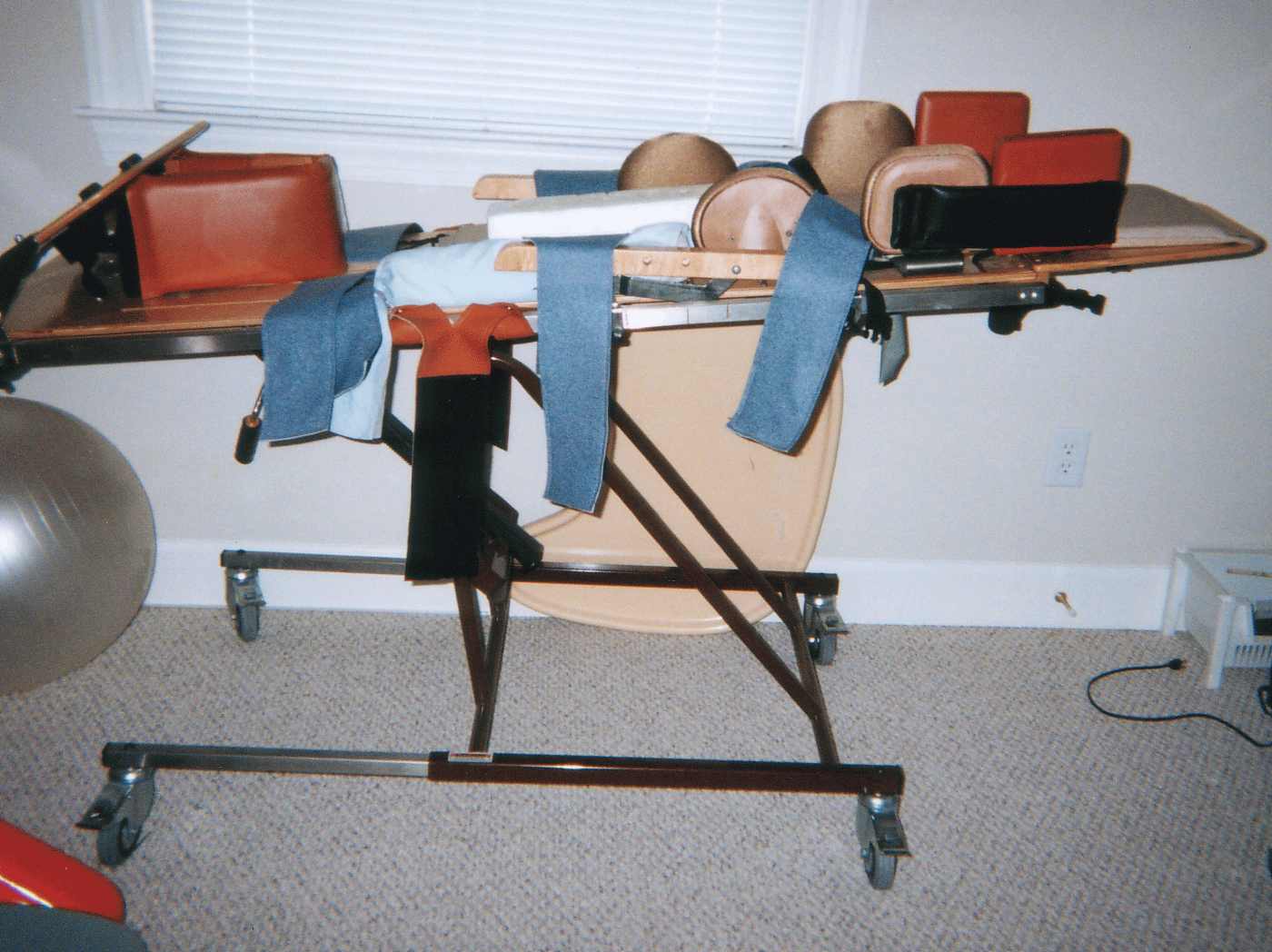
occasionally gets on the prone
board to maintain his leg muscles (see picture).
His occupational therapist is working also on fine and gross motor
especially for his computer access. The
joystick he uses we purchased from Dunamis,
Inc. and he is able to play some computer games completely on his own, also
access the internet, visit favorite web sites, and reply to his emails using
this special joystick, and the use of an onscreen keyboard
in conjunction with a word predictor software program. This accomplishment has made a big difference in his life,
has increased his self esteem, and above all he knows he can do this
independently. I see the potential
for a possible job in the future, we are focusing on practicing as much as possible
on the computer, and to develop speed in keyboard entry.
He is starting his senior
year in high school, and will probably take 2 years to complete- he is eligible
to stay in school until he is 21. After
high school, I hope to find a school that will provide additional computer
training. While this computer access
has given us hope for Robbie's future, we feel he is able to do it more
efficiently since he had the Baclofen pump implanted. It has greatly reduced his
involuntary movements. We
have been waiting a long time for some medicine or procedure that will
minimize some aspect of this disorder, and improve his quality of life.
We feel like gene therapy may offer some hope to us and other families,
but that is down the road. I keep in contact with Elaine
Timbers, who heads the Lesch-Nyhan foundation in Chicago, Illinois- she informed
me that a Dr Hyder Jinnah at Johns Hopkins will begin doing a trial study on a
new drug , galvapenem, that helps with the obsessive compulsive aspects- Robbie
will be included in this study. See link page for additional information of the Lesch-Nyhan
foundation and also for Dr Jinnah. There is a newsletter put out by Matheny Institute in New Jersey; it provides medical information on the disorder. Matheny School and Hospital and the Matheny Institute of Applied Research can provide useful information, since they have boys with LNS living there. There is an
recent article posted on 9/25/00 written by Dr. Nicklas, Dr. Jinnah and Dr.
Nyhan about LNS at this website. September 2001 At this time, we are having
to deal with several medical issues. Robbie
had been complaining of back pain for the last couple of months.
He had a cat scan recently and it shows there is a tiny stone in his
right kidney. We are attempting to
flush it out with plenty of liquids. and if he doesn't eliminate it, we will
need to do some kind of lithotripsy or surgery to remove it. He also has had a couple of
incidents recently of urine retention; this has started happening since a couple
of years ago, where has had to be catheterized to relieve the bladder- we
believe the combination of the Baclofen and Anafranil may be contributing to
this problem. We recently dropped
his Baclofen level to 420, and have also modified his evening dose of Anafranil.
It's been about 2 weeks, so far so good. Last and of more concern of
all, at a recent regular visit to the doctor an x-ray was made of his spine- the
poor posture in his chair has contributed to more curvature of his spine-so the
priority right now is to come up with a better seating system to avoid further
problems and possible spinal surgery. From the time Robbie was little , I , with my husband and daughter, have dealt with Robbie with very little help from others. In the last couple of years, I have had to rely more and more, on the help of caregivers to assist me with Robbie's personal care needs. I still feel some resentment at having to rely on others to help me with MY son, but not only do I need it to preserve my physical health, but also my mental health. As you can see from September's events, it can feel very overwhelming at times. Having assistance from others is crucial in dealing with this disorder on a daily basis. It also allows for parents to have time for themselves and other siblings, who may sometimes feel neglected since dealing with a special child can be so demanding. In the U.S.,and keep is mind the each state is different, the department of medical assistance is worth checking out, to check and see what programs , and waivers may be available to help your family in giving you respite care relief and ongoing personal care for your son.
|