Author: Hiran Ekanayake
Date: 03 Apr 2006
Until recently psychological explanations were more philosophical rather than experimental. However, with the introduction of computer science, researchers were able to model psychological aspects with the help of artificial intelligence and this new discipline is referred to as cognitive modeling (?). A more matured architecture is developed by Anderson (1993) and this platform is used by lot of researches to model and prove the internal decision-making processes of humans.
On the other hand e-Learning has changed the instruction of learning from traditional classroom-centered learning to more student-centered learning. This has lots of advantages as well as disadvantages. One of the issues is, most e-Learning systems offer the same content for all the students without considering the capabilities in understanding of students. This has created a situation where students are less interested to follow an e-Learning lesson compared to traditional classroom based lesson. Some researchers are trying to deliver an adaptive learning content by monitoring the learner’s patterns in following a lesson (Hewagamage & Lekamarachchi, 2003) in a LMS, while others are trying to use more advanced cognitive factors to understand the cognitive capabilities of students (Anderson et. al. (2004)).
Meanwhile, some recent research in psychology and neuroscience has identified both the critical role of emotion in decision-making and social interaction, and some of the mechanisms meditating the functioning of emotion. This triggered me to question whether can we use emotional appraisal of a student, when learning, to get an estimate of current interest (boring, disgusting...) of the student to the content he is experiencing, and change the content for a more positive emotional appraisal of the student and give him a more precious e-Learning experience. Modeling of emotions in the cognitive architecture has debated for some period of time, but Hudlicka (2004) integrated the both under the MIMID architecture. The relationship between the cognitive factors and emotions has to be investigated, but Thagard (2005) gives a more in-depth explanation about all in more philosophical perspective. More research is conducting to investigate the relationship between cognitive factors and learning, as in Anderson et. al. (2004) uses eye movements, and others use brain waves, heart-rate and GSR. So, it would be logical to think that there is a relation between learning and emotions.
References:
[1] Anderson, J. R. (1993). Rules of the Mind. Hillsdale, NJ: Erlbaum.
[2] Hewagamage, K.P., Lekamarachchi, R.S. (2003). Learning Patterns: Towards the Personalization of E-Learning. In Proceedings of the 5th International Information Technology Conference.
[3] Anderson, J. R., Douglass, S. & Qin, Y. (2004). How should a theory of learning and cognition inform instruction?. In A. Healy (Ed.) Experimental cognitive psychology and it's applications. American Psychological Association; Washinton, D. C.
[4] Hudlicka, E. (2004). Beyond Cognition: Modeling Emotion in Cognitive Architectures. In Proceedings of the Sixth International Conference on Cognitive Modeling
[5] Thagard, P. (2005). Mind: Introduction to Cognitive Science, Second Edition, MIT Press.
Based on my inferencing capabilities, I have developed a layered architecture,
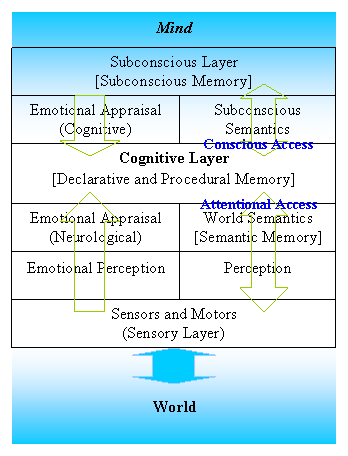
Fig. 00301001: A Layered Model of Cognition and Mind
I’ll try to expand the description of this model as I develop with its semantics. I should thankful for the following persons for their valuable feedback.
Troy Kelley, Army Research Laboratory, USA
Dr. Damith Karunaratne, University of Colombo, Sri Lanka
|