Author: Hiran Ekanayake
Date: 20 Mar 2005
There are many definitions, explanations and models to fulfill the above title. However I started as an independent thinker to do some revolution in the field!
It is much worth if you come here after reading the chapters 9, 10 and 11 of P. Thagard’s “Mind: Introduction to Cognitive Science” [P001006] where it gives an attractive introduction to the human brain, emotions and consciousness, and the research paper “On Cognitive Informatics” [P001007].
Following paragraph marks the beginning of my hypothesis. Please don’t accept all of them as absolute truths or don’t think that I am going to teach you some religion, but think differently!
I first wanted to differentiate knowledge and intelligence. Going along that I treated knowledge as information with their relationships stored under a knowledge base. After that I filled the intelligence with a new definition which is described below, and finally I saw “thinking” as constructing or modifying dynamic knowledge using existing static knowledge from the knowledge base. The knowledge about knowledge or skills to construct this dynamic knowledge is served by the intelligence.
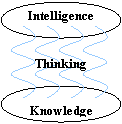
I00100301: Simple cognitive model for knowledge and intelligence
Figure I00100301 represents a simple architecture for the cognitive thinking model. The waves happening between intelligence and knowledge base represent the thinking process.
What is then “Intelligence”?
If you are familiar with physiology you should know the role of a DNA as carrying information needed for protein synthesis and replication. So if you consider amino acids as existing knowledge, the message of a DNA is played by the intelligence. I consider intelligence as knowledge DNAs.
DNA carries the physical intelligence needed to construct our physical system
Now you might argue that rules (in AI) also play the same role as constructing new knowledge from existing knowledge. However I am not going to support that argument, because according to my understanding intelligence is capable of carrying information needed to synthesize even rules. Rules give only one output knowledge, but knowledge DNAs give a set of output knowledge.
I can’t think of a representation scheme to hardcode intelligence at this point. However I guess generic algorithmic techniques along with conceptual graphs have a sufficient potential to help me.
What is happening as “Thinking”?
Thinking is the process of knowledge synthesis. The inputs are existing static knowledge from the knowledge base or external dynamic knowledge resulting from sensation. Intelligence helps to synthesize knowledge according to known sequences. The new knowledge may have capability to affect the world, but finally subjected get saved in the knowledge base for future references. The memory organization as short term to long term also affects the efficiency [P001008].
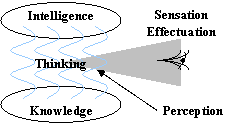
I00100302: Extended cognitive model for knowledge and intelligence
The previous model (I00100301) has extended in here (I00100302) to include physical sensational neuronical scope (I use this phase to address the path occupied by neurons and nervous system). At the end of the sensational scope you get senses (eye, ear, mouth, etc) and effectors (muscles) at the hardware level. From that level to the up, the path is occupied by neurons. However at some point the neuronical sensation touches the thinking region. This is the point where perception (feeling/awareness of sensing) generates or you perceive the word!
In the process of thinking, for particular problem knowledge, not only one solution knowledge would get generated. The result comprise by a set of solution knowledge. However not all solution knowledge are equally likely powerful or leads to a good decision. I use the word un-knowledge to refer these secondary unstable, un-useful knowledge. Selecting the best solution knowledge is up to the consciousness.
Majority of un-knowledge are unstable in the sense. Sometimes their execution leads to damages for your cognitive system, even for the physical system. Stress or depression is a result of this un-knowledge. I hope to do a wide study on this regard. I see this as the major drawback or side effect in human cognition. However as the stress could lead to creativity, this un-knowledge also could be used as a key to artificial creativity! Because some careful execution of this un-knowledge give a new creative directions to decisions.
How do Intelligent get developed?
The simple answer is by “Self-appreciation”.
From the solution knowledge set, only one or few knowledge would get selected and threw for execution. The selection of the knowledge would depend on your emotional desire, but still you might don’t know whether its applicability is positive. However if you get a desired result by this new solution knowledge you get self-appreciation, meanwhile your knowledge DNAs would get modified accordingly reflecting this satisfaction, which is very much similar to biological evolution.
Consciousness or Conscious Thinking
What is consciousness?
Please find answers to this question by yourself. It may be the awareness of your existence! Here what I am trying to do is to extend my previous model to include consciousness.
I see consciousness as overseeing your thinking process by your mind (What is “mind”?*). I can think many forms of conscious thinking. The blue scope in the figures represents the conscious vision.
Online/live Consciousness
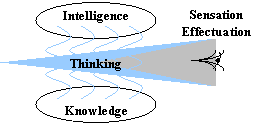
I00100303: Online consciousness
This type of conscious thinking happens when conscious vision concentrates on perception region in the thinking.
Offline Conscious Thinking
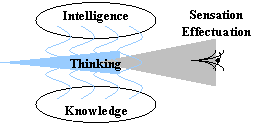
I00100304: Offline consciousness
This type of conscious thinking happens when conscious vision ignores perception region and concentrates on other thinking. May be here the perception has happened as a result of imagination (E.g. in sleep).
Unconscious Thinking
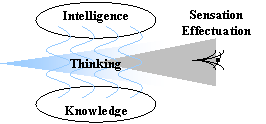
I00100305: Un-consciousness
Unconscious thinking happens as a result of un-concentrated conscious vision held by your mind. Sometimes it happens in another ways, for example, some trouble (error, disturbance) in intelligence, knowledge or sensational scope.
Super-consciousness
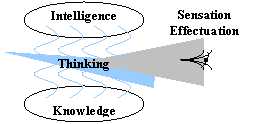
I00100306: Super-consciousness
Recursive thinking (thinking about the thinking) is a form of super-consciousness.
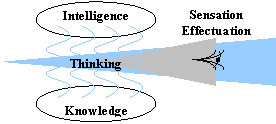
I00100307: Super-consciousness
You perceive the world superseding your perceptual sensation.
Cognitive Timer
Next I am introducing time perception in to this model. Although I can introduce a separate independent timer (e.g. geological timer) into the inner cave of the cognitive model considering that there is a separate timer in the outer world, I am not going to do that. Because I believe that the inner time is something derived from the perception about the outer world (What is time?). The unit of time depends on the person. Einstein’s theories can be used to describe this difference. According to his theories time is relative too, for example it has been proven that one second time unit on earth is different from that on sun!
Super cognition and models
Next I am going to summarize the path I am going to use to construct a complete model introducing mind into the model.
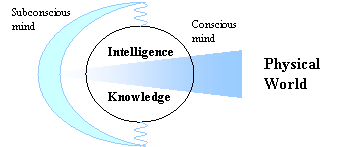
I00100308: Simple cognitive model for knowledge, intelligence and mind
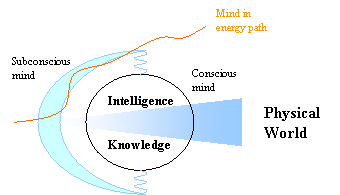
I00100309: Simple cognitive model for knowledge, intelligence and mind in energy path
An energy path is something like an orbit where it defines the personal emotional beliefs, the compatibility with other people and even the existence of life.
I stop here without going in to much deeper at this stage. I think the former description is enough to develop a computational model of artificial cognition. However I agree with you that there are many issues to be clarified or perfected.
Small add-on
What is “Mind”?
I am going to address this in a separate similar writing. However for the time being the existence or non-existence of the mind is depend on,
Present = Future – Past
=> 0 [approximately zero, but not zero]
References |