Author: Hiran Ekanayake
Date: 12 Mar 2005
Although I gave this content the above title without much difficulty, I am not confident enough to answer that I paid my in depth attention to make this writing “PERFECT”. But what I did was my best!
All started after I wanted to do a MPhil research. I started with a small scope which was unspecific. I thought it’s easy, I know what to do, so I can do. I was able to imagine the path and also milestones.
Mission: Find a multimedia database model to store and retrieve multimedia data.
Solution: Macromedia Flash is based on a multimedia document object model. So use that knowledge. However it doesn’t provide standard querying facility like SQL. Therefore if I integrate a SQL like multimedia query language to that knowledge I could solve the problem!
However I wasn’t stay there to work for this idea. Keyword searching in the Internet and other research relations directed me onto various other technological and research pills like,
MPEG, BilVideo, SVG, SMILE, XML, OODBMS, ORDBMS …
Among the above, BilVideo [P001004] research helped me to shape up my scope in several ways. Firstly it’s a complete video database management system and it has solved the problem I was expecting to solve. Also it introduced me various other issues I wasn’t seen earlier and thus it marked the first turning point in my research.
With the overall knowledge I had up to the point I concluded: mission accomplished!
Mission: Find a multimedia database model to store and retrieve multimedia data with all the surrounding knowledge.
This time what is the difference?
I have completed a surface study for my research. Now I know how others had reached the problem and their solutions. But I had a doubt, am I going to follow them to do the same?
Answer was NO!
This time I entered into the field with the expectation of doing a wide study. As a result I studied the MPEG series of standards. When you come to MPEG-4, 7, 21 they seems as well-defined frameworks for future multimedia but not subjected to easy implementation by current technology. Meanwhile I studied about SVG, SMILE and other related technologies for what can I get from them.
Still I had monotonous feelings, because I saw that am working at the data (low) level. No “liveness” can be enforced to that layer. The cause for this feeling can be described as,
When you are watching a movie you experience a real live scene. You accept people, animals as real live characters. However if you store this video and retrieve parts of data as a result of a query you don’t experience feelings about “living” anymore. They become only information. So what’s missing here?
Immediately I searched for “semantic multimedia”. As a result I found a research paper titled “A self-adaptive semantic schema mechanism for multimedia databases” [P001005]. It directed me for another different research pill. However soon I realized that I couldn’t find the precise solution even at this semantic level.
The phase [P001001] “Today’s multimedia applications operate mainly at the sensory level - collecting, preprocessing and storing raw input. What is needed is an ability to perceive visual and auditory content in a manner that parallels human perception” made a big sense on me and it destroyed my earlier believes about multimedia (I am describing the curve I had for find “Cognition” in T001001).
The paper followed a set of similar readings. As a result I developed an operational model of a cognitive-based multimedia database management system and a cognitive model for mind and intelligence. The former model is explained below and the latter is described in T001003
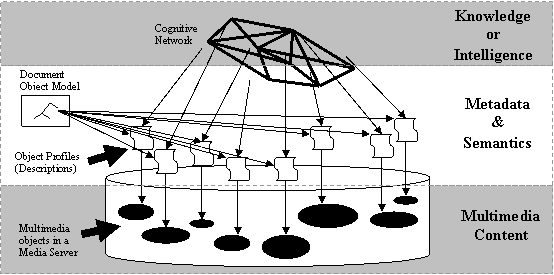
I00100201: Cognitive-based multimedia database management system
In short, Multimedia content layer holds raw data which makes up a multimedia object, for example the pixel wise data of an image. Metadata and semantic layer define the raw data while maintaining object level relationships. Knowledge or intelligence layer talks with the outer world as answers to cognitive level queries and it’s biased for cognitive intelligence measures.
A further explanation of the model will be provided after I perfect the hypothesis with practical measures.
Gradually I am experiencing specific or properly streamed scope in my study unless otherwise disturbed by conflicting knowledge.
I hope to rename this new field as “Cognitive Multimedia Modeling”
To be continued!
References |