


I would be open to posting differing interpretations if anyone cares to share them. Please e-mail me with your views, questions or better ways to organize this page.
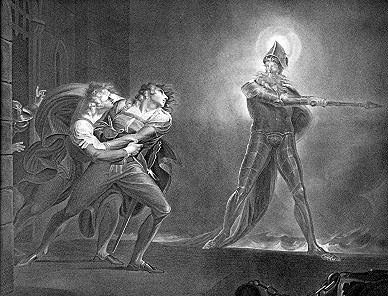
When discsussing this topic, I am often frustrated by an automatic assumption that Hamlet is considering suicide in this passage. Suicide would be the obvious subject of this speech if Hamlet had not already explicitly said that suicide was not an option for him in an earlier scene.
I had a professor in college who offered an alternative interpretation which I find more solid than a suicide interpretation. He equated the idea of "to be" with the concept of being a man of action or with taking action. Conversely, "not to be" was referring to not being a man of action or taking no action. This interpretation is consistent with the entire struggle of the play - should Hamlet believe the Ghost and kill Claudius in righteous revenge or should he not believe the Ghost and accept the fact that his father died naturally and take no action against the new King of Denmark.
The idea of suicide is furthered by Hamlet's reference to "the undiscoverd country" and "conscience makes a coward of us all." With these phrases, the Prince is admitting his fears of the afterlife. Hamlet is unsure if he will go to the paradise of heaven or unending, unedurable torture of hell. However, his path to the afterlife does not necessarily have to be embarked upon through suicide. Hamlet is contemplating killing the King of Denmark, an action that may have dire consequences including death. A king would naturally have loyal followers to protect him, and a guilty king may be aware of Hamlet's growing sense of the king's guilt and be prepared to fight back. In fact, Caludius is very aware of Hamlet's keen intuition and is terrified by him and attempts to murder him through Rosencrantz and Guildenstern, a plot that Hamlet is not fooled by. Hamlet is aware that his path against the king may lead to his death.
Consequently, Hamlet must also be aware that a path of action, or "to be," may lead to his his own death.
However, the two betrayals I find most fascinting are the ones by Rosencrantz and Guildenstern and by Ophelia.
These betrayals are so improtant to the play. They would be considered, perahps,as the "last straws" which would truly push Hamlet over the edge into madness. Still, we are aware that he is only feigning madness, and these betrayals serve to make us aware of Hamlet's lucidity and strength of mind
I love how the "Get thee to a nunnery" scene was handled in Kennth Branngh's Hamlet. My reason, takes me back to a critic I read for a Shakespeare class as a master's candidate. In this article, the author likened Ophelia to a prostitute who had been pimped out by her father. My sensibilies and my sympathies for Ophelia were shocked by this comparison, and I was, at first, repelled. The author supported his claim by showing that the word "nunnery" was used in Elizabethan England to label houses of ill-repute. Kowing of Shakespeare's love of using words with double meaning, the possibility of Hamlet's using "nunnery" to mean this is entirely possible.
If this definition of "nunnery is accepted, then Hamlet is expressing the depth of his betryal by Ophelia, becasue the reader has no reason to doubt that he truly loved her. For him to then call her a whore is unthinkable except that he has figured out that Polonius has used her to gather information from Hamlet that is no one else's business.
Rosencrantz and Guildenstern are guilty of a similar betrayal. They have been called on by Claudius to gather information for the murderous king. They are two of Hamlet's oldest and dearest friends. For them to work for the king at Hamlet's expense is beyond Hamlet's belief. But Hamlet's awareness of their betrayal at the close of player's scene let's the reader know that Hamlet is not insane, by incredibly aware. His disgust at their unwillingness to play upon a flute, with their willingness to play upon him, a human being, is as telling as his calling Ophelia a whore.