
| |
|
|
||
|
Home
|
The Himalayan Kingdom of Nepal
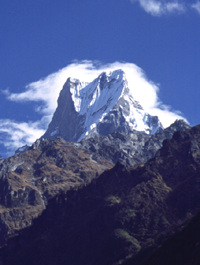 Nepal
is a land of eternal fascination draped along the greatest Himalayas. It's a
land of ancient history, colourful cultures and friendly people, superb scenery,
white-water rafting and the best trekking on earth. Besides, the national parks
of the lowland Terai region offer widelife-spotting safaris by elephant It's
an amazing country that offers something for everyone!
Nepal
is a land of eternal fascination draped along the greatest Himalayas. It's a
land of ancient history, colourful cultures and friendly people, superb scenery,
white-water rafting and the best trekking on earth. Besides, the national parks
of the lowland Terai region offer widelife-spotting safaris by elephant It's
an amazing country that offers something for everyone!
Kathmandu is the capital of Nepal, the largest city in the country and the main centre for hotels and restaurants. Along with the two other major cities in the Kathmandu Valley - Patan and Bhaktapur - Kathmandu has an artistic and architectural tradition.
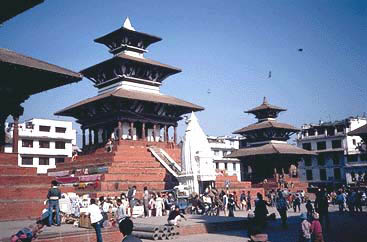
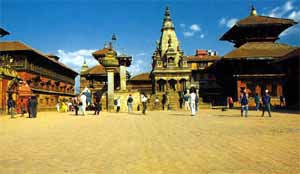
Durbar Square
In Kathmandu, as well
as Patan and Bhaktapur, there are durbar squares in front of the old palaces.
Clustered around the central Durbar Square are the Hanuman Dhoka, numerous interesting
temples, the Kumari Bahal (House of the Living Goddess) along with Kumari Chowk,
and the Kasthamandap (House of Wood).
Patan is separated from Kathmandu only by the Bagmati River and is the second-largest town in the valley. It is often referred to as Lalitpur, which means 'City of Beauty'. Patan's central Durbar Square is packed with temples; it has a far greater concentration of temples per square metre than in Kathmandu or Bhaktapur.
Bhaktapur, also known as Bhadgaon, Khwopa in Newari, or the City of Devotees, is the third major town of the valley and in many ways it is the most medieval. Bhaktapur was the capital of the whole valley during the 14th to 16th centuries and during that time the focus of the town shifted west, to the Durbar Square area. Bhaktapur's Durbar Square is much larger and more spacious than Kathmandu's and much less crowded with temples than Patan's.
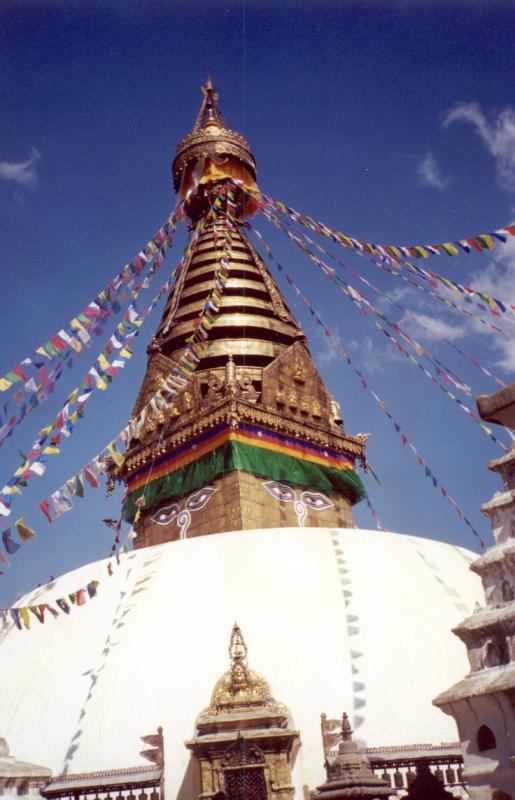 Swayambhunath
The Buddhist temple of
Swayambhunath, on the top of a hill west of Kathmandu, is one of the most popular
and instantly recognizable symbols of Nepal. The temple is colloquially known
as the 'monkey temple'. Geologists believe that the Kathmandu Valley was once
a lake, and legends relate that the hill on which Swayambhunath stands was an
island in that lake. It is said that Emperor Ashoka paid a visit to the site
more than 2000 years ago.
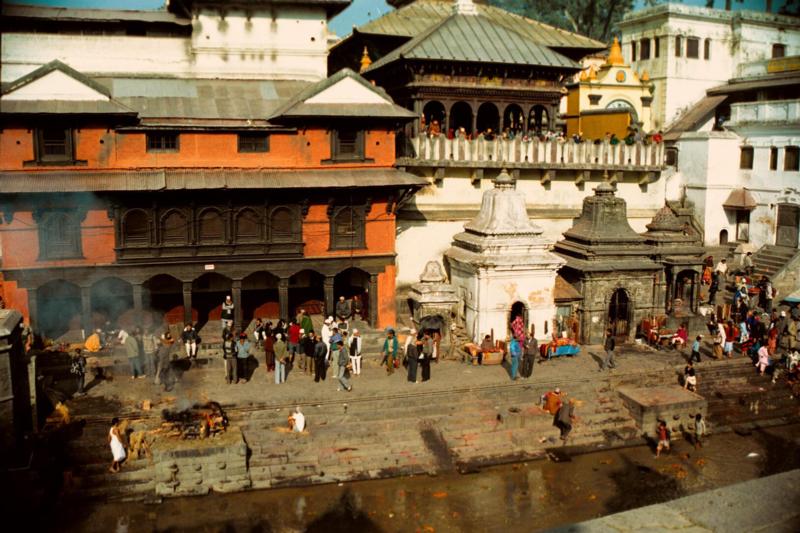 Pashupatinath
Nepal's most important
Hindu temple stands on the banks of the Bagmati River, between Kathmandu and
the Tribhuvan Airport and slightly southwest of Boudha. It is also one of the
most important Shiva temples on the subcontinent. The Bagmati is a holy river
and Pashupatinath is a popular place to be cremated. The burning ghats immediately
in front of the temple are reserved for the cremation of royalty.
Boudha
On the eastern side of Kathmandu,
just north of the airport and an interesting walk from Pashupatinath, is the
huge stupa of Boudha (also known as Bodhnath), the largest stupa in Nepal and
one of the largest in the world. It is the religious centre for Nepal's Tibetans
and there are a number of thriving monasteries and many small shops selling
Tibetan artefacts.
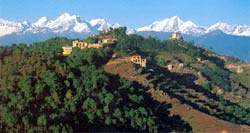 Nagarkot
Nagarkot is the best place
around the edge of the Kathmandu Valley that offer great mountain views. Mountain
watchers make their way up to the village, stay overnight in one of Nagarkot's
lodges, then rise at dawn to see the sun appear over the Himalayas.
Kakani
Standing at 2073m on a
ridge northwest of Kathmandu, Kakani is nowhere near as popular as Nagarkot,
but it does offer magnificent views of the Ganesh himal and the central and
western Himalayas. The road to Kakani also offers beautiful views. Once you're
through the pass and out of the valley, Kathmandu seems light years away. Although
it's easy to get to Kakani on a day trip, it's worth staying overnight if you
want to see the view.
Dhulikhel
Only 3km southeast of
Kathmandu Valley is the interesting small town of Dhulikhel. It's popular as
a Himalayan viewpoint, in part because the road to Dhulikhel is easier than
the steep and winding road to Nagarkot, but also because Dhulikhel is a real
town, not just a tourist resort. It's also a good centre for short day treks
- many visitors come here to stretch their legs before setting off on longer
treks.
Daman
Daman is 2322m above sea
level, midway between Kathmandu and Hetauda. Its claim to fame is that it has
the most spectacular outlook on the Himalayas - there are unimpeded views of
the entire range from Dhaulagiri to Mt. Everest. On the Hetauda side of Daman
is a magnificent rhododendron forest, which would be particularly worth seeing
in spring, then great views over the Terai to India.
The Buddha was born in Nepal but the Buddhist religion first arrived in the country around 250 BC by the great Indian Buddhist emperor Ashoka.
 [email protected]