
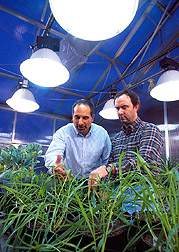
Kochian is an Agricultural Research Service plant physiologist. During 13 years of research at the US Plant, Soil and Nutrition Laboratory at Ithaca, New York, he has become a leading authority on mechanisms used by certain plants to take up essential mineral nutrients and toxic heavy metals from soil. Kochian is an international expert on plant responses to environmental stress, plant mineral nutrition, and the use of plants to clean up or remediate contaminated soils, otherwise known as phytoremediation. In addition, his extensive research has also provided information on an issue of importance also mentioned on the Techinal Issues page: how to prevent toxic metals from entering the food chain.
Kochian is a firm believer in phytoremediation. He calls it an "Green" Technology and says it is a simple concept and cost-effective. (Agricultural Research Service) He also says, "Contaminated soils and waters pose major environmental, agricultural, and human health problems worldwide. These problems may be partially solved by an emerging new technology-- phytoremediation". Kochian says phytoremediation is a needed solution since "One of the primary ways toxic heavy metals, such as cadmium, get in food is through plant uptake-- the metal is taken up by the roots and deposited in edible portions."
Kochian does not believe that current methods are enough, "Current engineering-based technologies used to clean up soils-- like the removal of contaminated topsoil for storage in landfills-- are very costly and dramatically disturb the landscape." Kochian realizing that "phytoremediation has been hampered historically by out inadequate understanding of transport and tolerance mechanisms" has done extensive research with a plant known as alpine pennycress that "thrives on soils having high levels of zinc and cadmium". His lab has been trying to discover the underlying mechanism that enables alpine pennycress to accumulate excessive amounts of heavy metals. After investigating the molecular physiology of zinc hyperacculumation in pennycress, Kochian's group has found several key sites for zinc transport were greatly stimulated in this plants. Amazingly they were able to clone a zinc transport gene-- one of the first such accomplishments achieved with any plant.
Kochian has also worked with uranium removal from contaminated soils. He has found that adding the organic acid citrate to soil greatly increases both the solubility of uranium and its bioavailability for plant uptake and translocation. Citrate does this by binding to insoluble uranium in the soil. "With the citrate treatment, shoots of test plants increased their uranium concentrations to over 2000 ppm-- 100 times higher than the control plants" says Kochian. This is very promising for cleaning up nuclear pollution sites. Recently, Kochian has identifies specific agronomic practices and plant species to remediate soils contaminated with radioactive cesium (cesium-137).
Kochian is one of the many pioneers in this research field. With increasing popularity and more funding phytoremediation will soon be one of the best methods for repairing our torn environment. As the methods of phytoremediation become better and the plants used become more effective and better adapted to the environment who knows what we'll be able to do.