|
Musical
Theory on Guitar: Intervals.
1
Introduction.
1
What
Intervals are.
1
Why
Intervals are Important
1
Intervals
within one octave.
1
Intervals
on the Guitar Strings.
2
Diminished,
Augmented, Flat And Sharp Intervals.
3
Intervals
Greater Than One Octave.
3
Inversions.
3
Ear
training.
4
|
|
“This lesson will cover the concept of
intervals. It will contain much terminology that will probably
bore the advanced player while confusing the beginning player. The
important thing is to associate a sound with each term. If it
doesn't make sense now, hold on to this page - after a few more
lessons, it probably will.”
|
|
|
Distances between notes have certain names
and arrangements. Those names are called intervals.
|
|
|
When trying to understand how particular
notes will sound good together, whether melodically (in
succession) or harmonically (simultaneous) i.e. in a scale,
riff, chord, power chord, etc… you’ll need intervals to govern
the rules. In other words, knowledge of intervals will help you
understand how to compose, transpose, shift or simply follow
scales, how to compose chords and how are they named, how to
create your own chords and name them, and how to check if a chord
fits a scale.
|
|
|
As said before
an interval is simply the distance between two notes. If we play
one note after the other, the notes form a "melodic
interval." When we play the notes together, they form a
"harmonic interval." If the two notes are the
same, we refer to the interval as a ”unison." The
smallest distance above a unison is a "half step"
(which, as we shall see below, is also called a minor second
interval). Any notes played on the guitar on the same string
separated by one fret are a half step apart (semitone). If they
are separated by two frets, they are a whole step (or major
second) apart. Notes separated by 12 half steps (semitones) make
up an Octave (octaves have been explained in the previous lesson:
bare Basics). On any one string on a guitar, an octave is made up
of two notes exactly twelve frets apart. The scale made by playing
the notes on every fret in an octave notes is a "chromatic"
scale.
|
|
|
There are twelve distinct notes on most western instruments (on
Oriental instruments such as Aud we have 24 distinct notes). We
refer to the intervals within one octave as seconds, thirds,
fourths, fifths, sixths, and sevenths. Unisons, fourth,
fifths, and octaves are called "perfect"
intervals. Seconds, thirds, sixths and sevenths can be either
"major" or "minor,"
with the "major" interval being a half step greater than
the minor interval. Between the perfect fourth and the perfect
fifth is an interval called the "tri-tone," which
has the same distance as three whole steps.
|
|
|
 Below
is a chart of the different intervals within one octave and the
amount of half and whole steps that make up that interval. Below
is a chart of the different intervals within one octave and the
amount of half and whole steps that make up that interval.
|
|
|
|
Table
of Intervals
|
|
Name
|
Width
|
|
|
|
|
Unison
|
None
|
|
Minor second
|
One half step
|
|
Major second
|
One whole step
|
|
Minor third
|
One whole + one half steps
|
|
Major third
|
Two whole steps
|
|
Perfect fourth
|
Two whole steps + one half step
|
|
tritone
|
Three whole steps
|
|
Perfect fifth
|
Three whole + one half step
|
|
Minor sixth
|
Four whole steps
|
|
Major sixth
|
Four whole and one half steps
|
|
Minor seventh
|
Five whole steps
|
|
Major seventh
|
Five whole and one half steps
|
|
Octave
|
Six whole steps
|
|
|
|
The
diagram below shows how to play these intervals on the guitar.
Note that the diagram shows two ways to play each interval.
|
|
|
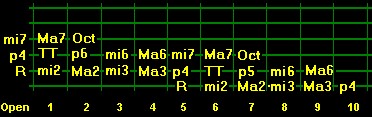
R = Root
mi = minor
Ma = major
p = perfect
TT = tri-tone
Oct = octave
|
|
|
First play the root, and then the other note
marked with the interval. The interval refers to the distance
between the root and the second note. Play the notes first as a
melodic interval, both ascending and descending, and then (unless
the notes are on the same string) as a harmonic interval. The
point here is to demonstrate the sound of the interval. However,
you should eventually find good fingerings to play each melodic
and harmonic interval within one octave.
|
|
|
A "diminished" interval is always a
half step lower than a minor or perfect interval. Thus, a
diminished 7th is the same as a major 6th. A diminished fifth is
the same as a tri-tone. An "augmented" interval is
always one half step higher than a major or perfect interval. An
augmented 5th is the same as a minor 6th, and an augmented 4th is
the same as a tri-tone. Note that all diminished and augmented
intervals will be equal to another interval. The terms augmented
or diminished are usually used when the interval is different from
one would expect from the type of chord or the key.
|
|
|
"Flat" (or "b") or
"sharp" (or "#") intervals are other common
terms used to denote intervals. A flat interval is either a minor
or diminished interval; it is used to identify an interval a half
step lower than one would expect from the chord type or key. A b7
(flat 7th) will usually mean a minor 7th. Sharps are
usually augmented intervals but sometimes can be major intervals,
and are used to identify an interval one half step higher than one
would expect. A #6 is often a major 6 interval in a minor chord or
key, which ordinarily contains a minor 6. A tri-tone is often
called a b5 or a #4. –You didn’t understand this paragraph?
Don’t worry, forget about it and keep reading.
|
|
|
The number sequence continues beyond the
octave in a similar fashion. A 9th is the same as a 2nd but one
octave higher. An 11th is the same as a 4th + one octave, and a
13th is the same as a 6th + one octave. These terms are mostly
used for extended seventh chords. The terms 10th, 12th, and 14th
are not usually used for reasons that will become clear when we
discuss chords.
|
|
|
When you descend (ie go backwards) from the root (say A) to an
interval of a fourth (so it’s
A>G#>G>F#>F>”E”), the note (E) will be an
octave below the fifth (also E). Thus the "inversion" of
a perfect fourth is a perfect fifth.
In other words:
-- D# -- E -- F -- F# -- G – G# --A-- A# --
B -- C -- C# -- D -- D# -- E --
-----------|--------------------------------|---------------------------------------------|---
Backward 4th Interval.
Root.
Perfect 5th Interval.
The rules about inversions are:
|
|
|
a.
if you add up the interval numbers of an interval and it's
inversion, the total is always 9
b.
the inversion of a major interval will always be a minor
interval, and vice versa
c.
the inversion of an augmented interval is always a
diminished interval, and vice versa
d.
the inversions of perfect intervals are always perfect
|
|
|
The
use of inversions will get clearer when the “circle of fourths
and fifths” is discussed. Keep in mind that inversions are
different that chord inversions. Chord inversions will be
discussed in the chords theory lesson.
|
|
|
It is important to be able to distinguish
different intervals by ear. Practice the intervals all over the
neck. Play intervals at random, and try to identify them. Some
intervals will sound good when played harmonically like the fifth.
Other intervals will sound dissonant (Nashaz) like the tritone.
You should also be able to differentiate between the minor third
and the major third, because this is the only difference between
major and minor chords, as we should see later. There are various
books with cassette tapes for ear training (most notably those by
David N. Baker). There are also various software tutorial programs
|
<<<<<<<<<<<BACK|
|