|
Basics.
1
Introduction.
1
Notes
and Tones.
1
Guitar
Tuning.
1
Sharps
& Flats.
2
What
Are Chords.
2
Power
Chords.
2
Scales.
2
Glossary.
2
References:
3
|
|
Before being able to understand the
next lessons, one should understand the basics of musical
theory and the basics of guitar. This lesson might be very
boring for people who already know the fundamentals. But at
the same time it might be overwhelming for the beginner. So
Bare with me… Here goes:
|
|
|
Every body should’ve heard about Do
Re Me, right? Long time ago, we were able to distinguish 12
specific frequencies by which we can play music. Those 12
frequencies were called: Do Di Re Ri Mi Fa Fi So Si La Li
Ti… and that this pattern repeats itself again and again.
Each repetition or, let’s say group, is called an Octave.
So when we move from “Do” to a sharper (thinner)
“Do” we called the second “Do”, a higher octave. So
the higher the octave, the higher it’s frequencies are.
Note that Do, Re, Mi, Fa, So, La, Ti are the white keys in a
piano, the other five are the black ones. Later, those 12
notes were named by alphabetical numerals ie : Do: “C”,
Di: “C#”, Re: “D”, Ri: “D#”, Mi: ”E”, Fa:
“F”, Fi: “F#”, So: “G”, Si: ”G#”, La:
“A”, Li: “A#” and Ti: “B”.
The musical distance between each note
and the next one is half a step, also called Semitone.
Oriental instruments like the Aoud
(3ood) have more than just 12 notes! Each note CAN BE a
quarter step below the actual frequency. But this doesn’t
mean that Arabic scales have 24 tones, although it does,
because when a certain tone is selected to be a quarter
lower, it stays like this for the whole song… most of the
time.
|
|
|
Different stringed musical instruments
are tuned differently. For instance guitars have different
tuning than the Aoud (3ood) for example. And even the guitar
itself has many famous tunings,,, may be you can invent your
own one day. The standard guitar tuning which is used more
than %90 of the time is as follows:
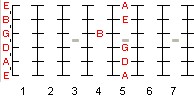
Starting from the 6th string
which is the thickest and topmost: E, A, D, G, B, E.
When a string played open, ie without using your left
hand on the fret board, the strings should make the sounds
of EADGBE. On each string (except the 3rd) the
string under it is tuned to the fifth fret of this string.
For example, the 5th fret of the 6th
string has the same sound of the 5th string open
(which is “A”).
See the diagram.
|
|
|
Notes can be represented by sharps:
"#" or flats "b".
A "#" note represents a note
(half step) after the sharped note (sometimes called
"Augmented").
For example C# is one note after C.
A "b" note represents a note
before the flattened note (sometimes called
"Diminished").
For example Eb is one note (semitone)
before E.
Thus, a C# is the same as Db.
Note that 2 particular notes don't have
sharps and they are B and E, after a B comes a C and after
an E comes an F.
Some people say that an E# = F and a B#
is a C... I don't see why that can be wrong.
Here is a simple diagram which
represents the sharps and their flat equivalent beneath
them:
A
- A# - B - C - C# - D - D# - E - F - F# - G - G# - `A - `A#
- `B - `C - `C#, and so on....
A
- Bb - B - C - Db - D - Eb - E - F - Gb - G - Ab - `A - `Bb
- `B - `C - `Db, and so on....
Most people, including me, prefer #’s
over b’s.
|
|
|
When 3 or more notes are played
together, this is playing a chord. A chord (pronounced cord
NOT tshord) is usually named by the name of the root note.
The root note is the bass note of the chord meaning that it
has the lowest frequency. Most famous chords are the Major
chords and the Minor chords.
There are however many more types of
chord like Diminished, Augmented, Sustained, etc… Needless
to say, you can always invent you own chord and name it!
are special types of Minor/Major
chords! They, however, are not composed of three notes; they
are only composed of 2 notes. Hence the reason why they can
replace any Major or Minor chords. Power chords are also
called fifths, reason will be apparent in the next lessons
(Intervals, chords).
|
|
|
A scale is a group of notes not usually
played together but rather one then another. When a song is
played in, say, C major scale then ALL the notes in the song
will belong to the CMaj scale, which has only 7 of 12 notes.
|
|
|
Neck: the long stick of the guitar,
which has the strings and the frets.
Fret: the metal strips that separate
different notes.
Fret board: the side of the neck, which
has the frets.
Bridge: the metal piece where the
strings come out of the body.
Scale: particular set of notes.
Chord: 3 or more notes played together.
Interval: musical distance.
Semitone = Half step = The immediately
adjacent note.
2 Semitones = Full step = distance of 2
frets on a guitar.
|
|
|
Will show all notes and tones, their
names and sounds:
http://www.music.vt.edu/musicdictionary/appendix/scales/solmization/syllables.html
Names of guitar parts:
http://www.people.fas.harvard.edu/~desmith/guitar/acoustic/info/parts.htm
Names of notes on the fret board:
http://www.people.fas.harvard.edu/~desmith/guitar/chords/images/fretboard.jpg
Tuning Your guitar:
http://www.people.fas.harvard.edu/~desmith/guitar/acoustic/info/tuning.htm
<<<<<<BACK|NEXT>>>>>>
|
|
|