Scene
1
There was great argument over why poor Ophelia's death was going to
be a Christian burial between the two gravediggers. Why would
it be a Christian burial if she drowned herself but the coroner examined
her case and said that it was going to be a Christian burial? One
of the gravediggers was wondering if it is even possible to be a Christian
burial unless it was self-defense and how that is possible, it "sounds
more like, 'self-offense.'" As it said in the play, there are
three sides to an act "to do, to act, and to perform." However,
the gravediggers have to go by what the coroner said even if it is
a Christian burial just because she is wealthy. The gravedigger is
joking 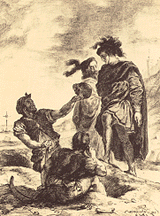 around
and in an unusually merry mood when Hamlet and Horatio come up to
the graveyard. Hamlet sees the careless actions of the gravedigger
with the old skulls and bones and is utterly disgusted because all
he can think about is how the bones
at one point where people and that one day that will happen to him.
Hamlet is extremely bothered by the gravedigger that he starts a witty
conversation with him. Slowly Hamlet forces out the gravedigger that
the grave is for a woman but hamlet has no idea that is for Ophelia.
Hamlet goes on the conversation on how long he has been working as
a gravedigger and in reply, the gravedigger says, "of all the
days in the year, I started the day that the late King Hamlet defeated
Fortinbras." The digger continues about how this stranger, Hamlet
is a fool for not knowing what is going on and tells hamlet about
how the young hamlet is a nutcase and was sent to England to be forgotten.
The two men still chat about the oddest topics for example how long
before a person rots in the ground and about the grand life the skull
of a late king's jester Yorik had before he died. While the men are
talking, the procession of Ophelia comes towards them and right away
hamlet says of how it looks like the women took her own life and how
she must be from a wealthy family.
around
and in an unusually merry mood when Hamlet and Horatio come up to
the graveyard. Hamlet sees the careless actions of the gravedigger
with the old skulls and bones and is utterly disgusted because all
he can think about is how the bones
at one point where people and that one day that will happen to him.
Hamlet is extremely bothered by the gravedigger that he starts a witty
conversation with him. Slowly Hamlet forces out the gravedigger that
the grave is for a woman but hamlet has no idea that is for Ophelia.
Hamlet goes on the conversation on how long he has been working as
a gravedigger and in reply, the gravedigger says, "of all the
days in the year, I started the day that the late King Hamlet defeated
Fortinbras." The digger continues about how this stranger, Hamlet
is a fool for not knowing what is going on and tells hamlet about
how the young hamlet is a nutcase and was sent to England to be forgotten.
The two men still chat about the oddest topics for example how long
before a person rots in the ground and about the grand life the skull
of a late king's jester Yorik had before he died. While the men are
talking, the procession of Ophelia comes towards them and right away
hamlet says of how it looks like the women took her own life and how
she must be from a wealthy family.
At the burial Laertes is very emotional about his sister's death and
does not understand why she should have more rites to her burial but
the priest is persistent and explains that it is not possible because
"her death was suspicious." This drives Laertes madder than
he was before her death. The queen says her emotional goodbye about
how she wished she would be throwing flowers at her wedding and not
at her death. Laertes is so upset before they bury her that he jumps
into the grave to show his love for her. By this time, Hamlet realizes
the women is the beautiful Ophelia and is outraged at Laertes. He
comes out of hiding and mocks Laertes words of pain, and starts to
fight with each other over how they feel about Ophelia.
Hamlet exaggerates his love for Ophelia more than Laertes did for
her; Hamlet constantly outdid Laertes even by using the same metaphors
as him. Hamlet tries to explain to Laertes that he cannot out do him
in actions or words of love for Ophelia, stating that both men are
a little bit insane. Before Hamlet leaves, he asks Laertes why he
is acting so harsh against him because he has been good to him and
does not understand, and in ways does not care. In the last lines
of the act, Claudius reminds Laertes of the plan and to be patient
for everything will come down very soon.
Scene
2
Hamlet and Horatio are talking about Hamlet's unforgettable
journey to England. Hamlet starts out describing how he found the
letter that King Claudius wrote to the king of England saying to kill
Hamlet as soon as he arrived without any warning. Hamlet stole the
letter and wrote his own acting as the king out in "bureaucrat's
neat handwriting," and with the royal seal to fool the king into
killing the messengers, Rosencrantz and Guildenstern. After reading
the letter, Hamlet feels that he has no choice but to kill Claudius
for everything he has done to him. Having no guilt for Claudius he
feels bad for Laertes and how he acted towards him. In the middle
of the conversation, Osric comes in with a message for Hamlet from
the king about a fencing bet between Hamlet and Laertes. Osric goes
on for a while in very outlandish and b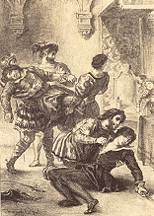 ubbly
language about Laertes and finally gets to the point of the bet. "the
king…bet in a dozen rounds between…[Hamlet] and Laertes,
he won't beat …[hamlet] by more than three hits…" Whether
they started immediately or later to Hamlets whishes, the bet was
a fencing match to win six Barbary horses with several weapons to
use against each other. Before the match, Hamlet is not sure of his
emotions but with disregard to Horatio's advice to act upon any unsure
thoughts, he goes into the match. When Hamlet and Laertes are shaking
hands to begin, Hamlet with the mentioning of his mental illness tries
to lighten the room and Laertes, by saying everything is the mental
illness' fault even admitting to killing his father to the mental
illness. Laertes in return does not move on his feelings of revenge
on Hamlet and only accepts hamlets gestures as love nothing more.
Claudius weakly tries to look like he his on hamlets side to win but
hamlet announces that the king bet in the weaker fencer. To counter
those words Claudius proposes a drink to hamlet "if… [He]
makes the first or second hit… [The king] will drink to hamlet's
health, and into [Hamlet's] drink [he'll] drop a pearl…let's
begin…" but to Hamlet's unknowing Laertes sword and drink
were poisoned to kill him.
ubbly
language about Laertes and finally gets to the point of the bet. "the
king…bet in a dozen rounds between…[Hamlet] and Laertes,
he won't beat …[hamlet] by more than three hits…" Whether
they started immediately or later to Hamlets whishes, the bet was
a fencing match to win six Barbary horses with several weapons to
use against each other. Before the match, Hamlet is not sure of his
emotions but with disregard to Horatio's advice to act upon any unsure
thoughts, he goes into the match. When Hamlet and Laertes are shaking
hands to begin, Hamlet with the mentioning of his mental illness tries
to lighten the room and Laertes, by saying everything is the mental
illness' fault even admitting to killing his father to the mental
illness. Laertes in return does not move on his feelings of revenge
on Hamlet and only accepts hamlets gestures as love nothing more.
Claudius weakly tries to look like he his on hamlets side to win but
hamlet announces that the king bet in the weaker fencer. To counter
those words Claudius proposes a drink to hamlet "if… [He]
makes the first or second hit… [The king] will drink to hamlet's
health, and into [Hamlet's] drink [he'll] drop a pearl…let's
begin…" but to Hamlet's unknowing Laertes sword and drink
were poisoned to kill him.
In the beginning of the match, Hamlet does quite well but does not
drink when he got hits, disregarding Claudius' request to drink the
win with the pearl. Gertrude is overjoyed that her son is winning
and helps hamlet on a break and drinks to hamlet not knowing about
the poison. Claudius feels more guilt than ever now because he just
poisoned his wife. Laertes almost feels as guilty for the trick he
his playing but still goes on. In the next round Laertes wounds Hamlet
and in a "scuffle" they end up switching swords and hamlet
is wounds Laertes badly. Both Gertrude and Laertes collapse and Gertrude
dies speaking being poisoned by the drink. Hamlet in rage wants to
find the evildoer and listens to Laertes last words. Laertes says
how death to them both is soon because of the poisoned sword and how
the king is at fault, he mixed the poison. In Rage Hamlet kills Claudius
with the sword and poisoned pearl drink. Laertes finally speaks forgiveness
as he forgives Hamlet, and about Laertes and Hamlet not having responsibility
for the deaths of Polonius or themselves. In Hamlet's last moments,
he talks to Horatio, "to tell everyone what happened; set the
story straight," and for Horatio not to kill himself. Horatio
carries much sadness for his beloved friend Hamlet. Fortinbras enters
with the English ambassador bearing news of the success, of war and
of the fake letter, instead welcomed by a tragedy of a kingdom. Horatio
and Fortinbras talk of the rites of the people and That Hamlet be
honored and have military rites for he would have been a great king.