|
Scene
1
In the beginning Polonius sends one of his servants, Reynaldo, to
France to spy on his Laertes, his son. Polonius wishes to find out what
kind of behavior Laertes has, but tells his servant not to give him
a bad reputation. After the servant leaves Ophelia comes in and tells
Polonius she may know why Hamlet has been acting crazy lately. Polonius
had previously forbidden Ophelia to see Hamlet, but now believes that
it is because her refusal to see him that he has gone crazy.
Scene
2 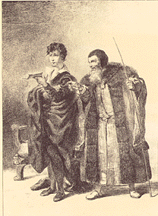
Claudius
and Gertrude are speaking with Rosencratz and Guildenstern about Hamlets
madness and have asked them to spend some time with him in Denmark to
see if they can’t find out the source of Hamlets craziness. The
two agree to do so, as they are friends of Hamlets and go off to find
him. Then Polonius and his daughter Ophelia enter and tell the king
and queen that they believe Hamlet has gone crazy because Ophelia stopped
seeing him and that he was in lovewith her. Before Polonius tells the
king about Hamlet’s madness, he told him that the kind of Old Norway
had no idea that his nephew Fortinbras had intentions of attacking Denmark
and instead gave his nephew permission to attack Poland if he vowed
to never to attack Denmark. The King of Old Norway also asked Claudius
for a safe passage to pass through on the way to Denmark. Polonius wishes
to speak to Hamlet alone and doing so gets nothing out of him and leaves
just as Rosencratz and Guildenstern arrive. The two never tell Hamlet
a good answer as to why they are here and finally admit that Hamlet’s
conclusion that they were sent to find him is true. They tell Hamlet
that the players have arrived and he is delighted to hear this news.
He speaks to one of the players and asks him if he can perform a certain
play in which a murder takes place and if so if they will perform some
lines he wishes to write. The player says they will and Hamlet writes
the exact murder that Claudius used to kill his father according to
the ghost. He will use the play to see if what the ghost said is true
by observing the kings reaction during the play.
|