.............................................................................................................
Projects and Current
Researchs:
210Pb:
The 210Pb CRS age model used for peat is based on simple assumptions:
1. the peat bog is receiving only atmospheric inputs, that is why the major
part of 210Pb is unsupported 210Pb (coming from the atmosphere through the
Rn) and not supported 210Pb (i.e. detrital and contained in the mineral matrix),
2. the flux of 210Pb is constant. From previous studies, this is verified
on a yearly basis. One major explaination for spatial variations of 210Pb fluxes is the variations in precipitation
(can we expect variations in the 210Pb fluxes due to climatic change?).
Because 210Pb has an half life of approximately
22,3 y, it i possible to age date samples back to the beginning of the industrial
period.
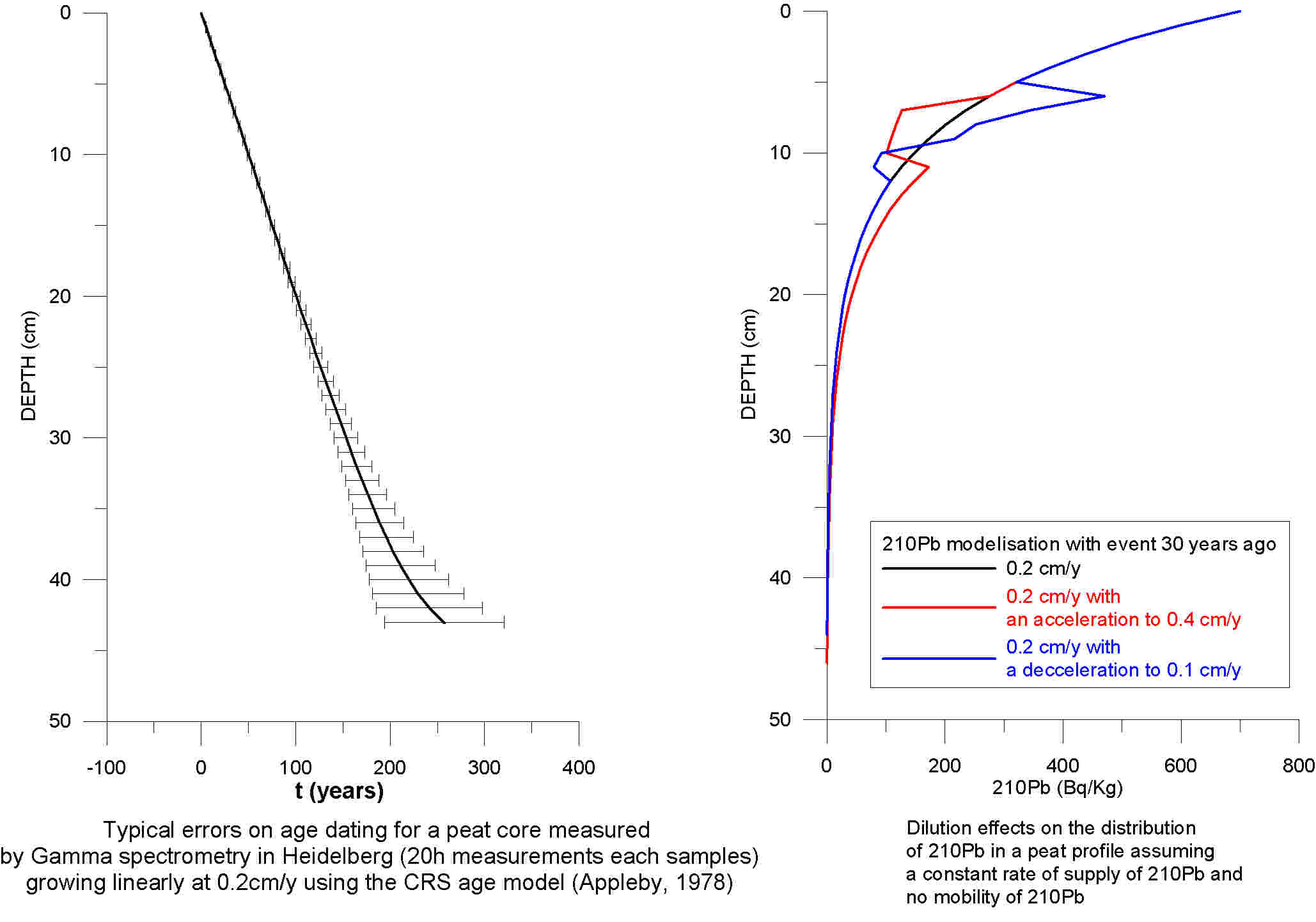
The first part of the figure is an idealized
age-depth model considering a peat bog growing with a linear rate. This figure
is here to illustrate the growing errors on the age estimation with depth.
The second part is an illustration of the
diluting effect. Indeed if the bog is growing faster (slower), the
210Pb entering the bog will be dilute (concentrated) for the corresponding
depth interval and the profile won´t respect the tradtionnal decay
curve.
This happens in most of the cases because peat bog growth is affected by
different parameters.
For a mathematical approach of the 210Pb age dating, see the book chapter
by P.G. Appleby:
Chronostratigraphic Techniques in Recent
Sediments, in Tracking Environmental Change Using Lake Sediments, vol.1 (Eds.
W.M. Last and J.P. Smol), Kluwer, Dordrecht, pp.171-202
If you have any question about interpretations
and mesurements, mail me: [email protected]
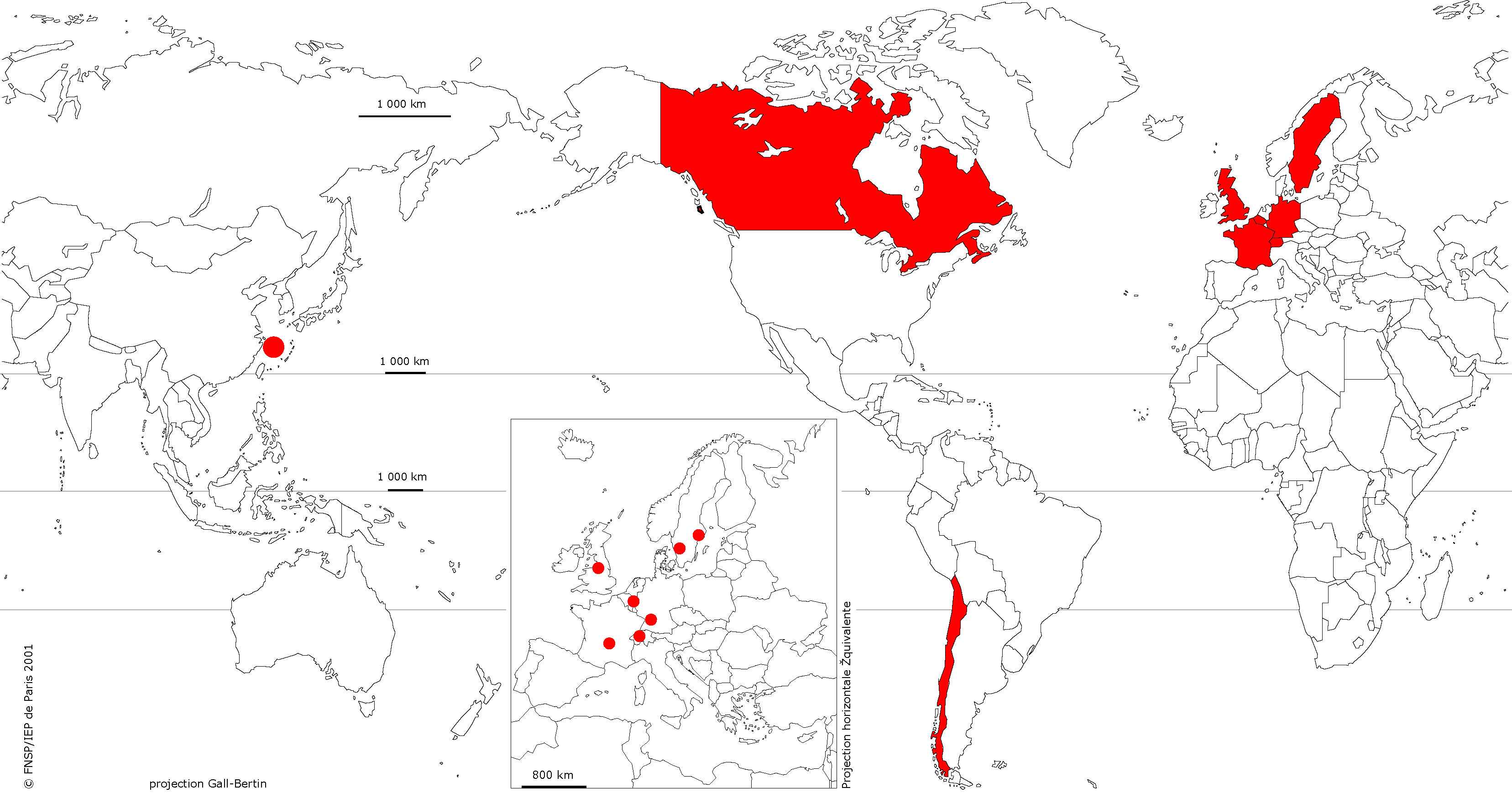
LOCATIONS of samples measured by me using the Gamma Spectrometer from the
Institute of Environmental Geochemistry
 PEAT BOGS AS ARCHIVES!: the
forum!
PEAT BOGS AS ARCHIVES!: the
forum!
Environmental Geochemistry in Black Forest: the album!
Accueil

