
I would not call this a tutorial, I'm just posting some experiences and suggestions.
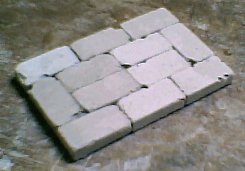
That didn't fly, the paint stays on the outside of the blocks and doesn't work itself in nicely.
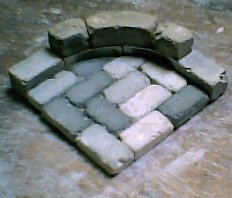
So, I tried diluted black ink, resulting in the darker floor tiles shown here. While it seems to be good, the ink collected mainly on the top surface, an effect I was not looking for.
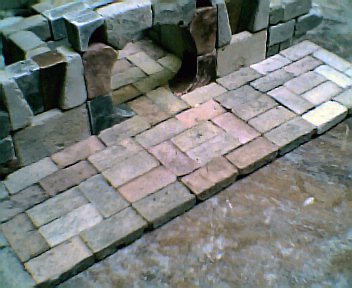
Each batch of stones - what comes out of one mold - gets a different shade. This is done easily by putting a little enamel in a bath of turpentrine, and soaking the thoroughly dry plaster stones in it. When they stop bubbling I take them out, and let them dry for a few days.
When I make brown stones, I use three different hues of brown. Since the solution is never the same, every batch gets a different hue. I mix at least three different hues before I start building anything
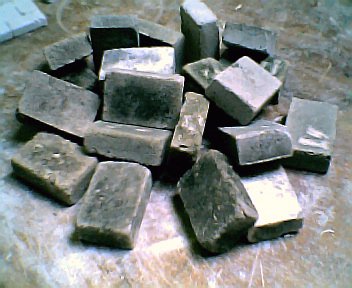
Grey stones are made with either just black paint, or with some browns added for variety.
These were colored with black, brown and a pinch of bottle green enamels. I start with just black, then add some more turpentine and a brown for each next batch.
The results are completely haphazard - exactly what I'm aiming for with medieval stuff.
The same I have done with just browns, beige hues or reds.
INDEX
Plaster Block Intro
Plaster block dungeon
Plaster block buildings