
Note: Grammatically revised text only. This document is available by chapter and simple text. It is just a piece of the whole text, the following chapters are in translation process. The whole original Spanish text is available here.
OBJECTIVE FOR THE WORK OF WRITTEN
DEGREE OF JOURNALISTIC PRODUCTION
The communities of the southeast of the Nation have remained in almost a limb, during these near to 250 Republican years. The cocalerose1 marches are only a small sample of their complexity and their special relationship with the rest of the Country. The economic and political approaches that have governed in the last 50 years (and maybe before) they discriminated against them as inhabitants of the "national territories". Bogotá is not considered a territory of the same kind; it almost reproduces the relationship that reigns between the European nations and their "overseas territories". If we call "colonists" (inhabitants of the colonies) to people that live there it is a premonition of more yearnings of autonomy. The dominance gave cause aggressive postures when they are deciduous, pejorative, and even they decide to increase their demands. Well entered the 20th century, cases of slavery - the Arana House1 is one of them - and the terrible economic conditions of the peasants of the whole region, they seem unaware to the national reality, but they have never stopped to be in it.
My experience in the Guainía, so poor and so improvised, it is a small point of communication with that reality. It allowed me to reconsider my personal relationship with the rural areas and contextualize them with my perceptions on the situation in the rest of the country. Also, it included several relationships with the Colombian state: Option Colombia, the Net of Social Solidarity and the territorial entities with those that I had contact. As source of research I only have the memories of my experience and what I have made is to explore, to detail and to revise them to look for their possible wealth. I look for to expose them from my vision, the only one that I have by hand and that it responds without obstacles when I consult it. If the contact among the Guainía, the university, the students and all the possible readers of this text become narrower, I will be able to say that I made something. To wake up the curiosity about that area of the country is a very small step, but it is also to open a door that since I know it, it has been closed. I have seen Japanese fruits in Superley of Unicentroe2, while all the wealth of the Amazon forests that we have near to the foot is completely ignored. All the magazines show the technological advances that are given in the industrialized countries, but the agricultural, hunting and fishing techniques of the natives it seems only to know them they and one or another expert. In Cali I have heard Colombians proud of being descending of Europeans and Africans, but about the native ones I have only seen admiration for their gold.
Our culture and state conceptions have always been limited and, although in the speech it is manifested as very open, in the smallest and numerous practices it is excluding. In the same way our democracy conception, backed by the Academy, it is flagged like respectful with the minorities, but in fact it is sunk in the same practices of the rest of the Country. Our proximity with the investigation and the analysis has not been enough to open us the eyes. Many calls to the order become a justification for the injustice, as when the academy joins with the interests of our political or industrial hierarchy and it leaves aside the near contact with the weakest social sectors. In Colombia, these almost have a relationship of nonexistence with the university, if not in all Latin América2. They are study and analysis object, but rarely active and participant subject of the policies that direct them. I cannot even affirm correctly that they have relationship with the small study plans. It is bigger our interest for Internet and Microsoft that for the form like the potato that we eat up in the every day soup takes place. Don't speak about the wood or the tables that sustain the dishes, the computers, and the mattresses on those that we carry out our daily life. A small approach to the rural areas and its residents is necessary, indispensable, fair and all that you want, but, before anything, is a small answer to the necessities of affection and understanding the people that live there. I can even put the economic problems in a second plane, because that that hurts more is that the interest to solve them is so immeasurably small.
Click  go back to the note mark.
| Coca planters or growers. (The notes beginning with e- are notes for the English version only.) | |
| The Arana House was a Peruvian cauchera (rubber company) that hunted and enslaved until the death thousands of indigenous of the Caquetá and Putumayo forests, in the decades of 30's and 40's.
|
|
| Superley is an "exclusive" supermarket located in Unicentro, a mall near to high society neighborhoods.
|
|
| It starts since the same name. Carlos Fuentes, in an article in El Espectador's Sunday Magazine, he said that to call us Latin America was an injustice with ourselves. That we were much more than Latin and the correct thing would be to name us Indo/Afro/Iberoamérica, and to recognize the other almost forgotten and so many times subdued roots. I altered the order to this word and I synthesized it in INAIA, a word that sounds very likely to many others that originated in these lands. |
This is a description of what happened to me in the lapse that starts in February 11 1995 and ends in July 15, same year. Those are the dates that I remember. This whole work has been elaborated by heart to tip. The pictures, the conversations with friends that were also in Option Colombia, they tell me much about the country as a group, but too few about Guainía specifically. I brought local newspapers and they gave me texts, but they only speak of very specific topics, they are very short or related only to a single situation in time and space. It is very little compared with what I learned and I lived there. The media, the statistical and almost any reliable data about that departamento is something very hard to get. Even the IGAC3, in the maps of the departamento, they ask for help in the information gathering. When I traveled, my objective was to find a professional that would will to be my thesis director, besides fulfilling the assigned work. But the time passed, the professionals are scarce and there were restlessness and many responsibilities.
Option Colombia gave me the opportunity to travel to Inírida, to work with the Net of Social Solidarity, not like a state official but as a student in the course of an interdisciplinary practice. During the semester of the experience, I sent out a monthly report for the Net and, if I recall well, two for Option. In them I talked about the activities related with that institution, following a methodology sent from Bogotá. That helped me when remembering, not so much because I had them with me, but because I had the habit of to remember and to reconstruct. But several reports got lost in paper tangles in Bogotá and they were only three, and those I recovered them thanks to the students of the COC4, but near to the end of the process of writing. Anyway, the experience was something unforgettable, full with things that I will take always with me. Option demanded me to make a feedback to the university5 and the text that I elaborated as answer I introduced it to the teacher Julián González as my thesis project. He was of the same mind about deepening it and even publishing it. He recommended me enlarge it as much as I could, using my memories as base. What followed was to squeeze and to squeeze my brain in search of all the rakes of the Guainía that had been in it. Thanks to God, they were many; after everything, six months don't pass in vain. I presented them to Julián and he requested me amplification, but this time containing the information by subthemes again. I found that memories are as an arboreal road: if you take for a road you found it subdivided in several another, and the same with the next, and so on. I could continue speaking of the Guainía infinitely, discussing my own memories and analyzing them until the smallest minutiae. It cost me more and more work to differentiate my personal life of that that could interest a possible reader, academic or not. I made a list of possible topics that deserve to be treated and then I took the most interesting, those that hid more things to say. But the fatigue in search of memories took me to rave. It is very difficult to go into in the own mind and not say the only things that the self wants to say. I attempted a text in which I only said what I like to say and titled it Drowsiness. It hardly made sense, it was very arduous for reading and it was based on thousands of things that the reader didn't know. Therefore, Julián advised me to translate that first great text (almost 40 pages) to the reader's language, one that had never known Guainía. He encourages me to toss scissors to all that was reiterated or it was unnecessary, to enlarge what was not well explained and to correct the not so well edited things.
So, paragraph by paragraph, I looked for those characteristics in the text, I turned it back and forth, but conserving the original intention of showing the departamento from my vision. The latter was the only one that I had to contrast in such a meticulous way, and in fact the only one that I could show in the text.
The two following rewritings were fed with texts of José Luis Romero and Jesus Martin Barbero's conferences. I got the songs, each one with a meaning anchored in the text, since my view, they are indispensable. The first one is a deep memory, the biggest hit before my coming. The last one I could only hear it in Christmas, when someone gave the compact disk to my nephew and I understood the meaning of the lyrics. It is almost the same one that that of the thesis, but more folkloric and more cheerful. When reading them you will realize why I'm saying this.
The last version arose from Julián's recommendation of taking the text at a good level. There is not doubt that I didn't achieve it. It lacks a lot for say that, but the road traveled among the previous version and that last one was quite a long distance. Speaking in terms of quality, of course. In addition, a misfortune happened in the road. The text that began the process that I wanted to include in the appendix, as a testimony, it was devoured by a computer. No matter how much I tried I could not recover it, I have regretted thousands of times for not having a backup copy. In the course of this work I have learned all and each one of the reasons for those that a computer can destroy a diskette. But it beats me that I still have to learn one hundred more.
I organized it again, I removed several paragraphs in those that it prevailed the speculation and the opinion; I have summarized it and ordered again. But I know that if I work the text once more, I will find out defects in it, that I will want to organize something and I will think that many of its sections don't make sense. But in some place I have to stop. It would take me more than five years to find the work that I could call "almost perfect", or at least to say "this is it!"
In this whole process they almost lapsed two years: From November 1995 to August 1997. Time in which I turned my eyes head over heels, I condemned myself to the underemployment and I had to fight for a space in computers those were not of mine. But it is worthwhile to begin. To narrow knots and feel me nearer, be just from here. To take always present those that I met and to look in my mind for an appropriate answer to the problems that I felt closely. To remember their plurality of origins and to give thanks to  6 for made it possible. Inírida is the demonstration that we can live with the natives, the Venezuelans and the Brazilians, blended with all that we the mestizos are. The most terrible (and armed) intolerance they are conquered by simple people, with their humility. I have always seen the natural wealth beside the hearty generosity, so many times that I no longer believe that it is coincidence. On the other hand the pride, the reproduction of the suspicion and mainly the prepotency, they are fertile ground for pain and death. Will it be possible that we recognize it once at all? It is not about to restrain us mutually, but to share and to bring without waiting anything to change, from the heart. Because everyone who gives something with interest puts the things above people, he or she gives foot to hypocrisy and suspicion. If I hide my interest, being good actor or not, the other can, in someway, look a shine of it. If I opt for the nerve, my words become aggression. It is not better maybe to be sincere and to think about the other ones? My religion is the foundation of my facts, even in my improvisation. When I have stopped to follow it, it is when I have made a mistake (it happens to me to frequently). It is the social motivation of this thesis, of my practice, of my yearning to see to the minority groups well treated. The tyrannies of the Middle Ages harmed us a lot, they twisted us the spirit and today we have to reconstruct it. There is much talkative in the road that only looks for fattening their saving accounts. But what about those sincere those help although they manipulate them? The Colombian society needs the peace and Guainía has it. Come closer! Go and learn that is your life the one that worth! The one that is at risk when the one that stands for war triumphs...
It is a lot of pretense for such a small text, but it isn't for a human group, when they know what they want. It is what this thesis looks for. If it gets it we will have another reason to thank and to continue ahead, to smile and to live, but this time with less tears.
Pon manó, apewe? is a free translation of where do you go, brother? to the puinave language, the same one that they speak most of the communities in Inírida surroundings. By this way, since the beginning, I support a beautiful language, so that Spanish doesn't push it toward its extinction. By the same way, I have reduced all the spaces in white and the size of the characters to reduce the paper consumption. It would be a contradiction to speak of ecology and not to make something similar.
I request to that his will be completed in this text. He created the men and the waters and He put them each one in their place. He is here, in the forest and in everyplace, although they are many those that ignore Him completely. Be this thesis a step toward that Being, to Who I seek to serve. That we come closer to his tolerance and his peace and to the discovery of that unknown place that is in ourselves.
Click to return to the note mark.
| 3 | Geographical Institute Agustín Codazzi, the national maps drawer office. |
| 4 | Option Colombia Corporation. If you want to consult about it and the IGAC, click here.
|
| 5 | Please see the appendix.
|
| 6 | Normally, we would put the word "God" in this place, but it would be as wanting to put the sea in a pail. God is a word to name something that doesn't fit in a word, a concept to explain something that doesn't fit in a concept. All the cultures of the world have a special vision of Who is the Maximum Level Possible of Kindness, Who created everything and Who goes beyond the physical world, although He is also in it. To use the capital in the pronouns when I mention Him is a form of respect, the symbol tries to overcome the precariousness of the language when we face a reality of that size.
|
START: OPTION COLOMBIA IN UNIVALLE
October 1994. They appeared in Univalle signs, graffitti and even a mural. All them referred to "Option Colombia". Then a note in the t.v. news about the same thing. It only said that it was a possibility of going to small and remote towns, to teach and to test the knowledge acquired in the university. Then, posters appeared with the title "the Option Colombia practice"; they invited to attend a meeting in which they would explain the program content with more precision.
I attended as I could, the same as people of different faculties. It was explained that students of several universities created the Corporation Option Colombia (COC) with the purpose of seating the achievements of the Constitution of the 91e1. The experience consisted on traveling to a remote municipality chosen by one's self and to work for six months with an agency of the state or an NGO related with each person's specialty. It was looked for to bring near the university to the small town, to the cultural diversity that is the nation, to transform the student into a «cultural amphibian» that helped the entity to communicate with the populations that have not received any benefit from the state.
The candidate to practitioner proposed a place and a work that he could carry out, and the Option crews look for a state entity or NGO that made something same or similar. It was possible, but not sure, that they found him exactly the place and the work that he had requested. If the student considered that the place and the work proposed by Option didn't interest him, he simply said no. If he wanted or he could wait, they continued looking for options until giving with the suitable one.
The idea got my attention: It was related with communication and it takes me closer to several cultural needs that I had not been able to solve. In the practice the field work, the direct contact with people was demanded, something of what had been spoken a lot in the university and that it had always been left to the student's personal criteria. I decided to propose communitarian work with indigenous in the Santa Marta Snowy Mountain Range or in the Macarena Sierra.
In a meeting, some weeks later, a partner of the COC asked me if I wanted go to work to the Guainía, with the Social Solidarity Net. None of us remembered where the departamento was and we had to look for a map to locate it. It was exactly in the small extreme of the eastern end, in the frontiers with Venezuela and Brazil. I asked if in that departamento there were indigenous. Marco Alejandro, one of the students that had instructed us about the COC, responded me that they were the population's 98.8% according to the DANEe2, and I accepted.
Why did I accept? During my carrier1, I also took subjects with different plans. I shared experiences with people from philosophy, physical education and psychology. Additionally, I saw a seminar about democracy and human rights that it was given for all the students of Univalle, with professors of diverse specialties. While I took those classes it felt one time and another the same thing: The university was centered theoretical and mentally in Europe, there was a vision of INAIA2, but the European point of view prevailed. I felt that there was a hole in my instruction, which our culture is and it has been from the beginning a mixture of the indigenous, the European and the African thing. I lacked to explore two of the three roots of INAIA that had been so little worked in the plan. To fill the hole it was necessary to look for the native in their past and in their present and this was the precise opportunity. Then I would look for to explore the African root, harder to follow in the other side of the Atlantic. This was one of the primordial reasons for those that I decided to travel.
I had to leave toward Bogotá, to receive an instruction on what was the Solidarity net in a more precise way and to leave toward Inírida, the capital of the Guainía. I liked the little bit that I knew about the net; I had only seen publicity in t.v. and one or another article in newspapers. I knew that it was the government's agency with programs for the poorest benefit. Something that should exist from the beginning of the Republic, but, as I would know later, not even in 1995 it had touched earth.
I went out with a little baggage, I traveled by land and I arrived to the National Archive building, almost besides the Nariño's Palace. With students of all parts of the country, of different specialties and idiosyncrasies, I received an "instruction-lightning", about all and each one of the programs of the net. It was data bombing, thrown all together like to the juriae3. We all felt that we lacked something. We could ask many questions, to interrogate and to interrogate, but that it is not the most used custom of the student body. There was not enough time, we didn't know what we will find really when arriving to the departments, It were shown something that was completely new and, as if it was not enough, the Colombian state is dark and complicated.
They presented us eleven programs in total, in housing, health, education and employment. I found a complete mess that of urban housing, full with laws, turns and sheaths. Nobody was prepared for that kind of instruction and nobody came out prepared of it. For those that will work with the FOSES (Fund of Emergency and Social Solidarity) they were given an additional instruction that anyway only lasted one day. Then, we distribute ourselves, each one for the land in which he will work. Some they left immediately, others in some days and, a partner and me, in 15 days.
THE LITTLE TRIP
When I traveled, only Satena arrived to Guainía and in "the Colombia's airline"e4 there is never share. We wait, we call every day and there was never share. They told us that we went a.m. at 6 o'clock to the airport "to see what they could make", but the idea of getting up so early with everything and suitcases, without the most minimum certainty, it convinced us that we would have to look for on other site.
Then, already in Guainía, they would count us that the airplanes arrive almost empty,
with several free seats; what they do is to request a collaboration to put you in the
airplane and to give you the surprise of the share when you are already in the air. Thanks to , we
were also said that the load planes sometimes took people and that was cheaper. That
was an incentive. We check and it was 10 thousand pesos less, and if
we were lucky we would have a seat; if not, we would go above boxes and corotose5 that
the plane took. January3 arrived to its end and we should have arrived at its beginnings. 15 days of
wait, with money that slipped away in one's hands as a hen amid the jungle, they went enough for
convince anyone.
To the partner that also went to Guainía it was not so bad. Telmarrosa Ceciliahurí Angarita Gómez is from Bogotá. She lived in the capital and she didn't have problems with the buses neither with the feeding. Where she had them it was in the National university, that seems to be more rigid in the paper work than Univalle. They demanded her to request permission in three different offices to retire for a semester and she had to present a work that demonstrated that she didn't leave for tourism, they credit it or not, neither it served her as a contribution for her career.
Anyway she decided to go; their principles demanded her to fulfill the given word. We went to buy the tickets to an office, at the other side of the city, where they received the load for the airport. Only two load lines arrive until Inírida and they ordered us to present us a.m. at 6 o'clock in "the track in front of El Doradoe6". That damned track doesn't exist for any taxi driver, in Bogotá they are few those that know where you can find that thing or another. If you question them, they send you where it is not, the most common thing is that they tell you «I don't know, look well in this direction, maybe you find it». After a lot of turns and a fight with the taxi driver so that he didn't cheat me (he made it already), I found the place crossing the street.
In a cellar full with boxes and barrels waited all the passengers. I arrived late 2 hours, but
the airplane would come out about 10 in the morning, anyway. In the wait we met three
missionary nuns, a lawyer, a policeman and a teacher that also went for Inírida. There
were other 15 people that went in the same airplane but they stop at Puerto Carreño, in
Vichada. All were habituated to wait, except us. It was not seen neither a small seat, neither a wall neither anything. We could not sit down in some box of the cellar, because we could damage that it took inside. We must to lean us back in the wall, to give turns so
that the legs went not slept and to wait. We talk about those DC-9s those they had
fallen for that time, but thanks to ours it was a jet.
We gave the tickets and we made line; the women and the children entered first, so that they reached to catch seat. The other ones would sit down on the boxes, or somewhere around, where we could. We ascend to the airplane through a metallic stairway, not the typical boarding ones, but a painter's one.
The load inside was not treated better than us: broken potato bundles were seen, thrown potatoes, boxes of broken mayonnaise and of tomato sauce bottles and with their content watered. There everything went: furniture, groceries, vegetables, cement, bars, etc. It had near to 12 seats in the part of ahead and the women occupied them almost all. We the men who were more than enough sat down among the potatoes, as in any chivae7, and we waited. At least we could look for the window and sit down where we wanted. They went up with the stairway to the fuselage with a lot of uproar and they threw it somewhere around, among the seats. Since the same airplane you felt in the countryside. The airplane was used by peasants and their voices and ways remembered the small town atmosphere.
Most of we were pure overweight. The managers of load carrier surplus the airplane to the maximum of their capacity and sometimes until more (and only speaking of load). Only when some airplane falls they adjust the controls; the rest of the time, a tragedy should be expected for not risking the life for a while.
When we finally leave toward the track, we had a line of airplanes of all type and size behind us: Light planes, Hercules, load jets, etc. waiting their shift to be able to raise flight. What irony, Bogotá has traffic trouble until in the airport!
The truth is that I felt very comfortable in the flight. I had an entire window to look down and to contemplate the landscape, without seats that were in the way if I wanted to look besides. I saw how the monstrous city went becoming mountains, little toy cows and trails of houses in the surroundings. The dark and cloudy green land went descending and it went peeling it self little by little in the agricultural areas, until becoming the grass of the plain. Waters of different colors were seen, with rivers and births borders full with thick forest. Every time that one of the toy cars passes through the little roads, they were formed small smoke clouds.
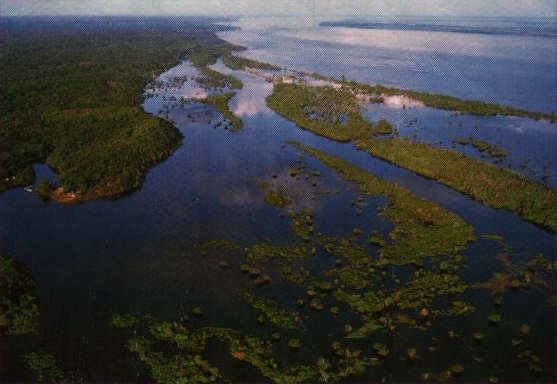
This is a postcard of the Amazon River that I found. It is more or less a vision of the Guainía from the air (in winter season.)
We made scale in Puerto Carreño and everybody had to descend so that they could discharge. We traveled the dusty and sandy streets of the urban helmet, hot as them alone. Tiny, of wide streets, the town didn't have a lot to show. It is only for highlighting the monument where the flag stands, the landmark that demonstrates where the Colombian territory begins.
"This way, exactly the same, is Inírida's climate, just a little bit fresher" told me those that had already gone. In the airport, almost the whole load was left below and it was replaced by a people's tumult; all were toasted by the sun and they had a singular air in speaking. Their faces revealed ancestors nearer to the indigenous, but they were the rich mestizo class that dressed up to date and they could pay the cost of the ticket.
The jet played earth hardly, all the rest of the boxes that were there come above us and we had to stop them among all, in a mess of hands, boxes, feet and potatoes. The children that had sat down more behind screamed "help!" among laughs, navigating in that sea of boxes. For good nothing happened to them.
The airplane stopped, they opened the scuttles and they put the stairway down again. From the windows mountains of white sand were seen around the airport, left there since they built it. In the opposite side a starry airplane lay years ago, almost whole, being turned to rust by sun and water.
When I went down the stairway, the first thing that I saw at the horizon was five columns of smoke, each one in a different cardinal point. I remembered the fights of the firemen against the fire in Cali's surroundings, almost always they were surrendered for arriving too late. It was seen once the Cristo Rey's hill, just besides the statue, through a whole day and night. The problem was the same, but this time they burned four times more species of plants and animals. We were in Inírida, the Guainía's capital.
WHAT WE MADE4
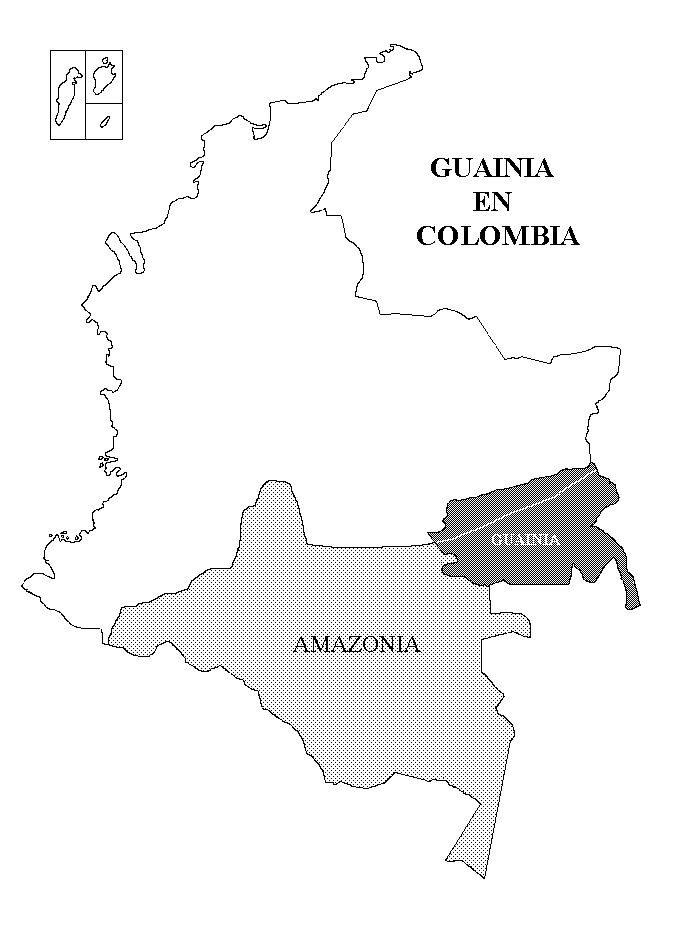
I carried out the practice Option Colombia in Inírida, the capital of the departamento of Guainía. Their urban helmet is quite small, more or less the size of Jamundíe8. Its population is compound mainly for colonists coming from different parts of the country, in an approximate proportion of 60%. The other 40% is integrated by indigenous of several ethnos that inhabit the departamento at rural level and of an important percentage of indigenous groups that migrated from Vaupés.
The great majority doesn't possess an educational level above the high school; the professionals that live in Inírida all of them have arrived through Bogotá to work with the municipal or departmental government. The only communication ways are the river Inírida and two airlines, Satena and AeroRepública that arrive two or three times per week.
The departamento of Guainía is located in the eastern end of the country, in the limits with Brazil and Venezuela, surrounded by Vichada, Guaviare and Vaupés. Most of its territory is forest and water. Their rulers consider the departamento inside the corpes5 of the Orinoquia for political and economic convenience, but in the strictly geographical sense, only the rivers Guaviare, Atabapo and Inírida end in the Orinoco. The rivers Negro, Isana, Cuyarí and Guainía belong to the Amazonia. The whole territory is crossed by infinity of brooks that end in their turn in the main rivers.
The natives are the majority of its population, with an approximate total of 24 cultures. The puinave and the curripaco are the biggest ethnos, but there are also guahibos, sikuanis, yerales and others. They are hard to quantify for the population's mobility. They inhabit the riversides, distributed in small communities of not more than 800 inhabitants, very distant to each other. Only Inírida, the capital, has near 14 thousand inhabitants, with a percentage of floating population of 25 percent.
In the Inírida river the ethnos puinave prevails; in the Atabapo and in the Guainía, the curripaco; in the Isana-Cuyarí and in the Negro river the latter share the territory with the yeral; the Guaviare is inhabited by different ethnos, mainly those coming from Vichada and Vaupés. According to the DANE, the total of the ethnos they make the population's 98.8%, but, if I only lean on in my observations, I could say that the real figure oscillates between the 70 and 80%. However, the census doesn't consider the mobile population neither the recently displaced colonists.
Inírida is the only municipality, the other ones are corregimientose9 and the gobernacióne10 administers them. Anyway, the rural area that controls the Mayor's office is immense. It begins in the Guaviare, it arrives until the Middle Inírida River and it includes discharging brooks.
The net
In what concerns to my practice, I supported the presidential program of the Social Solidarity net6. My work consisted in coordinating the departmental table of solidarity and the sector tables of health, education, housing and employment. I also made surveillance to the projects of the following programs:
At the arriving moment, the departmental planning secretary carried out these activities, by governor's responsibility. According to the operative regulation of the net, the members of the collegiate management body (the governor, the mayors of the municipalities, representatives from the community, the NGOs, the executing entities, the churches and other civil organizations) they were those in charge of the administration of each program. However, as all those people had the whole time almost saturated with activities, the normal thing was that it was delegated in an institution that had a general vision of the departamento's problems. In most country's departamentos it corresponded to the PNRe11 delegation, but in the Guainía it didn't exist. Only until March 95 the delegate's appointment was official, and it corresponded us, to my Option partner and me, to collaborate with the organization of the new delegation and to work like secretary and messenger, while the corresponding ones were named.
Anyway, the work of the net is an interdisciplinary work, in which all the state institutions intervene, so much the departmental and municipal secretaries as the decentralized institutes (as the ICBF, the Agrarian Box, etc.e12); with all things related to them. In each sector table each institution technicians sat down with representatives of the community (or the same community), to make decisions about the resources used in some programs and/or which communities or people were benefited. For example, in the housing sector table they met one representative of each neighborhood of the municipality, representatives of the communities of the rivers, one representative of the Mayor's office, one of the departmental planning secretary and at least one of the Solidarity net. Representatives of the public infrastructure secretary were present in some occasions, the PNR, the Caja Agraria and the INURBE. Among all them they decided which neighborhood has more poverty concentration in Inírida's urban helmet and which departmental micro-region has more unsatisfied basic needs. None could have been cover by previous governments' rural housing programs.
The resources that would feed the programs came from the co financing funds, some of them: Solidarity and Social emergency Fund (FOSES), Integrated Rural Development Fund (DRI), Infrastructure vial (FIV), Social Infrastructure Fund (FIS), Urban Infrastructure Fund (FIU) and Financial Territorial Development Fund (FINDETER), besides the institutes of Urban reform (INURBE) and Family Welfare (ICBF) and the education and health departmental and municipal secretaries.
Obstacles
It was an obstacle for us to arrive to a departamento where there was not PNR delegation. People in charge of the net programs in departmental planning knew very few about it and they waited much from us. As we were instructed in Bogotá at fantastic speeds, the advantage that we took them was very small. Even more, we had to borrow everything: Computers, paper, typewriters, telephone, etc. It was a plus that in the departamento they were very kind and they didn't complain about the annoyances that we cause them.
Almost all the decisions we had to consult them with the central level; hard phone communications and congestion are bread of every day for the precariousness of local Telecome13 equipment. We had the luck to be in the airport with people that knew the region; not being this way, we had arrived without knowing at least where was the governor's office. Anyway, the departamento collaborated with us with 2 months of rent and feeding.
Another obstacle was the scarce possibility to visit directly the indigenous communities, for the distance and the enormous consumption of gasoline that mean the overboard motors. I could only be within the communities in three occasions, two days long each one. In the departamento the centralization is very hard to avoid, because there are communities at a distance of 15 days by river and those connected by air only have flights every 15 days, like Barrancominas and San Felipe populations.
About the central levels, the decentralized institutes regional offices are all in Bogotá or Villavicencio, it complicates the deskwork a lot. In many times the officials were not, after (at least) 40 minutes of insistence, or they didn't want to respond because "they were very busy", and that neither would be a cheat, because the regional offices assist the whole Orinoquia or Orinoquia and Amazonia the both.
| e13 | The state owned telecommunications company. It uses to be the only one phone company in rural areas. |
And we benefit...
Whom my work did benefit? I believe that mainly to the presidency of the republic and the net delegation. It is supposed that it was for community benefit, but it is hard for the community to make the most important decisions. The normal thing is somebody other who knows how the things are made. The officials are not accustomed to the people participating. If somebody consults them they answer the little thing that they know and they put him to turn rounds or to make line for speak with the governor or the mayor. Only some few officials manage the entirety of the problems. In a poor departamento as the Guainía there is not an information office for the public, when what is needed would be more than four.
The bad attention is not only owed to laziness. When requesting them about communitarian participation, departmental government's secretary and the municipal planning secretary (both in charge of their local entity by absence of the holder) they told me almost in chorus in a meeting "you could not be so democratic". As if it was not enough, the departmental corregimientos coordinator mentioned me informally a proverb of the region: "Neither the mañoco7 is food neither the Indian is people". His intention when making that quotation was a clear manifestation of racism, because he dedicated the whole conversation to demonstrate that the Indians were inferior people. That they are still high officials with mentalities like that gives worries to anyone.
It cannot be refused that to face a different culture implies more than a difficulty. The natives have a different way to behave, they manage terms in their own language, but they find hard to understand Spanish terms in a technical level. They listen to you, they say and they make as if they have understood, have they understood or not. For them the ignorance is something supremely shameful and it is not normal that they accept it in front of who represents an authority. With the little thing that I knew them, I found that they only accept it in front of well-known people, of trust, that they do not seem "to be doctorse14". There are also differences in the blood relation, in the way they celebrate, with the language, with the data... However, none will be enough to justify dictatorial, prideful and racists positions.
The government's ministry Indigenous Affaires Direction has an office in Guainía. It is supposed that it assists all the problems presented to the communities with the state authorities and anything like that, but only one anthropologist and one indigenous boat pilot are in charge. Only one person to assist at least four cultures in a departamento twice more extended than the Valle! Add to that colonists that look at the natives as an inferior ethnos and say "they are lazy", "they seem like animals", "they do not have any ambition" and so on.
The anthropologist should explain cultural aspects to human groups that do not have the most minimum interest in understanding each other, and among them I can count the professionals. Also, the communities have a heap of necessities to solve; each one implies that the indigenist moves to distant places and explains the same thing one time and another. In the long, he takes the same posture of a box official in a state institution: &he nags people, he gives them excuses, display with the tone of his voice and attitude the nuisance that causes him that they ask him the same question for fiftieth time. The mistreatment to the citizen is the state corporate culture and they are few the entities that escape to it.
From the Andean-industrial point of view, the natives do not know how to make anything, they are very belated people. As they do not have industrialization (machines, electronic and other teams), they are considered belated. A worker of any company would overcome them with easiness in the machinery8 operation, most of them are undocumented and illiterate, and that locates them at the same level of the unemployed or the indigent. Very few people recognize that many of their complex abilities in the handling of the natural means are top technology. In the great majority of the communities of the rivers Isana-Cuyarí and Guainía-Negro, where only the miners and the few Colombian government's representatives have arrived, the natives have devised how to him to obtain out everything (drinkable water, nutritious, transport, medicines, housing, etc.) from forest and rivers. Their activities generate a tiny contamination level that any country's municipality would envy.
However, in the Guaviare and in the near to Inírida communities, where the colonization is more and more intense, the natives feel shame of being what they are. They reject the natural and traditional products for consume foods produced for the market, with a smaller nutritional content and to those they are not accustomed. The forgetfulness and the cultural shame attack with force the traditions of sharing things in community, they mine their deep respect to the ancestral authorities and the environment.
It can feel the step of the different ethnos toward the customs that we would call ours. It becomes a common cultural place the physical native with mestizo's mentality; somebody with features and indigenous accent, but that he only has in common with the communities his genetic code.
The road that we follow in our relation with the U.S. has the same symptom. The
Colombian also feels shame out of his culture. It is very strange an English school without
clientele, they are more those that have travel to Miami that those that know an indigenous
resguardoe15. Right here in Cali, the signs in Spanish are disappearing. It seems that to the
merchants they don't find their language very "in", neither very "play"e16, nor anything similar. We behave like a subordinate culture and the codes of the dominant one are those that prevail. However, we can still follow the advice of Rubén Blades and look for something better.
MINEiROS
Mining in Guainía is the activity that reports more earnings, above the coca cultivation or trading. In any curve of the Inírida River it can be seen the "rafts", or metal frames mounted on drums of gasoline full with air that float on the dark waters. Each one has palm roof and it loads on the indispensable pumping motors for to impel air to their plungers. These guys descend until 25 meters under the water, in search of gold. Each one takes a hose to absorb the earth of the bottom and to look for the veins amid the darkness, the sand and the mud. Of his expertise it depends if he becomes rich or he dies flat. It is normal that from absorbing the bottom, a niche is made and the land comes over. It is also necessary that he be a strong and resistant man, because the hose pull hard for wherever it wants. In addition, he has to spend whole hours under the cold water, amid treacherous currents.
Spite the arduous work, people come from a distance because they can end up being won three million pesos in one month. As iron powder attracted by a magnet, miners, prostitutes and merchants have arrived from all parts of the country, behind the Guainian wealth. In Inírida there is a block where most are miners; their houses are firm, wide and well built.
The Brazilian plungers, well known in Brazil like garimpeiros, they end up coming from places so distant as Manaos, Brasilia and until Sao Paulo. They seem more experienced in the search and the extraction than the Colombians, because they have acquired experience working in their country that has ten times more forests and mineral wealth. Most of these men don't speak Spanish, they understand when you speak to them, but they answer in Portuguese. They don't come to learn, not even for tourism, they only come for the gold. When they get it, they spend it out almost immediately in beer and women.
However, the luck not always smiles them. They are many those that have arrived only to suffer, to get in debt and to know the mysteries of the Guainía. For the Brazilians the terror in Colombia is the DAS. Some times this security body organizes combing to capture them and deport them. They enter in hotels, in rent-rooms houses, usually at night, and they catch them unexpectedly. However, little or anything the operatives do, because they hide or they get some from the town each time they have to. In 4 or 5 days they are seen back by the streets of the town, as if nothing had passed. Most has been hired by gold merchants and the raft owners, they are who keep most of the earnings. With all their money, it is easy to influence the local politics.
Although most of the bosses are Colombians, there are some "mines" inhabited almost exclusively by Brazilians and there the Colombians are treated as foreigners. Little cares that the territory in the map has the «Colombia» sign, they are majority and in fact they are not distinguished for their honesty. Some Colombian miners spoke to me very well about them. They assured that they are very humanitarian and more cordial that the same countrymen. But very few of them have a medium level of instruction; their consumption habits make them live on the edge of the bankruptcy, in spite of all the money that they achieve to earn. Anyway, that it is a disease that attacks them all, without distinction of nationality. Moreover, the merchants move to the "mines" and they get paid according to the revenues of their clients, it means with inflated prices. Not very big breads can be seen by thousand pesos, beers by the triple of their commercial value. The plungers pay as well. The traders consider the surplus something natural, a retribution for put them the goods almost in the hand. "If it was not for us they would have to go until Inírida" some of them say.
"Come, I'll tell you..."
Among the plungers there are legends, thousands of anecdotes that they love to tell. Some of them like to show their rafts and to explain the process. Diary they risk life and work until late night. When they are seen walking around, with the Sunday clothes, it is that they are resting. They take advantage of those moments to speak about everything with emotion.
In Mavicure they told me a history that seems a Creole "Deep Blue":
There was a very quiet plunger; he didn't say anything more than the thing asked, but he was very good under the water. All those that worked with him knew that he was overturned. His wife had left him, boring of expects wealth and not see anything but debts. As he was so needy of money, the guy continued working. An evening, just he submerge, he unfastened his hoses and went down at most deep, by pure lung. Other plungers that were able to see him made signs calling for his return, but he didn't notice. Something like that meant to let that the current dragged him into a sure death. Almost everyone thought that it was an accident. One also came unfastened and was able to make that he saw him, amid the darkness of the river. The guy looked at him and continued as if nothing was happening. His helper thought it better and it recognized that he could not follow him so deep. He said himself that he would probably have to fight for take him out so he returned to the surface. In addition, there was the possibility of him attempting it another time, when he would be alone. The mad plunger got lost in the darkness and nobody saw it again. There was the hope that they would find his body river below, but nothing happens. The fishes ate him up or the earth swallowed him.
They also told in Inírida of a candid one who arrived from Boyacá without at least money for return. The guy thought that the mines were dug in the floor, as those of coal or emeralds. As he didn't know how to dive, he had to devote himself to work for a daily wage to be able to return; he finished staying definitively.
The miners are men with lots of money but without instruction, nomadic that they only pursue gold and they leave when it finishes. And it is easy to go. The "mine" is in fact only a heap of rafts anchored in a place of the river's current. They are always above the biggest veins, those that they can explode with the system they use. Nothing about tunnels. Some said that they invented that name at the beginning, to hide the true origin of the gold and not to have to share it. Nowadays it is strange the Iniridense not knowing a raft.
A lot of gold, but...
The miners spoke very well of their activity, but not all shared their opinion. The Inírida River was the favorite place to dig in its channel with the dredges, but Inírida's mayor decided to veto the place. The riverside indigenous communities were annoying with their drunkenness, their weapons, their fights and the prostitutes those came behind them.
As strange thing, the prostitutes are not the professional group more socially accepted; at least by the face. The "women of the life"e16 have their main headquarters in the bar "Firulais", distant three blocks of the Governor's office, it is normal in any town of the country. But their branches in the rural area are not. Near to the mine they can be seen carps made with plastics and sticks, where the ladies hang their hammocks and they shelter sun and rain. They get paid according to their experience, beauty and popularity, always in gold, in grams or in lines (0.8 of gram)9. The gold of the plungers is so attractive that there are always women willing to pursue them.
Most native communities are evangelical, very strict about the illicit sexuality and the alcohol consumption. In addition, the mining contaminates their sources of water and it generates dispersion among the youths. As one of them told me: «Work the earth is very tiring. You sweat a lot and you don't win anything. On the other hand, in the mine you won more than the triple and in less time.» The novelty and the possibility of entering the national society under economic superiority conditions, they are very strong incentives for them.
Among the colonists the contamination with mercury begins to be a concern, too. Populations in the Guaviare and the Inírida rivers already realized and they didn't like. They begin to appear illnesses in the skin, inflammations in the pleats of the body and they diminish size or are scare some species of fish. The origin of such things is not mystery at all. The plunger uses the quicksilver to purify the gold and, when he doesn't spill the resulting liquid in the river, he burns it. After all, the chemical will go down to sources of water that they are used for cooking and drinking. To the merchants, charmed with the consumption of beer and the lot the miners buy them, they didn't like the idea of stop seeing them.
The near Venezuela, the distant Brazil
Some in town looked the Brazilians with mistrust and they didn't give sample white of wanting to make something different to drink and impel prostitution. Their dishonesty and their relaxed customs didn't help a lot. Lacks of economic integration with Brazil make many of its beneficent possibilities become wasted. Trade with the neighbor is not profitable, because its inflation has lowered a lot and its currency now is stronger. The nearest city is Manaos and it is as far as Bogotá; with the small difference that there are not flights neither roads that take until there. You can arrive by river, but the trip is too long.
With Venezuela happens the opposite. In spite of the Guardiae17, the trade with this country is a fact: They are brought gasoline, roof badges tiles, cement, beer and until flour for the arepase18. All the cars that you see giving turns around the town are brought of smuggling from there. Many of the aid the Venezuelan state gave in previous decades went to stop in communities of this side of the frontier, sold as merchandise. A typical trick of our contractors: to charge the cement at Colombian price and to carry out the work with Venezuelan cement that worth near the half. The Venezuelan consulate in Inírida is as well-known as the ICBF.
On the other hand, the Brazilian office is in San Felipe, a colonization center distant 10 days by river. There are flights until there, but 15 days each. In fact, the south frontier of the departamento is an almost unknown place, where the colonization is still incipient. To arrive at the Isana-Cuyarí River they are needed three travels by air through Vaupés, two for take gas and another for the passenger, because there the gas distribution
can suffer trips. By river, a long distance should be traveled by the Inírida, pass to the
Guainía and from there to the Isana. In summer, you walk another distance carrying the load in the shoulders or pay a expensive transport that only knows if it is there.
The indigenous officials that came from the frontier with the Brazil were very quiet. Each resguardo has a legal representative before the government, but to those of the south the communications, the transport and its costs, isolate them from its territories. Data about their populations are scarce and old. According to the same governor's words, this area is in hands of the garimpeiros and nobody knows the luck of the inhabitant natives.
As "solution", the congress members promote roads toward the river Guainía, which would make easier taking out gold, deforesting and colonizing. As if it wasn't enough, in the whole departamento you can not get a single environmental license. The leaders know what they are, but because they have said it in t.v. The ministry of the environment only demands them when a project affects 15 thousand people or more. Inírida, the "megalopolis" of the region, hardly arrives at the 14 thousand. The departamento is an entire bank of species, rich in oxygen and animals in road of extinction, but its wealth is as big as fragile. Observing the speed of state advancing I see this a very serious thing...
| e17 | The Guardia Nacional, Venezuela's army. |
| e18 | Round maize loaves, the Colombian typical plate. |
Tell me with who you administer and I will tell you who loses
By law, the indigenous communities are entitled to the bonuses generated by the minerals extracted from their territories. Many of them don't know how to spend their money. Some of them distribute it among their selves in same quantities, other parts give it to the captain (recognized legal authority) and this man flies away and nobody knows about him again. The local politicians like to impel projects, but they are half-ended, with such a scarce community instruction that they condemn them to failure.
The money sent by the state isn't surrender directly to the communities, but rather the governor's office administers it and executes it. The populations present the projects, according to their needs, the leaders give the check mark and they carry out them. However, the indigenous authorities know few about methodologies. The offices that should serve them difficultly as a guideline hardly work, their officials defer and defer the delivery of such projects to Bogotá. The contracts between the community authorities and the miners are usually oral and the miner is who determines how much was taken out.
Everything accumulates so the money and the gold get lost in the road. I only knew about a community that used their money well; they were directed by an evangelical pastor, a very quiet and very serious guy. Other, on the Atabapo River, knew that they had gold and they didn't still exploit it. Today, their destination depends on the instruction that they reach and in the capacity that they demonstrate to manage the language of the state. It is as putting a newspaper of a small municipality to investigate all the puzzles of the proceso 8.000e19.
For take out a project ahead, the communities of Guainía (and of whole Colombia) they
should: To fight with the state, to push it so that it moves, to hold back the promise managers, to take out the well educated thieves, to solve their problems of internal
coordination, to prevent that the system corrupts their leaders and (if they have left time) to be
in charge of all the works that allow them to continue alive and to raise their children.
Superman, with all and his powers, would be seen like a baby. There is nothing left but trusting in and to hope our faith saves us.
COLONISTS
In Guainía there are three main colonization centers: Inírida, Barrancominas and San Felipe. The most important is Inírida, very big and heterogeneus, as a hot neighborhood of Bogotá.
The first capital was in San Felipe, then in Port Colombia and later they changed it to Inírida. And there it stayed. The others were in the river Guainía and it was complicated to arrive to them even by river. Inírida, on the other hand, served to the armed forces as support point. They no longer had to travel so long distance for arrive to the frontier with Venezuela, and they had the Guaviare and Atabapo rivers at near step, both near the colonization area that interested them.
Since its foundation the town has grown vertiginously. In 30 years, the small indigenous population became a town with more than 14 thousand inhabitants. A sharp contrast with the rest of the departamento, with indigenous populations that don't surpass 800 people.
The town is seated in a dry area surrounded of in-flood-covered areas. There are three brooks around the urban helmet: Pipe Deer to the east, Pipe Vitina to the occident and Pipe Rabbit to the south. In the middle of summer they don't overcome 2 meters wide, but in winter (or more properly in rain season) you cannot see a bank from the other one. As Colombian town that is respected, it has people living in in-flood-covered area.
The population grew from the margin of the river, with the port at a wise distance, to avoid that the waters took it out. The Inírida is an enormous river if we compare it with the Pance or the Cali, let us say three times wider than the Cauca and very much deeper. Many years ago, it grew so much that it flooded six blocks beyond the port.
But their river is their life. By it they arrive daily fishermen in canoes and boats to offer some of the 24 fish species that can get, with merchandise to sell. In the past they were fish so big that a medium man could not measure it with the extended arms. Today they are not so common.
Inírida has two very gifted supermarkets, Servientregae20, Agrarian Box and all that is usually found in a small town. People of all parts, mainly from Boyacá and from the Plains, they turned it their house, attracted by its calm and the money that coca left. Lately, the gold and the employment that the state entities offer are what maintain them.
| e20 | A well known courier office in Colombia. |
Tourism?
Tourism is hardly seen. Carlos Cubillos, a hotel administrator, told that only once he had assisted a gringoe21, but that he had left unsatisfied, because the guy waited a resort. My eyes only saw Brazilian in plan of business, state officials "working", a couple of Colombians adventurers and two Argentineans. Very little bit for 6 months and such a potential.
The fame of guerilla and coquera area doesn't help a lot. Those whom enjoy more the territory are the officials that stay some little days at there and they spend them very well. It doesn't matter, the one that pays is the state and the governor's office assists them the best way they can, so that they take a good impression. Some they are sent by their superiors, it wasn't that way they would not come.
The couple of Colombians that I knew was "ecoturists" that caught the fishes with fishhook, they took them pictures and then they loosed them. They looked for places where the forest was intact, where they could see the Indians in live and direct. "They told us that there were places where the Nukak took out the whites by arrow, and we desired more go there"! told me the man.
Anyway, it lacks a lot of hair for bun. The Agrarian Box, the only bank entity that there is, it hardly works. The one that arrives is because it is willing to arrive anywhere. Although to people it is charged expensive, they are treated well. The problem is the precarious situation. The tourists are not informed about the importance of conservation. The tourist publicity of the departamento is limited to one or other folding and an almanac. This latter has a picture of a river dolphin, thrown in the beach, as if they had just fished it.
| e21 | Gringo means any foreigner with blue eyes and blonde hair, not any foreigner. For example, the Japanese are not considered gringos. |
Animals in roads of...
Unusual opinions arrived to my hearing, as that of an official of the governor's office. He believed that it was better to legalize the smuggling of animals. He saw the traffickers put monkeys, birds, snakes and other species amid barrels, plants or whatever they would imagine. As they had to take them out by flight, they didn't feed them in the airplane, fearing being discovered. As consequence, their "shipments" arrived almost all dead because of stress, heat and oxygen lack. For those that went better they took them out by earth, but just in the itinerary toward Bogotá they died for accumulation, fright or just sadness.
The posters of the INPA10 stay as decorations. They show the legal sizes for some 21 species, between maximum and minimum, but people fish what they can and most of them don't know how to read. If the police get complicated, the fishermen give a turn and they enter the town from behind. They travel it by foot, with wheelbarrows full with their copies; and they scream loud lung the name of the species that they take: «Mojarra, mojarra!» «cachirre, cachirre!» There always was who bought them, and if not, they got paid cheaper.
However, the fishermen didn't make as much damage as mining or pruning. They were the first ones seeing the consequences and they got scared when seeing the shortages and the size decreases. Some blamed the barbasco11 of the natives, others to the army and the police that pushed them with the smuggling and looked blind with the Brazilians.
There was a rumor that "the boys" (the guerrilla) had prohibited the pruning and the fishing in the Guainian Guaviare. Their sudden ecological conscience will leave many with unoccupied hands. Some Inírida councilmen were happy with the possibility of see the town grew.
The region has an endemic shortage of professionals. There are only merchants, miners, guerillas fighters, peasants and public officials. The young high schools that leave the only school are hired most by the state as teachers for other populations. Some end up getting work just leaving elementary school, because there is not who teaches for the smallest. The "contracted one" (it means the Church) controls a third part of the departamento education, and all by boarding schools. The population's dispersion and the shortage of resources make impossible another modality. Almost that they pulls up the youths of their environment for give them a teaching of very low quality. If they go to the university, in Villavicencio or Bogotá, it is to end up their transplantation.
Services?
The water that arrives by aqueduct cannot be drunk without being boiled and the electric power is rationed 2 or 3 times per week. The diesel plant of the outskirts goes out every day at 12 in the night, to avoid its reheat, and it lights up at 8 o'clock a.m. The water it is not properly treated, They only allow it to sit a little. It is pumped from the river until bigger moto-bombs and it arrives at each house through PVC tubes.
To the guainieños have to leave the pipe in the surface of the streets, because the pipe cannot be buried in floors of pure rock. They are seen there, like a temptation. In some of the neighborhoods they ended up stealing a mother tube and they left everybody without water.
The Inirida's floor is an extremist: It is sand or immense rocks, nothing else. It is not found a cobble or round rocks as in the rivers of the Valley. That whole area of the amazonia rises on the Guyana Shield, a single enormous rock that goes from southern Venezuela, northwestern Brazil to the Amazon areas of Ecuador and Peru. In some streets it raises the rock to the air amid the sand because otherwise it would be necessary to fly it with dynamite or to spend a lot of drill to reduce it. In the Indigenous Area, a near neighborhood to one of the brooks, the rocks appear amid the houses and until inside them. From one moment to another it is seen arising there, between the room and the kitchen, or in the rear end, as if it would be a wall. It makes part of the landscape and it breaks in to its domains.
When the airport was built, it was flew the rock with dynamite and several indigenous old women noticed that since that time, they would come all the wickedness, that it was better to leave the rock as it was. And the rock was flew and by air arrived the politicians, the merchants, the miners, the prostitutes, our civilization, our half-modernity... Nowadays there is a quarry in route to the airport, and the floor is eaten away to build, like in Bogotá or Cali.
Garbage begins to accumulate toward the south, beyond the airport. Inírida, innocently, it has begun its basuroe22. Only some few indigenous families (they can be counted with the fingers of one hand) they are devoted to the recycling, in the same way as our indigent make it. Even this way, the normal thing is that all the garbage produced by a family it is burned exactly in front of the house, when the garbage drum is filled. There is a truck paid by the Mayor's office that each that it can pass by and takes the things to the basuro, but they are several neighborhoods that they don't know it.
Inírida sees rainwater running by its wide streets, in abundance in the rainy season. Only the main street and the roadway in front of the church are paved. Hardly seven
blocks, between the governor's office and the port, have sewer system. There are other two small tracts with buried pipe, but they don't have any connection to each other, as if the town had been made by pieces. Most sees the residual waters pass in front of the house, how they
travel to pleasure in its route to the river and they stagnate in plane places. Thanks to , those that come out of the houses they are not black waters, but those of laundries and dishwashing. Many homes have septic well. People dig it among the holes that appear amid the rock, or they lift it in a little house outside the house.
| e22 | The basuro is Cali's city dump, a dirty and ugly example of how not to dispose garbage. |
...And the town there
Now there is not anybody who stops the growth of Inírida. Its kind, working (except the state professional employees), drinking full at highest levels people, they reproduce and they take in their families to know that beautiful and peaceful corner, so likely to stay. The ordinary Colombian when "Guainía" is asked, they confuse it with La Guajirae23, they have to see the map to know where to locate it, they think that it is at the Eastern Plains, but they doesn't imagine the forest. And she is there, know her or not. As well as the town tranquility, stranger for the great city inhabitants. In its streets the robberies, the murders are not every day bread. There are them, but they are not plentiful.
Their streets are almost all for pedestrians. Only the rich of town have car, it is not good for something different to turn the town around. Minibuses, trucks and vans take charge of passengers and load, and they are not many. The normal thing is that the driver waits and people pass. Something completely strange for the city dweller: Their streets hardly sound. What sounds is the bustle of taverns, billiards and stores, but few motors. With the main street paving, motos and cars began to run and even this way, its streets continue being human. They don't know that in the city we don't live them but rather we suffer them! They ignore that pedestrians pass the street as quickly as possible and with fear, so that they don't pass us for above...
The colonists are a mixture between the simple and rustic peasant, and the inhabitants of the marginal neighborhoods of our cities. Each one for their side defense his self, takes their earth and tame it like a wild pony. Even the parish priest from the only one Catholic temple he complained about how hard it was to motivate them to make something in common. The natives that live to their side continue being community, but not in the same way, because they want to resemble their neighbors.
The Iniridense society is a hard to believe kaleidoscope: Boyacenses, Cundinamarqueses, Llaneros, Bogotanians, Vallunos, Chocoanos, Nariñenses, coasters and some few local. All live blended with Puinaves, Curripacos, Piratapuyos, Yerales, Guahíbos, Tucanos, Desanos, Uaunanos and another small groups. To them they are added the Brazilians and some few Venezuelans. All of them can live in the same neighborhood, to marry among them, to suffer with each soccer game, to despair with every time that the plant is damaged... Everybody fight, everybody suffer, and it doesn't care the ethnos.
With the exception of the evangelical ones, all the men of Inírida are good to drink. They invite everybody who they can and they talk on any thing. And not only on weekends! It is striking the quantity of alcohol that they can waste away in a small town. The ordinary colonist thinks that "he is making homeland", he swears that he makes to recognize that territory like Colombian. The settlers of the town are hardly found and it doesn't care to them a lot. Very often the militaries go out to the streets with their colored faces and their camouflaged uniforms; and they jog and sing their male and patriotic hymns. In its turn, the guerrilla is everywhere, but they walk in civil clothes and they are more discreet. The common knows who they integrate it but conflicts are not generated by that reason.
Only ten deaths for a confrontation between guerrilla and army are the thirty year-old balance. A record that any departamento would envy. And those deaths were originated by a policeman that killed several in a small population. The guerrilla requested the army to bring him that they will judge him. The militaries refused and, when they were taking him out by the road to the airport, a shooting lit up, and the ten policemen that accompanied him they were all dead. The guerillas fighters took their own ones. The surplus is almost anything.
They are more the deaths for fights between the same "relatives" (indigenous) or the same colonists that they face for any thing when they are drunk. Anyway, the main cause of death continues being the bullet wound, followed by the drowning and the tuberculosis (according to the secretary of departmental health).
The discords, the sudden ill wills, I saw them somewhere around, blended in an explosive way with alcohol, money and women. But I felt surer in the most dangerous street in Inírida than in any corner of Cali. In the great city the aggressiveness is twice as much, the enemy is not nobody and it is everybody. It can be that a bullet comes out from a camper and it takes you directly to heaven. In Inírida, as in almost every town, if somebody wants to kill the other, the whole town smells it from the beginning. That they remain silent for convenience it is another thing.
With the growth it is getting lost the spontaneous charity, an ingredient that was very common among the colonists. As everybody have passed difficulties to arrive, if one arrived deeply distressed, it didn't lack who spread him the hand with a dish of soup or a place where to shelter for a while, provided he showed will to work. This is being replaced by the typical city unresponsiveness.
| e23 | La Guajira is the northern most Colombian continental departamento; it is predominantly desert. Nothing to see with jungles and rivers. |
The day of the...
May 15*, the Peasant's Day, they arrived to Inírida indigenous from almost all the departamento communities.
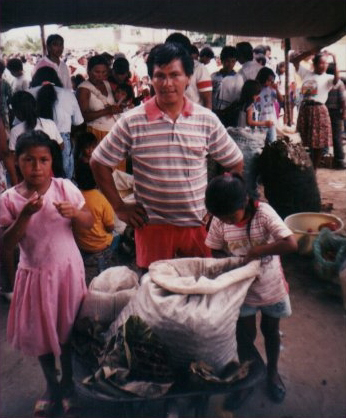 |
All they were organized under the roof of the school court, in a tumult of people and animals. They came to sell and to show what they had taken out from the earth or handmade. The government gave "incentives" to those that they presented better their products, but everybody knew that they were prizes and they assumed them as such. It was supposed that the name change was "for not generating competitiveness among the participants", but each one arrived was for selling. Only the agriculture secretary lifted a "stand", there they sold all class of mango derivates. The rich colonists came to exhibit their horses and to learn how to exhibit them in front of expert judges. Everything was a fair exhibition try-out, but more seemed an indigenous gallery, as bio-diverse as few. There I met the paujiles, birds big as a hen, with red beak and the whole plumage black. I saw very big roosters and hens, raided to tip of food, without hormones. I also tried manaca, chontaduro mañoco, caimarona grape, cocorito and other fruits from the region that I didn't know that they existed. I saw gigantic cassava, bananas and platano bananae24 in big quantity. Crafts and fabrics, Brazil sticke25 carved in symbols of the region: Christes, little canoes, little princesses Inírida, birds. These products would stand out in any part of the world, and even of Colombia.
The peasant's day in the Guainía is the native's day. That day the whole departamento appears just like it is. The colonists are seen as the minority that they are, small and rich. The one playing peasant is the native from the corregimientos. I find healthy not to mark ethnic differences, but are the natives recognized as such, or do they already consider themselves peasants? To sell that day it is necessary to speak Spanish, to manage something of the life of the capital, for not to lag behind. Competitions made that day were to rope a stick with horns, the oiled pig and the stick of prizes, all typical from the Plain and the interior. Is the loss of native culture the price of equality?
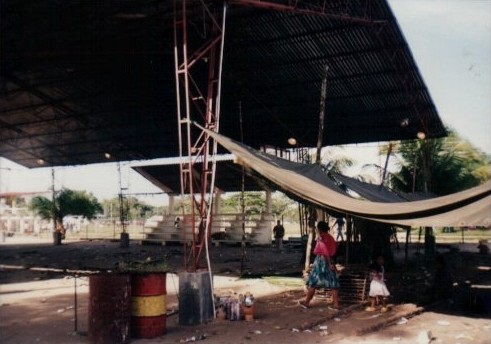 |
This was the way the school Custodio García Rovira court was left after the peasant's day. |
But what I know is so little. The natives are very different and I don't know them. I had small sporadic contacts with them, with their religiosity and their humility, with their communities, with their language, so different to ours, with their green world there in the east...
NOTES
