Sounding out a
Storm
|
  You can see the
lightening flash and hear the thunder rumble, but whereabouts is the storm? A basic
knowledge of how light and sound travel can tell us exactly how far away the storm is. You can see the
lightening flash and hear the thunder rumble, but whereabouts is the storm? A basic
knowledge of how light and sound travel can tell us exactly how far away the storm is.
The Basics
Sounds are caused by vibrations which pass through the air. They travel at about 340m/s
but they are affected by the temperature and humidity of the air through which they pass.
Light travels at 300 million metres per second and is unaffected by what it passes
through.
Maths in Action
Use the formula distance = speed x time
The flash of lightning from a storm 5 kilometres away (5,000 metres) takes 0.00017 seconds
to arrive (time = distance/speed, time = 5,000/300,000,0000).
A rumble of thunder from a storm 5 kilometres away (5,000 metres) takes 15 seconds to
arrive (time=distance/speed - time = 5,000/340).
Storm Warning
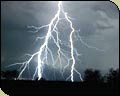 The time lag between seeing the flash and hearing the thunder
tells you all you need to know about its distance away. Light is so fast that you can say
you see the lightening immediately. In contrast, sound moves at 3 seconds per kilometre,
so counting the seconds tells you the distance. For each 3 second delay, lightening struck
a kilometre away! The time lag between seeing the flash and hearing the thunder
tells you all you need to know about its distance away. Light is so fast that you can say
you see the lightening immediately. In contrast, sound moves at 3 seconds per kilometre,
so counting the seconds tells you the distance. For each 3 second delay, lightening struck
a kilometre away!
Factors Affecting Speed of Sound
Temperature - The speed of sound increases as the air becomes hotter. This is because heat
makes molecules move faster and bump about more, transmitting a pulse in less time. The
accepted value for the speed of sound in air is 332m/s at 0Ί Celsius, and increases by
0.6/s for each additional degree. At 20Ί Celsius sound travels at 340 m/s.
Humidity - The speed of sound through air is also increased by increasing the humidity. On
humid days there are extra molecules in the air to help transmit the sound wave. This
factor is much less important than temperature.
On dry cool days sound travels at about 330 m/s and on hot humid days at about 350m/s.
This will not affect your storm warning calculations but should be born in mind!
|
|
|


