
Journal of the Aero/Space Sciences, 26, 3, page 131, March 1959
hallcamber.jpg
main frisbee page
main page
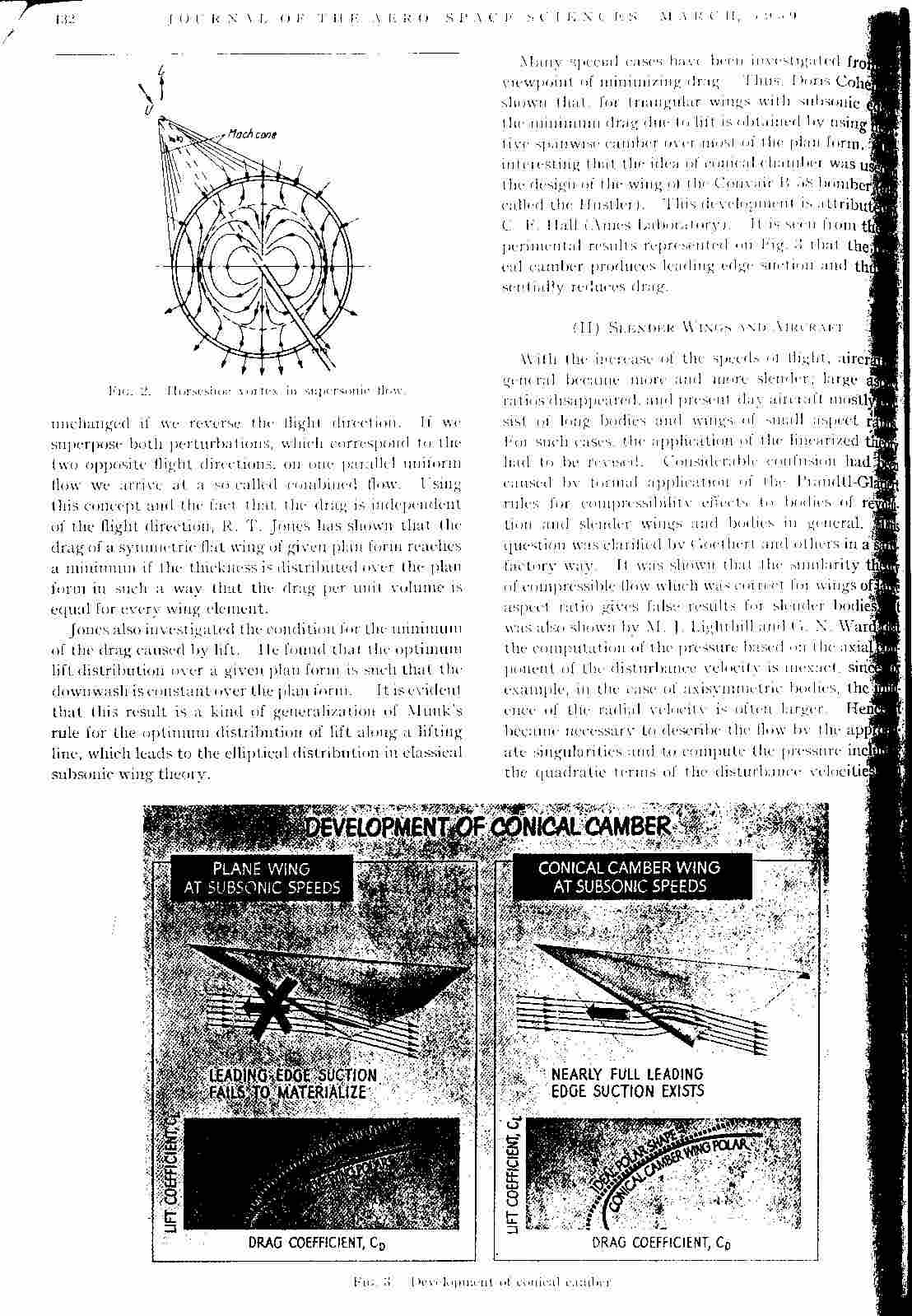
Typically for engineers, this kind of leading edge is called the Hall effect, after C. F. Hall, even though Cohen did all the work. Leading edge camber was used in the B-58 Hustler aircraft made by Convair. Yes, there is a B-58 bomber. I have scanned a graphical explanation of the Hall effect (not to be confused with the quantum effect of the same name) and placed it on my web site http://www.geocities.com/gregu10/hallcamber.html
We used to use fastbacks for MTA, maximum time aloft, and could get 11 seconds in the smallest breeze using fastbacks. It helps a lot if you understand hover, and how to make the disc roll over the hover and "shelf" on the way down. For a clockwise throw it turns left on the way up, hovers climbing, stalls and reverses direction, then starts to turn left again as it comes down towards you, and then shelfs into nearly flat flight. Look for that towering hover at the top for a really good throw.
Throw it so it comes down about 60 yards cross wind from you and run over there and catch it one handed for a legal MTA. For those of you who still do not understand how to make a disc hover, be grateful: I once charted turnovers for a pick up game and 94% of the turnovers were thrown higher than shoulder height. They hovered.
So you should be glad if you can't throw a hover, but if you still WANT to, try this explanation from Bramwell's book:
"A cubic characteristic equation usually arises in the analysis of the lateral and longitudinal stability in hovering flight. Unfortunately the coefficients are often such that there are no rapid approximation methods, and it appears that a direct algebraic solution is the most convenient. The typical values of the coefficient give rise to a real root and a complex pair, and this suggests the method of Cardan as being appropriate.
(30 lines of painful mathematical symbols deleted)
In the unlikely event of the cubic having three real roots, a trigonometrical solution is necessary. Details of the calculations are given in Turnbull.
Since a cubic root with real coefficients always has at least one real root, and since the method of synthetic division is rapid, especially when performed on an electronic hand computer, one can always solve a cubic by the rather crude method of trial and error. One makes a reasonable guess at the root and calculates the value of R as described above, then adjusts the 'root' using mental interpolation, until R becomes sufficiently small. With a little experience this is quite a successful method."
***
Fortunately, many people can throw a hover, or not, without resorting to the Turnbull or Cardan computational methods. I always found it was like playing guitar, if I thought about it at all, I couldn't make the throw.