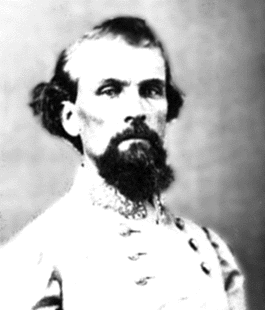
| Many people look to the famous strategists and to their writings; men like Von Clauswich, Sun Tzu, and Musashi; but Lt. General Nathan Bedford Forrest, CSA, put them all to shame. Forrest's insights into the principles of combat were not the product of formal training but of raw instinct and staggering intellect. General Forrest is commonly known as the greatest cavalry genius who ever lived, but his genius and his principles are readily transferable to the Southern mindset, probably much more so than those from the alien cultures of the Orient, and used in any conflict: physical or political. |
| Page 6 |
| GENERAL FORREST'S ART OF WAR |
 |
| The Three Principles of Southern Fighting |
| General Forrest's four main spoken principles were these: 1. Get there first with the most. When you see that a fight is inevitable, hit first and hit hard. 2. Put the scare on them and keep up the scare. Once you surprise them with your attack, never let up or give them time to regain their balance. Drive forward and never stop. 3. War means fighting, and fighting means killing. Wars are not won by half-measures. Wars are won by fighting and killing the enemy. Misplaced notions of what the conflict should be instead of what it is are wrong-headed, and fighting with anything less than 100% of the means at your disposal is a vice, not a virtue. 4. No damn man kills me and lives! This last demonstrates like nothing else the true fighting spirit, and the determination to destroy the enemy that is essential in a fight. As can be easily seen, all of the principles are vital for winning any fight. It boils down to this: hit first, fast, hard, and continuously, and don't stop until your opponent is no longer a threat. Use surprise and any other means at hand to accomplish victory. |
| Fighting On The Frontier |
| Forrest learned to fight on the frontier, where fights were not taken lightly. Since Colonial times, hand to hand combat in the South has been in one of two forms; the ceremonial, unemotional duel between gentlemen, or the loud rough and tumble fights of everyone else, which were the most fierce the world had ever seen. As the General was a self-made man from a poor family, it's likely that he learned these principles first-hand. According to observers, rough and tumble fights had no rules, other than that only the weapons nature gave you could be used; and they used them all. Fights usually began with standard punches, throws, and kicks, but they quickly closed into grappling range, where the object was to use the fingers and teeth to remove body parts. A normal clench would see the hands seizing the hair and using it to leverage the thumbs into the eye-sockets in an effort to "bring that peeper right out" as Davy Crocket once put it, while the knees pounded the opponent's body from below. Usually, an attempt would be made to drag the head close enough to bring the teeth to bear on the nose or lip, with the objective of completely severing it. Alternately, the nose might be caught between the fingers of one hand while its thumb sought the eye, and the other would grab the hair and drag the ear in reach of the teeth. Testicles were also grabbed and yanked on at every opportunity. All these techniques could be accomplished either standing or on the ground, and the fight proceeded until one either couldn't go on or surrendered. Not only is this "Confederate Karate" viable now in hand to hand fighting*, but the daring, courage, and spirit demonstrated in these encounters aptly show all of General Forrest's principles in action. *Note: Viable in the sense that it works very well is not the same as saying that it is legal; mayhem (the severing of body parts) is generally considered a major crime. Even more importantly, contact with blood when biting could put you at medical risk from blood-borne pathogens. However, either risk is worth taking if you are in danger of being killed, crippled, or raped, or if you are in all-out combat when it finally hits the fan. |
| Last Page ~ Next Page ~ Home ~ The McCausland Plan ~ Links |