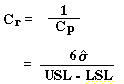
Capability Analysis: Getting the MostAlthough the most typical improvement resulting from capability analysis is an adjustment or change to the system itself, another opportunity should sometimes be pursued. The specifications may need to be challenged. Many specifications have been traditionally developed from "experience" or "past practice" rather than from customer need. If specifications have been developed without data regarding the customers' target value, a reassessment of specifications is an appropriate improvement strategy. Even though capability analysis assumes that the system is in control and thus predictable, it is still only a snapshot of the system as it currently exists. To get more from capability analysis, one can use it as a monitoring process over time to improve the system. One possibility is to monitor the Cpk of the system over time by plotting it on an X-MR chart. The first question to arise is when to create a data point (Cpk). Capability analysis should be calculated only if the system is in control. It should be recalculated when and if the system changes. This could coincide with the recalculation of control limits on the control chart, providing the data used for capability analysis. If this procedure is used, each change in the system will result in a new Cpk value plotted on the X-MR chart. Getting the most from capability analysis also means having a thorough understanding of the capability indices and their relationships. A capability index not discussed previously is the Cr index. Cr is simply the reciprocal of the Cp index.
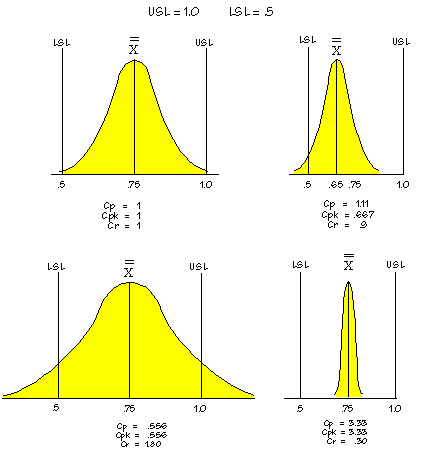
Cr is also called the "capability ratio" and is the index most often used by General Motors and its suppliers. It is a useful index because, when multiplied by 100, it is the percent of the specification spread used by the actual spread of the system. A Cr of 1 still represents a "capable" system, but now the smaller the number the better. In other words, it is better that the spread of the system uses less than the spread between the specifications allows. The sketches below give a comparison of the capability indices in several example situations.
� Previous
��������� Capability
Analysis Menu � |