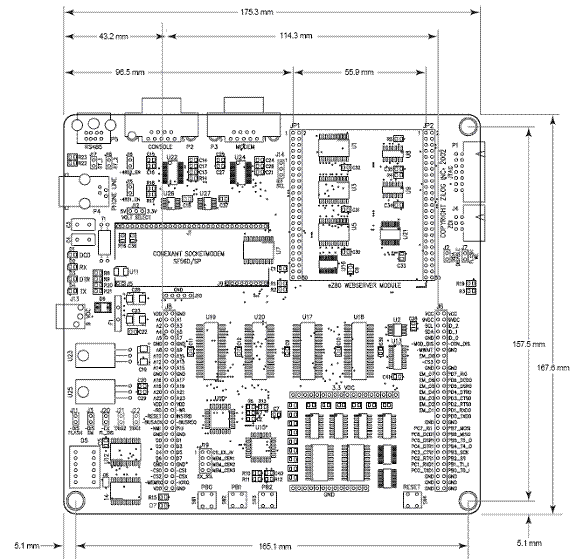
1. Operating frequency is 50MHz
2. On board 10/100 Ethernet Port
3. 256 KB on-board flash memory
4. 512KB total on chip static-RAM, 8KB for general use and 8KB for Ethernet MAC frame buffer
5. 32 General purpose input/output ports (GPIO)
6. IrDA compatible infrared encoder/decoder
7. Two independent UART ports
8. Four, 16-bit counter/timers with I/O capability
9. Real-time clock with on-chip 32KHz oscillator
10. Full-featured PLL
Although, all of these may be important features for one to have, the ones that are vital and relevant to this project are in bold. Having an operating frequency of 50MHz makes this microprocessor very fast at executing code instructions. This is well needed since the IrDA protocol code is extensive and lengthy. The 512KB SRAM available is one of the highest of any microcontroller. This memory is used to store code for latter execution and data storage. In addition to the 512KB of available memory, there exists an extra 8KB for data use. In this project memory is needed to save numerous variables in the coding as well as small data files that will be transmitted via infrared. There are 32 GPIO ports on this board. These can be used for numerous applications, such as switches, AD/DA conversion, LEDs (solely for input or output) and much more. Port D is used, as an output port to be able to use the LCD. Pins PD1 is for the RW, PD2 is for the E , PD3 is for RS and PD4-PD7 are data pins. Figure 10 shows the pin functions for the Sanyo LCD used here. Another feature, most microprocessors lack are two UARTs. It is common to see only one and sometime none on a microcontroller board. These Universal Asynchronous Receiver Transmitter are used to transfer instructions from a computer once the code has been downloaded via a HyperTerminal and the other is used to decode the data bits to a certain frequency and width to be transmitted via infrared. This brings us to the heart and foundation of the microcontroller, the IrDA transceiver. This is an IrDA compatible encoder/decoder that implements the physical layer emphasized by the organization and satisfies their protocol. This is an SIR component, meaning the maximum transfer rate is 115Kbps. This is the maximum speed for a UART serial connection. To have the correct width pulse of infrared light a crystal oscillator is needed for the code to base is frequency. For infrared transmission the required frequency is 3.684Mhz. This is a widely used frequency which yields a period of 271ns. Typically, for SIR speeds of 115Kbps, the pulse duration is 1.63usec therefore the choice of oscillator must give a period smaller than that.