 |
|
 |
 |
 |
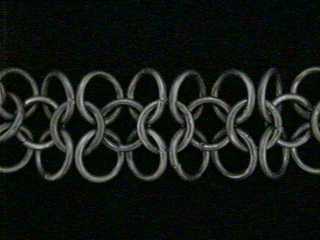
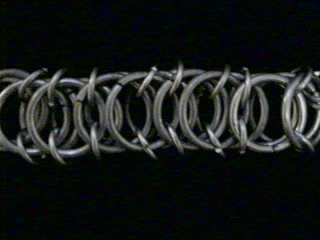
| A European 4-1 with each set of 5 rings going in the oppositie direction. This does not lay completely flat which might make it a poor choice for some jewlery, however it would add an interesting texture to larger pieces. |
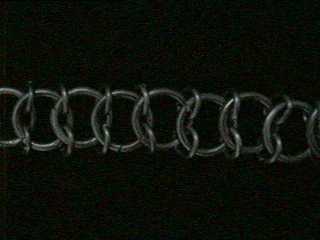
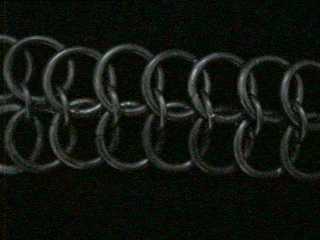
| Europen 4-1 using very small rings ont he edges. This is a good weave to do with different colors, as it showcases very well the larger, center rings. |
| Similar to above, but with the small rings in the middle. This makes the weave more dense, and would be an interesting alternative for people who want to get a thicker weave without using an N-1 something larger then 4. |
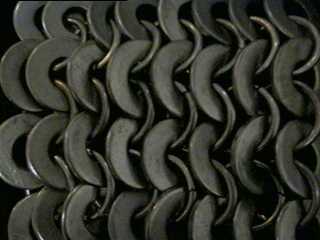
| An example of European 4-1 using solid washers for half the rings. This makes a very dense, heavy pattern. It looks rather scale like because of the way the washers overlap |
 |
 |
 |
| The same basis as the 4-1 using large and small rings, here applied to a box chain. Has the box weave, but makes a much flatter chain. |
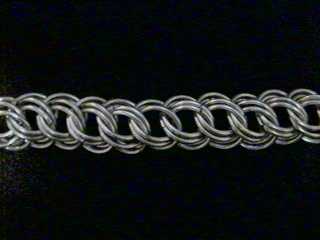
| A persian 3-1 with all the rings doubled. Persian 6-2? It makes a more solid chain that holds it's shape better, as well has having an interesting woven appearence, similar to the "king" weave. |
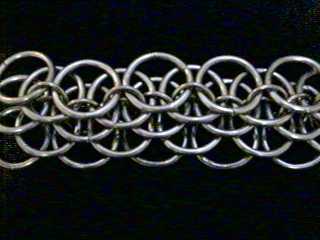 |
| Another weave that uses different ring sizes and wire guages. This is usually called "dragon scales". It is more apparent in large piece, however you can see the over lap of the large rings which gives this weave its name. Because it is layered this is a rather dens weave. Not so good I think for smoth bits of jewlery, but an interesting alternative for larger designs. |
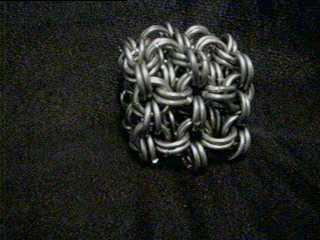 |
| 3D Japanese 4-1. The weave is built up as well as side to side. This can be used to make cubes, as well as just about any other structure based on box-like shapes. |