 |
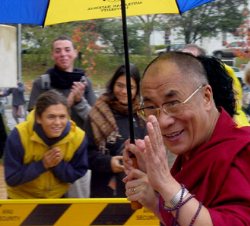
| Look at the wonderful expression of love on the face of the young person in yellow jacket. |
 |
| "Don't try to use what you learn from Buddhism to be a Buddhist; use it to be a better whatever-you-already-are." The Dalai Lama |
| Page 9A |
| Vajrayana (The Thunderbolt Vehicle) This is the kind of Buddhism predominant in the Himalayan nations of Tibet, Nepal, Bhutan, and also Mongolia. It is known as Vajrayana because of the ritual use of the vajra, a symbol of imperishable diamond, of thunder and lightning. At the center of Tibetan Buddhism is the religious figure called the lama, Tibetan for 'guru,' source of another of its names, Lamaism. Several major lineages of lamas developed, beginning in the ninth century with the Nyingma-pa. Two centuries later, Sarma-pa divided into the Sakya-pa and the Kagyu-pa. Three hundred years later, one of Tibet's revered lamas, Tsong-kha- pa, founded the reforming Gelug-pa. |
 |
| Tibetan Buddhist Lineages... � Nyingma-pa - Tracing its origin to the Indian adept, Guru Padma-sambhava, who came to Tibet in 817 C.E. at the in-vitation of King Trisong Detsen (742-797) in order to subdue the evil forces then impeding the spread of Buddhism. This lineage of Buddhism is uniquely Tibetan in that many aspects of the traditional Bon religion are mixed together with more properly Buddhist beliefs and practices to form a unique expression of Buddhist piety. This lineage emphasizes the move towards more advance stages of Enlightenment through 'preliminary practice' that comprises the beliefs and prac-tices of Buddhism before the advent of Tantra, and through the 'higher practices,' which involve the attainment of En-lightenment through the chanting of magical spells, special hand gestures and mystical diagrams. � Sakya-pa - The lineage has descended intact up to the present time from Khon K�nchok Gyelpo(1034-1102), founder of the Sakya tradition. From the doctrinal point of view the tradition traces its origins to the Indian Yogin Virupa through Gayadhara. His disciple Drogmi Shakya Yeshe (992-1074) travelled to India where he received teachings on the Kalachakra, the Path and its Fruit, and others from many Indian masters and returned to Tibet. Later, Khon K�nchok Gyelpo, one of his main disciples, built a monastery in the Tsang province of central Tibet and named it Sakya, or Grey Earth monastery. So the school took its name, Sakya, from the location of the monastery. Succession to the position of head of the Sakya tradition has been hereditary since the time of Khon K�nchok Gyelpo. The present incumbent is the 4lst occupant of the Sakya Throne. The central teaching and practice of the Sakya-pa, called Lam-dre (Lam-bras), the Path and Its Fruit, ultimately leads a practitioner to the state of Hevajra. The Path and Its Fruit is a synthesis of the en-tire paths and fruits of both the exoteric and esoteric classes of teachings. � Kagyu-pa - The lineages of the Kagyu school of Tibetan Buddhism derive primarily from two sources: Marpa Ch�kyi Lodro (1012-1099) and Khyungpo Nyaljor (978-1079). Marpa received the lineage of tantric teachings called the Four Commissioned Lineages - concerning the Illusory Body and Consciousness Transference, Dreams, Clear Light, and In-ner Heat directly from Naropa (1016-1100), who had been given them by his teacher Tilopa (988-1069). Mahamudra, the unique feature of Kagyu tradition, can be explained according to interpretations of sutra and tantra. Both aspects of the teachings are aimed at direct understanding of the real nature of the mind. The approach to Mahamudra, which differs slightly within each Kagyu school, generally follows through the stages of foundation, path and fruit. Tantric practices unique to Kagyu tradition are the Six Yogas of Naropa, Chakrasambhava and Mahakala. In the context of tantric prac-tice, the application of Mahamudra becomes much more profound and sophisticated. The Karma Kagyu was founded by the first Karmapa, Dusum Khyenpa (1110-1193). This tradition has remained strong and successful due in large part to the presence of an unbroken line of reincarnations of the founder, the successive Karmapas. � Gelug-pa - Founded by Tsong-kha-pa (1357-1419) as a reform movement within Tibetan Buddhism, followers acclaimed the third teacher as an incarnation of the Bodhisattva Avalokiteshvara, thus inaugurating the line of the Dalai Lama, the fourteenth and most recent of whom was born in 1935. Emphasis in this lineage is on a strict monastic discipline and on the conviction that the Bodhisattva, a Buddha who has foregone final Nirvana out of compassion for all sentient be-ings, is continually present. This tradition remains dynamic even after coming into exile. The major Gelug monasteries, Sera, Drepung, Ganden, and Tashi Lhunpo monasteries and Gyumey Tantric College have been re-established in vari-ous Tibetan settlements in Karnataka, and Gyut� Tantric College has been re-established in Bomdila, Arunachal Pra-desh, all in India. |
| Introduction to the Five Principal Spiritual Traditions of Tibet... Tradition has it that Tibet is the land of Avalokiteshvara, the Bodhisattva of compassion, and the Tibetan people are his descendants. They trace their ances-try to the copulation of an ape, an emanation of Avalokiteshvara, and an ogress, an emanation of the goddess Tara, whose progeny gave birth to the Tibetan people in the Yarlung valley. The early Tibetan nation was without a ruler until 127 B.C.E., when according to legend an Indian king named Rupati fled over the Himalayas after his defeat in Mahabha-rata war and reached the Yarlung valley. There he was enthroned as their king by twelve wise B�n priests, who, believ-ing that he had descended from heaven gave him the name Nyatri Tsenpo. From this time, the Tibetans evolved a dis-tinct but simple civilization founded on the idea of the inter-dependence of man and nature. In the pre-Buddhist period, Tibet's indigenous religion and culture was Bon, a fragment of which, though radically transformed through its contact with Buddhism, is still preserved among Tibetan communities in exile. Buddhism became Tibet's state religion only lat-er. Introduced for the first time in 173 C.E., during the reign of King Lha Thothori Nyantsen, it was gradually assimilat-ed, disseminated and finally integrated into the Tibetan way of life due initially to the efforts of the religious kings. King Song Tsen Gampo took control of the kingdom at the age of thirteen and built Rasa Trulnang Tsuglag Kbang and Ramo-che Tsuglag Khang two temples in Lhasa. He sent his minister Thonmi Sambhota to India to learn Sanskrit and writing, and as a result a Tibetan script was then modelled on one of those current in India. He invited Acharya Kumara and Brahmin Shankara from India and the Nepalese Acharya Shilmanju, who began the propagation and translation of the Buddha's teachings. Although there was neither conspicuous nor extensive study of Buddhist doctrine, the king himself gave instructions to many fortunate people, mostly concerning the teachings of the Arya Avalokiteshvara. During the reign of King Trisong Deutsen, Buddhism was spread with great zeal after he had invited the Abbot Shantarakshita and Acharya Padmasambhava to Tibet. The task of translating Buddha's teachings was carried out with great vigour and en-thusiasm. It is said that altogether one hundred and eight Indian scholars were engaged with Tibetan translators in the work of translating Buddhist literature into Tibetan. They also took part in establishing monasteries. After three gener-ations, the religious king Tri Ralpachen issued a decree that every monk should be supported by seven households. At the same time thousands of temples were constructed. He also invited many more Indian masters such as the Acharyas Jinamitra, Surendrabodhi and Danashila, who with the Tibetan translators Yeshede and others revised and standardised the earlier translations according to a revised terminology. In this way the Buddha's teachings were increasingly being propagated throughout Tibet. Unfortunately, this golden period known as the era of the Tibet's Religious Kings soon came to an end. Ralpachen's successor, King Lang Darma, did not support the Buddha's teaching. Monasteries were emptied and the monks made to disrobe, often being recruited into the army. As the Tibetan empire disintegrated into small principalities, Tibetan Buddhist culture entered a dark period. However, at that time, Mar Shakya Yeshi, Yoge-jung and Tsang Rabsel, holders of the monastic lineage of the great Abbot Shantarakshita managed to escape to the Domey (north-eastern) region of Tibet, where, with the assistance of two Chinese monks, they gave full ordination to Lachen Gongpa Rabsel, which marked the revival of the Tibetan monastic community. Similarly, with the arrival of Sad-hu-pala and others in upper Ngari (western Tibet), and the coming of the great Kashmiri scholar Shakyashri, the monas-tic lineages were greatly expanded and the community multiplied. Amongst those who were ordained by Gongpa Rabsel, Lumey and others returned to central Tibet and revived Buddhism there, building monasteries and temples and teaching the doctrine. The most vigorous revival of Buddhism, however, was taking place in western Tibet where Lha Lama Ye-she �, following the ways of the early religious kings, had dispatched intelligent young Tibetans to Kashmir, then a thriving centre of Buddhist learning. The great translator, Rinchen Zangpo (958-1055), and his colleague Legpai Sherab, returned successfully to Tibet and spread the doctrine through translation, teaching and establishing monasteries. Lha Lama Yeshe �'s persistence and sacrifice also created the conditions for inviting the great Indian master Atisha to Ti-bet. He revived the doctrine and dispelled many misconceptions about it (then current). He composed the famous text, 'A Lamp on the Path to Enlightenment,' which set the pattern for all the graded path, Lamrim, texts found in the Tibet-an Buddhist tradition. Among Atisha's many disciples, Drom T�npa, who later consolidated Atisha's teachings and founded the Kadampa tradition, was the most famous. During this period, Tibet's contact with the Indian Buddhist tradi-tion was restored, and the influence of different masters led to a diversity of teaching lineages. Gradually three major new orders, Sakya, Kagyu and Gelug, arose. Nyingma was identified as the form of Buddhism introduced since Guru Padma-sambhava's arrival in Tibet. These were the four great schools of Tibetan Buddhism, which will be introduced be-low. With the growing influence of the Mongolians in Tibet, the so called priest-patron relationship was established be-tween the Mongol rulers and Sakya Lamas of Tibet. Consequently, in 1253 Kublai Khan offered the three provinces of Tibet to the Sakya Lama Drog�n Ch�gyal Phagpa, whose successors ruled Tibet for one hundred and five years until 1358 when they lost control of Tibet to Tai Situ Jangchub Gyeltsen. The subsequent rule of the Phagmotrupa lineage lasted until 1435, followed by the Rinpung kings who ruled for four generations from 1435-1565, and the three Tsangpa kings 1566-1641. By the turn of the sixteenth century, the power and influence of the Gelugpa had grown enormously. The third Dalai Lama, Sonam Gyatso (1543-1588), strengthened Tibet's political prospects when he brought the Mongols back to Buddhism. This resulted from his visit to Mongolia in 1578 at the invitation of Altan Khan of the Tumet Mon-gols, who also gave him the title 'Dalai Lama,' meaning 'Ocean of Wisdom.' The fourth Dalai Lama, Yonten Gyatso, was born to a Mongolian family, but was taken to Tibet to be educated. In 1642, Gushri Khan placed both the spiritual and temporal rule of Tibet in the hands of the Great Fifth Dalai Lama, Ngawang Lobsang Gyatso (1617-1682). He founded the Ganden Phodrang government, which today continues to function under the leadership of the Fourteenth Dalai La-ma. In 1959, with the acceleration of Chinese aggression in Tibet,. His Holiness the Dalai Lama sought asylum in India. |
|
 |
| He set up a government-in-exile to take care of education, culture, settlements, monasteries and the political issue of Tibet. In this way, significant steps have been taken towards the maintaining the Ti-betan cultural heritage. The Council for Religious and Cultural Affairs is responsible for supporting Tibet's religious and cultural activities as well as the welfare of the monastic communities. There were more than 6000 monasteries and nunneries in the three regions of Tibet - U-Tsang, Dot� and Domey. Of these hardly any were left undamaged and the majority were totally destroyed by the Chi-nese. In exile, more than 200 monasteries and nunneries have been re-established in India, Nepal and Bhutan. Around 600 Tibetan Buddhist centers are functioning as religious and cultural centers in various countries around the world. |
|
| � FOUNDER: Padmasambhava 9th century � LINEAGES: Mindroling, Palyul, Dorje Trak, Shechen, Dzogchen, Kathok � CENTRAL TEACHINGS: Kama and Terma; Nyin-Thig � MAIN TANTRIC PRACTICE: 3 Innermost Tantras = Mahayoga/Anuyoga/Atiyoga (Dzogchen) � HEAD OF NYINGMA: H.H. Penor Rinpoche � LITERARY WORKS: Tibetan Book of the Dead, Rin-chen Ter-dzod � LAMAS: Sogyal Rinpoche (Rigpa), Chagdud Tulku and Chagdud Khandro, Jigme Khyentse Rinpoche SAR (New Translation Schools) KAGYU � FOUNDERS: Marpa & Gampopa 1077-1152; Naropa 1016-1100 � LINEAGES: Karma / Tsalpa / Baram/ Phagmo � CENTRAL TEACHING: Mahamudra (Anuttarayogatantra) � MAIN TANTRIC PRACTICE: Six Yogas of Naropa/Cakrasambhava/Mahakala � HEAD OF KAGYU: H.H. XV11 Karmapa � LITERARY WORKS: Jewel Ornament of Liberation � LAMAS : His Excellency Tai Situ, Beru Khyentse Rinpoche SAKYA (School that came from the monastery with grey earth walls) � FOUNDER: Khon Konchok Gyelpo 1034-1102 � LINEAGES: Ngor, Tsarpa, Ngorpa � CENTRAL TEACHING: Lamdre � MAIN TANTRIC PRACTICE: (Anuttarayogatantra) Hevajra/Mahakala/Chakrasambhava � HEADS OF SAKYA TRADITION: Ngawang Kunga / Sakya Trizin � LAMAS: H.E. Jamyang Khyentse Rinpoche � LITERARY WORKS: Discrimination of the 3 vows/Treasury of Logic on Valid Cognition and works of Gorampa Sonam Sengey and others. GELUGPA (School that came from Gaden Monastery) � FOUNDERS: Atisha 982-1054, Tsongkhapa 1355-1417 � LINEAGES: Gaden, Gyume, Drepung, Sera, Tashi Lhunpo and Gyuto � CENTRAL TEACHINGS: Chakrasamvara, Vajrayogini, Kalachakra � MAIN TANTRIC PRACTICE: Lam-Rim, Tong-Len � HEAD: Ven. Ganden Tripa Rinpoche � LAMAS: HH the Dalai Lama, Panchen Lama/ Ven Yeshi Dhondup, Lama Zopa. � LITERARY WORKS: Lam Rim / Works by Tsongkhapa |
| Tibetan Buddhist Traditions... NYINGMA (Old school; School of the Ancient Ones) |
|
| "One of the characteristics of karmic theory is that there is a definite, commensurate relationship between cause and effect. There is no way that negative actions or unwholesome deeds can result in joy and happiness. Joy and happiness, by definition, are the results or fruits of wholesome actions. So from that point of view, it is possible for us to admire not so much the immediate action, but the real causes of joy. "The foundation for practicing the seven-point cause and effect method is cultivating a mind of equanimity. Without this foundation you will not be able to have an impartial altruistic view, because without equanimity you will always have partiality towards your relatives and friends. Realize that you should not have prejudice, hatred, or desire towards enemies, friends, or neutral persons, thus lay a very firm foundation of equanimity. "Judging by our own experiences in this life and those of others, it is very obvious that consciousness is a phenomenon susceptible to change and transformation. Due to the force of bad companionship and different conditions, people change for the worse, becoming very aggressive. Likewise we see human beings changing for the better, becoming more gentle, kind, and so forth. This is an indication that an impermanent phenomenon is changeable, and therefore is subject to transformation. |
|
 |
| "In order to encourage in such practices as taking refuge, living a way of life which accords with the law of karma, and living in an ethically disciplined way characterized by observance of the ten virtues, and so on, we require a tremendous sense of confidence that we can do it. To generate that, and also a kind of enthusiasm, we find in the Buddha's texts a discussion of the preciousness of the human body and human existence. At that stage, we never talk about how impure the body and bodily substances are, or how imperfect they are. In fact, we are talking about how good it is, how meaningful, how purposeful, how much potential lies within our body, what good purpose it can be used for, and so on. This is to instill a sense of confidence and courage. "When approaching a technique like the Buddhist training of the mind, we must understand and appreciate the complexity of the task we are facing. Buddhist scriptures mention eighty-four thousand types of negative and destructive thoughts, which have eighty-four thousand |
| corresponding approaches or antidotes. It is important not to have the unrealistic expectation that somehow, somewhere, we will find a single magic key that will help us eradicate all of these negativities. We need to apply many different methods over a long period of time in order to bring lasting results. Therefore, we need great determination and patience. It is wrong to expect that once you start Dharma practice, you'll become enlightened within a short period of time, perhaps in one week. This is unrealistic." The Dalai Lama |
| Those who are wise, generous and free from selfishness give at the appropriate times. Then what is given to those who are worthy and morally sound is an offering of great purity and substance. Those who likewise show appreciation or perform acts of service make no lesser offering and they also share in this merit. Thus in giving, the heart is unbounded, what is given is of great fruit and those meritorious deeds bring about good fortune in the life to come. |
|
| By the benevolence of the Buddha, the Dhamma and the Sangha, may all beings be well and happy. Undoubtedly, one of the most menacing social evils in the world today, is the proneness of humans to drugs and alcohol. As the old 'women, wine and song' goes, alcohol seems to have a misleading social attractiveness to all, to men, women and children. No party or social gathering, not even grandma's funeral, without drinks, seems to be the order of the day. Today, drugs too have caught up to that level of prestige. Enough has been said everywhere about the evils of these. But something is overbalancing. It may be economic policies of governments, cultural trimmings of communities, mental degeneracy of the down trodden and the impoverished groups, or willingly or unwillingly being the booster of violent crimes in the land, for those who want to commit or wish to have them committed. But over all, what was once deemed a social re-quirment, namely drinking, has today turned out to be a social menace. Counteracting temperance movements, started and undertaken with a great deal of fanfare decades ago, appear to have served no more purpose than fiddling besides a deaf elephant, as they say in Sinhala. Talking of the evils of drinking, the Buddha's basic question is whether a person should drink something, having taken which he or she loses the power of judgement. This is his main logic about the intake of alcohol and drugs. Unimpaired judgement is man's greatest asset in life. It is the capacity to judge that makes man different from animals. We know what humans do, both men and women, when they have taken one too many, even for the road. A limited amount of alcohol is sometimes believed to be a relaxant. But it is not even in the power of medical men to decide what this amount is. Therefore most of them believe it is best left alone. This loss of judgement often leads to lack of decency and decorum in social behaviour. The resulting impropriety of behaviour can often lead to disasters of diverse sorts. This loss of one's sense of shame in drunkenness is one of six evils of drinking listed in the Sigala Sutta of the Buddhists. A beautiful sculptured panel of five life-size figures, titled Family Drinking Scene from Hadda in Afghanistan, tells us an equally beautiful story. It dates back to the second century of the Christian era. It is a piece of Buddhist sculpture, done in Greek Gandharan style. At the moment it is in the Muse Guimet in Paris and two other pieces on the same theme are in Alahabad. Having had the inspiration and the information for their work of art of national importance, these Afghanistan Buddhists portray the mother and the father in the family group as shamelessly naked in their drunkenness. They do not know that their skirts and trousers have dropped ten to fifteen inches, well below their belt line. This is the precise portrayal in the Commentary on the Sigala Sutta. What lovely admirers of Bud-dhism these Afghanistan persons would have been more than eighteen centuries ago. The other two sculptures in Ala-habad show equally vulgar lewd behviour under the influence of alcohol. What a remarkable respect these ancient civil-izations seem to show to a religious message of worth to mankind? One cannot fail here to note Buddhism's lead in moral reform over a period of more than two and a half millennia. On the question of drugs and alcohol, Buddhism has given further advice pertaining to other spheres in life too. It highlights hazards of drinking in many ways: physiologi-cal, social and economic. They range from economic drain here and now to drunken brawls, pronenness to disease, loss of reputation and decline of brain functioning. It is now for the Budddhists, as well as non-Buddhists, to view this posi-tion about alcohol in the life of humans in this country. As far as Buddhism sees it, sex as man or woman, and age as young or old, is not going to make any difference in one's attitude towards this issue. Perhaps it may be that only a few can develop such sharpness of judgement to assess its vices and virtues. We shall be very glad to leave it to the judge-ment of the serious liberation seekers, seeking for themselves or for others. We seriously leave alone the pursuants of pleasure and profit. May all beings be well and happy. May there be peace on earth and goodwill among men. Alcohol... In ancient times alcohol was often believed to have divine origins, to be "a gift of the gods" and is still used in the rituals of some religions. Buddhism took a far more realistic view of alcohol's beginnings. According to a legend in the Jatakas, a fruit tree with a fork in its main trunk once grew in a certain forest. Rain water and ripe fruit would col-lect in a hollow in the fork and, warmed by the sun, the resulting concoction would turn into a crude natural ale. One day a forester came across a flock of happy drunk birds and discovering that their inebriation was due to drinking the concoction, became the first person to discover and introduce alcohol into the world. The Buddha's main objection to alcohol and indeed to all recreational drugs was that it befuddles consciousness, thus making mental development diffi-cult. He also often warned against alcohol's negative social effects. Consequently, abstaining from all recreational drugs including alcohol is the last of the five Precepts that all Buddhists are expected to practice. Intoxicants... The fifth precept covers all intoxicants, including narcotics, that alter the state of consciousness and are physiologically addictive. The danger and negative effects of narcotics, such as cocaine and heroin, are too well known to need any further elaboration. Today they represent a serious health and social problem around the world. Drinking in-toxicants is not part of the Buddhist culture, although it seems to have become a widespread phenomenon in modern so-ciety. It is true that alcoholic consumption was prevalent before and during the time of the Buddha, but he never ap-proved of the practice. The fact that something is commonly practiced does not necessarily mean that it is good and wholesome. Those who advocate drinking as a factor for promoting friendship forget to take account of the reality that so many friendships have been drowned in those intoxicants. The brawls, strife and unruly behavior that often follow the consumption of alcoholic beverages represent an unequivocal testimony of the ignoble state to which human beings can be reduced to under the influence of intoxicants. Friendship founded on compassion and mutual understanding is much more desirable than that which is based on alcohol. Social drinking may produce a general euphoric atmosphere among drinkers (and probably a nuisance for nondrinkers), but it is never a necessary condition for interpersonal relationship. Often, people use this as an excuse to get drunk. The high rate of car accidents connected with drunk driving should serve as a strong reminder of the danger and undesirability of alcoholic consumption. On the other hand, it may be mentioned in passing that liquor does contain certain medicinal properties and can be used for medical purposes. Such use, if genuine and under qualified supervision, does not entail transgression of the fifth precept and is not considered a morally unwholesome act. The most obvious danger of intoxicants is the fact that they tend to distort the sensibilities |
 |
| and deprive people of their self-control and powers of judgment. Under alcoholic influences, a per-son is likely to act rashly and without due consideration or forethought. Otherwise decent people may even commit murder or rape under the influence of alcohol, or cause all kinds of damage (such as fire, accident, and vandalism) to people or property. The Buddha described addiction to intoxicants as one of the six causes of ruin. It brings about six main disadvantages: loss of wealth, quarrels and strife, a poor state of health (liability to diseases), a source of disgrace, shameless and indecent behavior, and weakened intelligence and mental faculties. NEVER FORGET, WE ARE ALL POTENTIAL BUDDHAS! Disclaimer: All images and/or articles retain the original copyrights of their original owners. |
 |
 |
 |
| April 18, 2004 |
|