 |
| Page 10 |
 |
 |
| "Compassion can be roughly defined in terms of a state of mind that is non-violent and non-harming, or non-aggressive. Because of this, there is a danger of confusing compassion with attachment and intimacy. "I used to feel that if I ever gain a state of cessation, I shall really take a good rest. Once we have attained such a state, we could take a good rest and a real holiday, in the true sense of the word. Until we get to such a state, it is foolish for us to be complacent. When we have attained the state of cessation, we have truly reached a very secure ground. "Many people think that to be patient in bearing loss is a sign of weakness. I think this is a mistake. It is anger that is a sign of weakness, whereas patience is a sign of strength. For example, a person arguing a point based on sound reasoning remains confident and may even smile while proving his case. On the other hand, if his reasons are unsound and he is about to lose face, he gets angry, loses control, and starts talking nonsense. People rarely get angry if they are confident in what they are doing. Anger comes more easily in moments of confusion. "Within oneself, within each single person, one finds many inconsistencies and contradictions. Sometimes the disparity between one's thoughts early and late in the day is so great that one spends all one's energy trying to figure out how it can be resolved. This can lead to headaches. So naturally, between two persons, between parents and children, between brothers and sisters, there are differences. Conflicts and disagreements are bound to happen. If so, then how |
| do we deal with them? If we have confidence in our capacity for reconciliation, then we will be able to deal with these situations. "While you are engaging in the practice of giving, you should do so with great happiness and radiance on your face. One should practice giving with a smile and with mental uprightness." The Dalai Lama |
 |
| Religious freedom - a ritualistic facade. Since 1979, a much-heralded program of "liberalization" began in Tibet under which some superficial fa�ade of religious freedom was allowed. This includes limited and selective renovation of places of worship, and allowing people a degree of ritual practices - such as making prostrations, circumambulating places of worship, offering butter lamps, reciting man-tras, turning prayer wheels, burning incense, putting up paper flags, etc. These are only external acts of worship. But propagation of the teachings of Buddha is either banned or, when permitted, strictly controlled. The essence of Bud-dhism lies in mental and spiritual development achieved through intensive study with qualified lamas, understanding and practice. But the Chinese discourage this in their campaign to misrepresent the Tibetan religion as nothing more than practices in superstition and blind faith rather than what it really is: a functional and scientific philosophy. The Dalai Lama, in his March 10, 1987 statement said, "The so-called religious freedom in Tibet today amounts to permit-ting our people to worship and practice religion in a merely ritualistic and devotional way. There are both direct and in-direct restrictions on the teaching and study of Buddhist philosophy. Buddhism, thus, is being reduced to blind faith which is exactly how the Communist Chinese view and define religion." Today's Chinese policy is aimed at bringing about a gradual and natural death of Tibetan culture and religion, thus reducing the Tibetans to an uncultured, super-stitious nation, fit only to be ruled and reformed by them. In this way, they hope to validate their "liberation" of - and claim to - Tibet. Reconstruction and Renovation - Almost all Chinese state-sponsored reconstruction of Tibetan monu-ments has been highly selective, intended only to serve their political and economic aims. These serve as museums to attract tourists rather than living cultural and religious institutions. Also, contrary to the Chinese claim, most of the rebuilt or renovated monasteries, including the "state-sponsored" ones, came through the initiative of Tibetans who contributed their labor and finances. The aid sanctioned by the Chinese Government forms only a very small fraction of the total expenses incurred. On the other hand, China confiscates the income of the monasteries from entry fees (im-posed by the Chinese) and offerings made by pilgrims. Reconstruction and renovation of monasteries can be done only after receiving permission from the Chinese Bureau of Religious Affairs. Such permission is given with great reluc-tance following a long period of bureaucratic red tape during which Tibetans have to make repeated appeals and listen, in return, to constant lectures about the negative influences of religion to "national interests." The limited number of monks allowed to join these monasteries serve more as showpieces for tourists and, in most cases, caretakers rather than true religious students and practitioners. In independent Tibet, the major Tibetan monastic universities served as cultural and learning centers for large numbers of students from Inner Asia. These institutions each had from three to ten thousand students and the rigorous curriculum began around the age of eighteen and culminated around the age of forty-five. The basic units of Tibet's monastic universities were its colleges, each university having at least two. These had their own administration, faculty and textbooks. For centuries, the monastic colleges functioned to promote critical and creative spiritual thought. from the monasteries' Democratic Management Committee; should have the consent of local authorities; should have the consent of county or provincial authorities; should obtain clearance from the Public Security Bureau; the candidate and the candidate's parents should have a "good political background;" should have been raised in a certain geographical area (e.g., Tibetans from Kham and Amdo many not be admitted to monasteries in Central Tibet); should study Marxism; should be aware that materialism and spirituality are contradictory, etc. Admit only the "politically correct" - China's guiding principal behind admission to monasteries and nunneries is that "We must foster a large number of fervent patriots in every religion who accept the leadership of the Party and govern-ment, firmly support the Socialist path, and safeguard national and ethnic unity," and that "seminaries should hold en-trance examinations and admit upright, patriotic young people who have reached a certain level of cultural develop-ment." These principles are clearly laid down in the Chinese "Basic Viewpoint and Policy on the Religious Question During Our Country's Socialist Period," and "Rules for Democratic Management of Temples," etc. Yet another organ known as the Tibetan Buddhism Guidance Committee is being set up to "oversee the practice of Buddhism in Tibet (TAR), Qinghai, Gansu, Sichuan, and Yunnan (Amdo and Kham areas of Tibet incorporated into Chinese provinces). Foremost among its tasks will be the implementation of government policies, education of monks and nuns in the pa-triotic mould, and supervision over monastery management." In addition to the above, there are other subtle and insi-dious methods of undermining religion which are not easily discerned by the uninformed. These include persistent anti-religious publications and theatrical performances, restricting religious teachings, educating Tibetan youth along Marx-ist lines with heavy anti-religious overtones, lack of a regular curriculum in the monasteries, lack of textbooks and teachers, forcing monks to perform for tourists, keeping police and para-military forces at the monasteries, arresting and torturing those suspected of having 'independent' thoughts, planting informers in monasteries, conducting political education and investigation in the monasteries by Work Inspection Teams and a ban on even apolitical prayers com-posed by The Dalai Lama. (Courtesy The Dept. of Information and International Relations, Central Tibet Administration.) |
|
 |
| often is devoid of subjects, verbs and articles - and is very much to the point. Sometimes he talks quickly, then stops and looks at his secretary, Tenzin Geyche, who nods assent. As if on cue, the Dalai Lama shifts to a one-sided conver- sation in Tibetan. Thirty seconds later, he resumes talking in English, gesturing and leaning forward in his chair, his voice filling the room. "Too much formality creates artificial," the Dalai Lama says. "That creates barrier between hu-mans to humans relation. After all, we are all the same human being . . . When I meet, say, the president of United States, or whether I meet on street one person, a beggar in your street, to me no difference." 'Dalai Lama' literally means 'ocean priest.' His vast followers, awestruck by his presence, cast their eyes downward, fall to the ground and weep."We cannot look directly in his eyes out of respect," says Tashi Dorji, 27, a Tibetan who works for the Tibetan Government-in-exile. "When he speaks, we bend low with our hands clasped. He tries to tell us to get up, but we don't. We can't." The Dalai Lama realizes the magnitude of his position, but dismisses the idolatry. His people call him "His Holiness." He calls himself a Tibetan who chooses to be a Buddhist monk. He also was leader of a country that Tibetans say is occupied and that Beijing says has always been part of China. He is considered the reincarnation of the previous 13 Dalai Lamas of Tibet, the first born more than 640 years ago. This Dalai Lama's different from his predecessors, though. For instance, the 13th Dalai Lama was strict and formal, and most Tibetans couldn't get close to him except during public blessing ceremonies. The 14th Dalai Lama meets often with Tibetans and foreigners and never keeps people at a distance. The Dalai Lama is among 600 Tibetan Buddhist monks living in Dharamsala, in northern India. About 7,000 of the 24,000 who live in this city are Tibetans, with the greatest concentration in the village of McLeod Ganj - the seat of Tibet's Government-in- exile. The Chinese occupied Tibet in 1950. For nine years, The Dalai Lama tried to negotiate peaceful coexistence with his people and the Chinese. When that failed, he fled in 1959 to India, where he set up Tibet's Government-in-exile. Leading the way - Lhamo Thondup was born July 6, 1935, to peasant far-mers in Taktser, a poor settlement on a hill overlooking a broad valley in northeastern Tibet. Buddhist priests from Lhasa -Tibet's capital, came for the boy when he was 2. Omens led them to him: from the way the head of the 13th Da-lai Lama had turned in his coffin toward the child's village, to the vision of the house seen in a lake by a high priest. The boy was renamed Jamphel Ngawang Lobsang Yeshe Tenzin Gyatso and raised by monks in Lhasa in the cavernous, 1,000-room Potala palace, where the fifth through the present Dalai Lamas resided. As a boy, he had no idea what it meant to be the 14th Dalai Lama - the ruler of the land hidden behind the Himalayas. He was intensely tutored in Bud-dhist teachings. At 15, with his country under threat from the newly communist China, he formally became head of Ti-bet, which is about three times the size of California. At that time in 1950, peace in Tibet was shattered when 84,000 Chinese soldiers launched an attack at six points along Tibet's border. Chinese officials say communism liberated the downtrodden Tibetan people from a feudal theocracy harshly ruled by a succession of Dalai Lamas. But many Tibetans say communism never was attractive for them, and they always considered the rule of The Dalai Lama benevolent. Fearful of being captured by the Chinese and believing he would be more effective outside Tibet, The Dalai Lama fled at age 24 across 17,000-foot Himalayan passes into India. Together with the 70-man remnant of the Tibetan government, he was given political asylum. The Dalai Lama chose India for its proximity to his homeland, and Tibetans felt a spiritu-al kinship with their neighbors because Buddhism originated in India. Buddhism teaches people to eliminate suffering caused by ignorance, egotism and self-centeredness. Buddhists cultivate morality, generosity, patience, energy, wisdom and meditation. They believe good actions lead to a promising rebirth. Tibet was the only place where Buddhist monks solely ruled the country. Leaders were thought to be incarnations of Enlightened beings, and they taught others how to calm their minds and cultivate altruism. Tibetans say they lived peacefully until the Chinese invaded their country. Since then, 1.2 million people, 20 percent of the Tibetan population, have died in combat and through massive famines from collectivized farming and diversion of Tibetan grain to China. The Chinese gutted all but 10 of Tibet's 6,254 mon-asteries, and their treasure - $80 billion in jeweled, gold, silver and bronze statues and other holy items - was trucked back to China and later sold in markets in Hong Kong and Tokyo. Tibetans later rebuilt some monasteries. Still, The Dalai Lama, 1989 Nobel Peace Prize winner for his non-violent quest to free his homeland, doesn't hate the Chinese. He considers compassion as a means to regain Tibet's autonomy. Leaders of Tibet's Government-in-exile have lived since 1960 in Dharamsala, a hill station in Himlach Pradesh, India, 125 miles from Tibet's border. From the center of Dhar-amsala, there's a hair-raising climb up thousands of feet along narrow roads that twist to the village of McLeod Ganj. Tibetans live under India's rules, but they're permitted their quasi-government. The Dalai Lama drafted a constitution in 1963, allowing Tibetans throughout the world to be elected representatives of the Government-in-exile. He has es-tablished an independent judiciary, an auditor's office and other departments. He no longer has final say on all govern-mental matters and can be impeached. "The government of India provided us Dharamsala," The Dalai Lama says. "Not our choice. Sometimes OK. Sometimes not. OK means scenery is good and wide open place . . . so we can expand," he says, smiling. Prayers and visits - "Living in Dharamsala in the 1960s and '70s was difficult for the Tibetans because it was isolated. Construction of a small airport and installation of a telephone system have improved conditions," The Da-lai Lama says. His sparsely furnished house is on a spur of a ridge overlooking the vast Kangra Valley. The home's main attraction is a small garden, where he has planted cacti, chrysanthemums and daffodils. The Dalai Lama also en- joys wildlife and has a cat. A bird cage he built outside his study window is surrounded by wire and netting to keep out larger birds and birds of prey. Sometimes he uses an airgun to scare the bigger birds. He never kills them. Nearby is a government compound guarded by Indian soldiers who stand behind wrought-iron gates. Plain-clothed Tibetans frisk just about anyone who enters. Across from the compound is Tsuglha Khang, the main temple. In the courtyard of the |
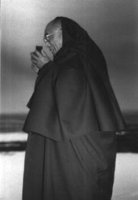
| The Dalai Lama: Spiritual and Political Leader of 6 Million Tibetans (Dharamsala, India) - Behind tinted glasses, his warm brown eyes welcome the traveler like an old friend. He gestures to a cushioned chair, then settles into a similar one within arm's reach of the sojourner. Surrounding him are ornate burgundy carpets and gold statues passed down over centuries. His soft, gentle face cloaks the hardships as spiritual and political leader of more than 6 million Tibetans, and of one who has lived 32 years in exile in the Himalayan foothills of India. He wears his title - 14th Dalai Lama - like his loosely fitting maroon monk's robes. Peo-ple revere him as a god-king, a living Buddha, but he's very mortal. He's friendly, funny, warm, frank, opinionated. For someone so surrounded by pomp and circumstance, he hates formality. He sometimes throws back his head in deep, resonant laughter. Other times, pondering his re-sponse, he presses his hand against his chin and his forehead crumples into deeply etched lines. "The formality, I do not like. Useless," says the 57-year-old (now 65) Dalai Lama, whose speech |
| India and The Hindustan Times. From 1 to 5 p.m., he meets with his cabinet members at his office and receives reports from various Tibetan monasteries in India. He also holds audiences with visitors: People are ushered in and out of his study in quick succession because his afternoon schedule is usually busy. At day's end, The Dalai Lama returns home and prays, meditates and reads scriptures. He occasionally watches television and enjoys taking photographs and fixing watches. He's always been intrigued by technology and he also likes Western comforts. "More modernized means using more machines, more instruments, more up-to-date facility in the house," he says. "When I go to different places, sometimes people arrange accommodations of huge old houses that looks as if you can put elephants in there. No spec-ial comfort there. Very prefer those modern houses, really efficient in every corner. No decorations or these things," he says, pointing at the ornate statues and paintings and jewel-colored embroidered cloths on the walls. "Something very practical and useful and comfortable." His travels have taken him to Brazil, England, Switzerland and the United States, where he met with George Bush in April 1991 (and as President in 2001). That meeting ended a 30-year Ameri-can boycott of the Tibetan leader. The United States never has recognized Tibet, considering it part of China, says a State Department official who asked not to be identified. "We have expressed some concern about human rights condi-tions in Tibet and other parts of China," the official says. "Many people told Tibetans in the 1960s that their quest for freedom was hopeless," the Dalai Lama says. With political changes in the former Soviet Union and East Germany, he believes Tibetan freedom isn't that far-fetched. "This is such a good time. All these other reasons from where we get tremendous inspiration. "During '60s and '70s, a little bit difficult. But during those years, we never gave up our hope, our determination. Therefore, I'm quite sure within few years' time, I think things will change. Obstacles remain be-fore Tibetans have political and social freedom in their homeland," The Dalai Lama says. "The old Chinese Communist leaders are in their 80s, and the first generation of revolutionaries still respect and obey the government regime," he says. Even with no signs of political liberalization, the Communist Party's free market reforms have improved the Ti-betan economy and quelled unrest. "And many Chinese sympathize with the Tibetan freedom movement," The Dalai Lama says. Once the current Chinese leaders are gone, "then I don't see any obstacle." When his people regain their freedom, The Dalai Lama says he'll step down as political leader. He's The Dalai Lama until he dies and he's uncertain if there will be a successor. "My feeling is we must utilize the Dalai Lama institution as much as we can," he says. For now, he plays a vital role in maintaining his country's culture. He's the Tibetans' hope and their archangel. Since his exile, he says he has drawn closer to his fellow countrymen. "I, myself, sometimes hesitate to make decision. So usual-ly what I do is listen to different views from concerned officials and also sometimes just ordinary people, for their opini-on, their feeling. Then, to that way, a certain idea which never come in my mind, it happen. "Then, on top of this idea, I myself also think, and try to analyze the situation, then the final decision, in the name of Dalai Lama," he says force-fully. "So different ideas come from others and ... then become Dalai Lama's decision." Then he bursts into a belly laugh. (Courtesy Anastasia Stanmeyer, copyright 1992) |
 |
| Buddhist School of Dialectics, young, shaven-headed monks debate in pairs: One slaps his ex-tended hand, stomps his foot and paces in front of his opponent, who sits peacefully and listens. Up the mountain is the Tibetan Children's Village, run by one of the Dalai Lama's sisters. It houses and educates about 1,500 orphaned youngsters, many refugees. Its branches throughout India serve 13,500 more children. The Dalai Lama sometimes visits the village and elsewhere, but the majority of his time in Dharamsala is spent praying, meditating and studying, beginning at 4 a.m. by reciting mantras. He reads scriptures, studies philosophy and often prays with other Tibetan Buddhist monks. He also pores over official papers, listens to the BBC World Service on the radio and reads magazines like Newsweek and Time and newspapers such as The Times of |
|
| The Praise of All the Buddhas - All the Buddhas are wonderful and glorious. There is not their equal upon earth. They reveal to us the path of life. And we hail their appearance with pious reverence. All the Buddhas teach the same truth. They point out the path to those who go astray. The truth is our hope and comfort. We gratefully accept its illumitable light. All the Buddhas are one in essence, which is omnipresent in all modes of being, sanctifying the bonds that tie all souls together, and we rest in its bliss as our final refuge. Disclaimer: All images and/or articles retain the original copyright of their original owners. |
| April 1 9, 2004 |
 |
| Visit our main Buddhism site. More information and images and, NO pop-ups! |
 |
| Java needed to view above image. |